
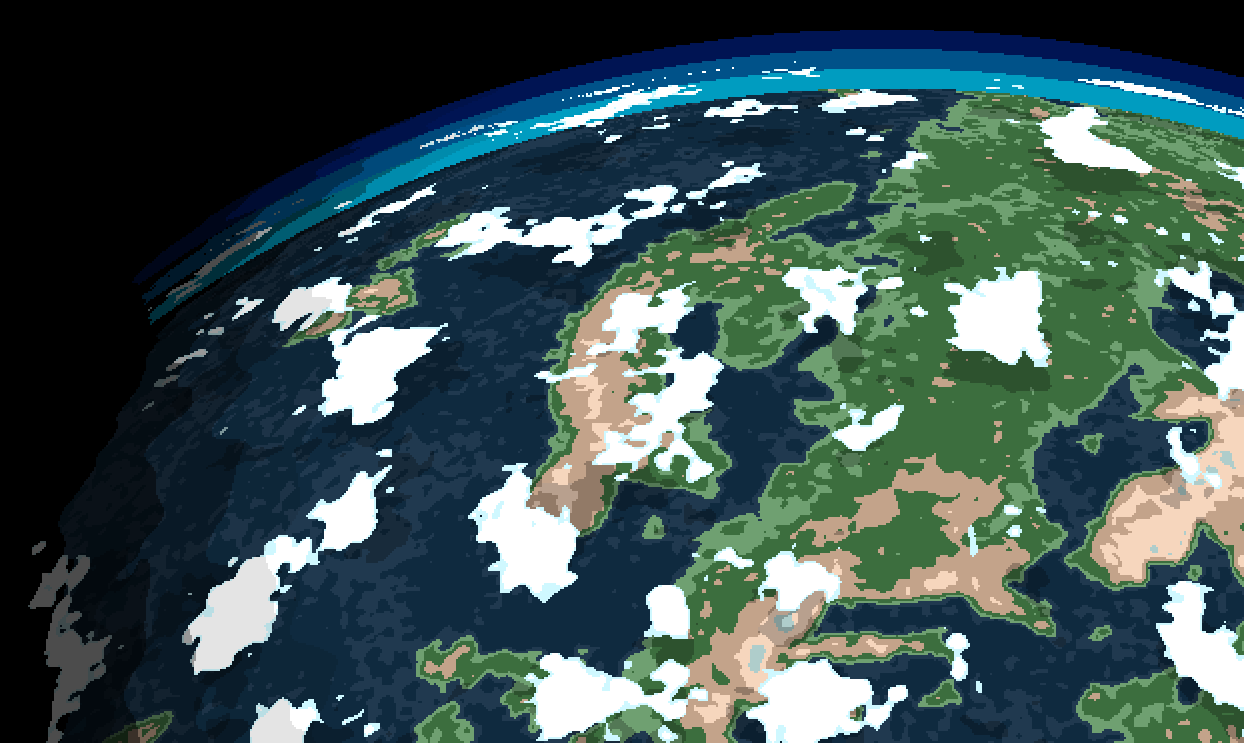
Animated Pixel Art Planet

This shader combines these two, and includes some improvements of my own:
- https://godotshaders.com/shader/animated-pixel-art-planet-shader/
- https://godotshaders.com/shader/3d-pixelated-planet/
Additional features:
- A graduated “atmosphere”.
- Multiple noise layers for the surface and clouds.
- Optional bump map for the surface.
- Several different shading modes.
- Posterisation.
- More flexible palette specification.
You will at least need to provide a surface palette to get something to display consistently, and probably cloud and atmosphere palettes as well. Linear 1px palettes such as those from lospec work well as a base.
The surface and cloud palettes can be refined by adding a second row, in which the red channel controls the cutoff value for the colour above it. The green channel controls the wave animation. The atmosphere palette is just spread equally between the surface and the atmosphere radius.
I think the rest of the options are explained well enough in the comments, or are best understood by tweaking them and seeing what happens.
Shader code
shader_type canvas_item;
render_mode unshaded;

const int SHADING_MODE_NONE = 0;
const int SHADING_MODE_SMOOTH = 1;
const int SHADING_MODE_QUANT = 2;
const int SHADING_MODE_DITHER = 3;
const int SHADING_MODE_MAX = 4;

const float COLOUR_ESTIMATION_CUTOFF = 0.001;

// This should usually be set to the side of the rect that is displaying the
// planet, to match the size of pixels of sprites.
uniform float pixel_scale = 360.0;


//// Surface
uniform float surface_radius : hint_range(0.01, 0.5, 0.001) = .3;
// Palette for the surface.
// The colours should be in a single row ordered from lowest to highest.
// If a second row is present, cutoff values for the colours above will be
// taken from the red channel, with animation values taken from the green
// channel. See the 'surface' function for details of how these are used.
uniform sampler2D surface_palette : filter_nearest, hint_default_white;
uniform vec4 background_colour : source_color = vec4(0., 0., 0., 1.0);
// Base rotation of the planet on its axis.
uniform float surface_base_rotation : hint_range(0.0, 6.28, 0.1) = 0.0;
// Speed at which to animate the rotation of the planet.
uniform float surface_rotation_speed : hint_range(-1.0, 1.0, 0.001) = 0.0;

// Primary noise
uniform int surface_primary_cell_amount = 10;
// Factor by which to multiply the generated noise.
uniform float surface_primary_strength : hint_range(-5.0, 5.0, 0.01) = 1.0;
uniform vec3 surface_primary_period = vec3(9.5, 9.5, 9.5);

// Secondary noise
uniform bool surface_secondary_enabled = true;
uniform int surface_secondary_cell_amount = 20;
// Factor by which to multiply the generated noise.
uniform float surface_secondary_strength : hint_range(-5.0, 5.0, 0.01) = 0.3;
uniform vec3 surface_secondary_period = vec3(9.5, 9.5, 9.5);
// Amount to rotate this noise source relative to the primary.
uniform float surface_secondary_rotation : hint_range(0.0, 6.28, 0.1) = 0.0;
// Speed at which to animate the rotation of this source relative to the primary.
// This can be used to generate apparent motion of the whole surface, as if fluid.
uniform float surface_secondary_rotation_speed : hint_range(-1.0, 1.0, 0.001) = 0.0;

// Tertiary noise
uniform bool surface_tertiary_enabled = false;
uniform int surface_tertiary_cell_amount = 30;
// Factor by which to multiply the generated noise.
uniform float surface_tertiary_strength : hint_range(-5.0, 5.0, 0.01) = 0.3;
uniform vec3 surface_tertiary_period = vec3(9.5, 9.5, 9.5);
// Amount to rotate this noise source relative to the primary.
uniform float surface_tertiary_rotation : hint_range(0.0, 6.28, 0.1) = 0.0;
// Speed at which to animate the rotation of this source relative to the primary.
// This can be used to generate apparent motion of the whole surface, as if fluid.
uniform float surface_tertiary_rotation_speed : hint_range(-1.0, 1.0, 0.001) = 0.0;

// Non-noise bumpmap.
// This is added to the primary noise, before the secondary and tertiary noise
// is added.
uniform sampler2D surface_bump_map : hint_default_transparent, repeat_enable;
// Factor by which to multiply the bump map values.
uniform float surface_bump_strength : hint_range(-1.0, 1.0, 0.01) = 0.3;


//// Clouds
uniform bool display_cloud_shadows = true;
uniform float cloud_shadow_darkness : hint_range(0.0, 1.0, 0.05) = 0.25;

// First cloud layer
uniform float cloud_1_cover : hint_range(0.0, 1.0, 0.01) = 0.3;
uniform float cloud_1_radius : hint_range(0.01, 0.5, 0.001) = .32;
// Palette for the clouds.
// Works the same as the surface palette.
uniform sampler2D cloud_1_palette: filter_nearest, hint_default_transparent;
uniform int cloud_1_cell_amount = 10;
// The speed at which the clouds move over the surface.
uniform float cloud_1_rotation_speed : hint_range(-1.0, 1.0, 0.001) = 0.03;
// The speed at which the clouds change shape.
uniform float cloud_1_fluctuation_speed : hint_range(-1.0, 1.0, 0.001) = 0.03;
uniform vec3 cloud_1_period = vec3(9.5, 9.5, 9.5);
uniform vec3 cloud_1_secondary_period = vec3(9.5, 9.5, 9.5);
uniform int cloud_1_secondary_cell_amount = 10;
// Factor by which to multiply the generated noise.
uniform float cloud_1_secondary_strength : hint_range(-1.0, 1.0, 0.01) = 0.3;

// Second cloud layer
uniform float cloud_2_cover : hint_range(0.0, 1.0, 0.01) = 0.0;
uniform float cloud_2_radius : hint_range(0.01, 0.5, 0.001) = .32;
// Palette for the clouds.
// Works the same as the surface palette.
uniform sampler2D cloud_2_palette: filter_nearest, hint_default_transparent;
uniform int cloud_2_cell_amount = 10;
// The speed at which the clouds move over the surface.
uniform float cloud_2_rotation_speed : hint_range(-1.0, 1.0, 0.001) = 0.03;
// The speed at which the clouds change shape.
uniform float cloud_2_fluctuation_speed : hint_range(-1.0, 1.0, 0.001) = 0.03;
uniform vec3 cloud_2_period = vec3(9.5, 9.5, 9.5);
uniform vec3 cloud_2_secondary_period = vec3(9.5, 9.5, 9.5);
uniform int cloud_2_secondary_cell_amount = 10;
// Factor by which to multiply the generated noise.
uniform float cloud_2_secondary_strength : hint_range(-1.0, 1.0, 0.01) = 0.3;


//// Atmosphere
uniform float atmosphere_radius : hint_range(0.01, 0.5, 0.001) = .34;
// Palette for the atmosphere.
// The colours should be in a single row ordered from lowest to highest.
// Additional rows will be ignored.
uniform sampler2D atmosphere_palette : filter_nearest, hint_default_transparent;


//// Posterisation
uniform bool posterise = false;
// Palette to restrict the calculated colours to. All colours in the palette
// are considered.
uniform sampler2D posterisation_palette : filter_nearest, hint_default_black;


//// Light/shading
uniform int shading_mode : hint_enum(
	"None",
	"Smooth",
	"Quantised",
	"Dithered",
	"Max Brightness"
) = 2;
// A cap on the brightness produces by the light.
uniform float maximum_brightness : hint_range(0.0, 10.0, 0.1) = 1.0;
uniform float sun_strength = 2.0;
// Controls the width of the transition from light to dark. Higher values result
// in a quicker transition. For Quantised shading, this means narrower bands of
// different shades.
uniform float shade_transition = 10.0;
// Also contributes to the width of the transition from light to dark.
// For Quantised shading, higher values result in more bands.
uniform float shade_step = 8.0;
// Vector pointing to the sun. This must have some magnitude or the lighting
// will not work.
uniform vec3 sun_direction = vec3(1.0, 0.2, -0.3);
// Textures for different shades when using the "Dithered" shading mode.
// Only the alpha channel is used to indicate if the pixel should be lit or not.
uniform sampler2D dither_texture : filter_nearest;
uniform int dither_levels = 0;

// Noise specification for the shading.
uniform int shading_noise_cell_amount = 40;
uniform float shading_noise_strength : hint_range(-1.0, 1.0, 0.01) = 0.3;
uniform vec3 shading_noise_period = vec3(9.5, 9.5, 9.5);

// modulo function that returns positive wrapped values. (13 % 5 = 3, but -13 % 5 = 2)
vec3 modulo(vec3 divident, vec3 divisor){
	vec3 positiveDivident = mod(divident, divisor) + divisor;
	return mod(positiveDivident, divisor);
}

// 3 dimensional pseudo random number generator
vec3 random(vec3 value){
	vec3 return_value = vec3( dot(value, vec3(127.1,311.7, 201.9) ),
				  dot(value, vec3(269.5,183.3, 367.7) ),
				  dot(value, vec3(245.1,367.7, 105.6) ) );
	return -1.0 + 2.0 * fract(sin(return_value) * 43758.5453123);
}

// Calculate z-position of sphere surface
float calculate_z(vec2 uv, float radius) {
	// equation of a sphere at coordinates (0.5, 0.5)
	// (x-.5)^2 + (y-.5)^2 + z^2 = surface_radius^2
	float w = sqrt(pow(radius, 2.) - pow(uv.x - .5, 2.) - pow(uv.y - .5, 2.));
	return w;
}

mat3 rotate_x(float angle) {
    float s = sin(angle);
    float c = cos(angle);
    return mat3(
        vec3(1, 0, 0),
        vec3(0, c, -s),
        vec3(0, s, c)
    );
}

mat3 rotate_y(float angle) {
    float s = sin(angle);
    float c = cos(angle);
    return mat3(
        vec3(c, 0, s),
        vec3(0, 1, 0),
        vec3(-s, 0, c)
    );
}

// construct rotation matrix about 1/sqrt(2)i, 1/sqrt(2)j, 0k unit vector
// because UV coordinates start at the top left and rotating the noise
// rotates all the noise, not just the sphere so if you rotate about any
// axis of the coordinate system the noise moves through the sphere
// and it doesn't look like it's spinning (duh)
// it's also why it rotates on a tilted axis
// because this was the easiest solution I found
mat3 generate_rotation_matrix(float theta) {
	vec3 rot_1 = vec3(
		.5*(1.-cos(theta)) + cos(theta),
		.5*(1.-cos(theta)),
		-(1./sqrt(2))*sin(theta)
	);
	vec3 rot_2 = vec3(
		.5*(1.-cos(theta)),
		.5*(1.-cos(theta)) + cos(theta),
		(1./sqrt(2))*sin(theta)
	);
	vec3 rot_3 = vec3(
		(1./sqrt(2))*sin(theta),
		-(1./sqrt(2))*sin(theta),
		cos(theta)
	);
	return mat3(rot_1, rot_2, rot_3);
}

// Put the UV on a pixel grid.
vec2 calculate_grid_uv(vec2 uv) {
	return round(uv * pixel_scale) / pixel_scale;
}

// Return the colour from a palette that most closely matches target.
vec3 get_nearest_colour(in sampler2D palette, in vec3 target) {
	ivec2 palette_size = textureSize(palette, 0);
	vec3 closest_color = background_colour.rgb;
	float min_dist = 2.0;
	int rows = palette_size.y;
	int columns = palette_size.x;
	float n = float(columns);

	for (int row = 0; row < palette_size.y; row++) {
		float yuv = 1.000 / (2.000 * float(rows)) + float(row) / float(rows);
		for (int column = 0; column < columns; column++){
			float xuv = 1.000 / (2.000 * n) + float(column) / n;
			vec3 index_color = texture(palette, vec2(xuv,yuv)).rgb;
			float dist = length(index_color - target);
			if (dist < min_dist) {
				min_dist = dist;
				closest_color = index_color;
				// If the current colour is really really close, just return it
				// and don't bother checking the rest.
				if (min_dist < COLOUR_ESTIMATION_CUTOFF){
					return closest_color;
				}
			}
		}
	}
	return closest_color;
}

// Get the inverse alpha from a dither texture for the specified UV.
float get_leveled_dither(int level, vec2 uv) {
	ivec2 texture_size = textureSize(dither_texture, 0);
	int level_width = texture_size.x / dither_levels;

	float pattern_x = mod(uv.x * pixel_scale, float(level_width));
	// Add an offset for the pattern location
	pattern_x = pattern_x + float(level_width * level);
	float duvx = pattern_x / float(texture_size.x);

	float duvy = round(
		mod(uv.y * pixel_scale, float(texture_size.y))
	) / float(texture_size.y);

	vec2 dither_uv = vec2(
		duvx,
		duvy
	);
	return 1.0 - texture(dither_texture, dither_uv).a;
}

// Get a colour from a palette by row and column index.
vec4 get_colour(sampler2D palette, ivec2 palette_size, int column, int row) {
	float uvx = (1.0 / float(palette_size.x + 1)) * (float(column + 1));
	float uvy = (1.0 / float(palette_size.y + 1)) * (float(row + 1));
	return texture(palette, vec2(uvx, uvy));
}

// seamless noise function adapted from Godot Shaders seamless Perlin Noise function
float seamless_noise(vec2 uv, float w, vec3 _period, mat3 rot_p, int cell_amount) {
	vec3 uvw = rot_p * vec3(uv, w); // multiply by rotation vector to spin world
	uvw = vec3(uvw * float(cell_amount)); // multiply by cell amount and then round to create discrete cells
	vec3 cells_minimum = floor(uvw);
	vec3 cells_maximum = ceil(uvw);
	vec3 uvw_fract = fract(uvw);

	// wrap every period
	cells_minimum = modulo(cells_minimum, _period);
	cells_maximum = modulo(cells_maximum, _period);

	// calc lerp
	vec3 blur = smoothstep(0.3, 1.0, uvw_fract);

	// generate cube of pseudo-random values for every pixel
	vec3 p_000 = random(vec3(cells_minimum.x, cells_minimum.y, cells_minimum.z));
	vec3 p_100 = random(vec3(cells_maximum.x, cells_minimum.y, cells_minimum.z));
	vec3 p_010 = random(vec3(cells_minimum.x, cells_maximum.y, cells_minimum.z));
	vec3 p_110 = random(vec3(cells_maximum.x, cells_maximum.y, cells_minimum.z));
	vec3 p_001 = random(vec3(cells_minimum.x, cells_minimum.y, cells_maximum.z));
	vec3 p_101 = random(vec3(cells_maximum.x, cells_minimum.y, cells_maximum.z));
	vec3 p_011 = random(vec3(cells_minimum.x, cells_maximum.y, cells_maximum.z));
	vec3 p_111 = random(vec3(cells_maximum.x, cells_maximum.y, cells_maximum.z));

	// return a smoothed version of the noise
	return mix(mix( mix( dot( p_000, uvw_fract - vec3(0, 0, 0) ),
                     dot( p_100, uvw_fract - vec3(1, 0, 0) ), blur.x),
                mix( dot( p_010, uvw_fract - vec3(0, 1, 0) ),
                     dot( p_110, uvw_fract - vec3(1, 1, 0) ), blur.x), blur.y),
			mix( mix( dot( p_001, uvw_fract - vec3(0, 0, 1) ),
                     dot( p_101, uvw_fract - vec3(1, 0, 1) ), blur.x),
                mix( dot( p_011, uvw_fract - vec3(0, 1, 1) ),
                     dot( p_111, uvw_fract - vec3(1, 1, 1) ), blur.x), blur.y), blur.z) * 0.8 + 0.5;
}

// Calculate the light at the given radius.
float calculate_light(vec2 grid_uv, float radius) {

	// Some shading types do not need the light to be calculated, so return
	// early for those.
	if (shading_mode == SHADING_MODE_NONE) {
		return 1.0;
	} else if (shading_mode == SHADING_MODE_MAX) {
		return maximum_brightness;
	}

	// Normalize UV coordinates
    vec2 normalized_uv = (grid_uv - vec2(0.5)) / radius;

    // Convert UV to 3D point on sphere
    vec3 sphere_point = vec3(
        normalized_uv.x,
        sqrt(max(0.0, 1.0 - dot(normalized_uv, normalized_uv))),
        normalized_uv.y
    );

	float light = dot(
		normalize(
			sphere_point
		),
		normalize(sun_direction)
	);
	float brightness_cap = maximum_brightness / sun_strength;

	// Introduce some noise into the light to create more interesting shading,
	// if requested.
	if (shading_noise_strength != 0.0) {
		float w = calculate_z(grid_uv, radius);
		float noise = seamless_noise(
			grid_uv,
			w,
			shading_noise_period,
			mat3(1.0),
			shading_noise_cell_amount
		);
		if (!isnan(light)) {
			light = clamp (
				light + ((noise - 0.5) * shading_noise_strength),
				0.0,
				1.0
			);
		}
	}

	// Adjust the light value for the selected shading type.
	if (shading_mode == SHADING_MODE_SMOOTH) {
		light = sun_strength * min(
			brightness_cap,
			(light * shade_transition) / shade_step
		);
	} else if (shading_mode == SHADING_MODE_QUANT) {
		// Adding the floor results in a quantised gradient.
		light = sun_strength * min(
			brightness_cap,
			floor(light * shade_transition) / shade_step
		);
	} else if (shading_mode == SHADING_MODE_DITHER) {
		// When using dithering, the quantisation is done by dividing into
		// different types of dither below.
		light = sun_strength * min(
			brightness_cap,
			(light * shade_transition) / shade_step
		);

		ivec2 texture_size = textureSize(dither_texture, 0);
		for (int level = 0; level < dither_levels; level++) {
			float cutoff = float(level + 1) * (1.0 / float(dither_levels));
			if (light <= cutoff) {
				light = maximum_brightness * get_leveled_dither(
					level,
					grid_uv
				);
				break;
			}
		}
	}

	return light;
}

// Calculate additional noise and combine it with the existing noise for the
// surface.
float apply_surface_noise(
	float perlin,
	vec3 period,
	vec2 uv,
	float w,
	mat3 rot_p,
	int cell_amount,
	float strength
) {
	if (isnan(perlin)) {
		return perlin;
	}
	float result = perlin;
	float noise = seamless_noise(
		uv,
		w,
		period,
		rot_p,
		cell_amount
	);
	result = clamp(
		perlin + ((noise - 0.5) * strength),
		0.0,
		1.0
	);
	return result;
}

// Generate the surface.
vec4 surface(vec2 uv, mat3 rot_p, mat3 rot_p2,  mat3 rot_p3){
	float w = calculate_z(uv, surface_radius);
	float perlin = seamless_noise(
		uv,
		w,
		surface_primary_period,
		rot_p,
		surface_primary_cell_amount
	);
	if (!isnan(perlin)) {
		perlin = clamp (
			((perlin - 0.5) * surface_primary_strength) + 0.5,
			0.0,
			1.0
		);
	}
	if (!isnan(perlin)) {
		vec3 uvw = rot_p * vec3(uv, w);
		// The bump map will be mirrored on the other side of the sphere because
		// the UV values wrap around. This is convenient for certain effects
		// anyway, and if there is a way to wrap the texture around the whole
		// sphere I'm not sure how to do it.
		// The back side can be unmirrored (but still repeated) by flipping the
		// sign of the x component of the vector if the z component is < 0.0,
		// but you may get seams.
		/*if (uvw.z < 0.0) {
			uvw.x = -uvw.x;
		}*/
		vec4 bump = texture(surface_bump_map, uvw.xy);
		if (bump.a > 0.0) {
			perlin = clamp(
				perlin + ((bump.r - 0.5) * surface_bump_strength),
				0.0,
				1.0
			);
		}
	}
	if (surface_secondary_enabled) {
		perlin = apply_surface_noise(
			perlin,
			surface_secondary_period,
			uv,
			w,
			rot_p * rot_p2,
			surface_secondary_cell_amount,
			surface_secondary_strength
		);
	}
	if (surface_tertiary_enabled) {
		perlin = apply_surface_noise(
			perlin,
			surface_tertiary_period,
			uv,
			w,
			rot_p * rot_p3,
			surface_tertiary_cell_amount,
			surface_tertiary_strength
		);
	}

	// Default the colour to transparent outside the sphere, or the background
	// colour within it. This prevents shaded areas from being transparent.
	vec4 color = vec4(0);
	if (perlin <= 1.) {
		color = background_colour;
	}

	// Iterate through the palette and assign colours to the surface based
	// on the generated noise/bumpmap.
	ivec2 palette_size = textureSize(surface_palette, 0);
	float last_cutoff = -0.1;
	for (int column = 0; column <= palette_size.x; column++) {
		float cutoff;
		float animation_factor = 0.0;
		if (palette_size.y > 1) {
			vec4 spec = get_colour(surface_palette, palette_size, column, 1);
			// The red channel in the second row of the texture indicates the cutoff.
			cutoff = spec.r;
			// The last colour has to have a cutoff of 1.0 or the planet surface
			// will have holes in it.
			if (column == palette_size.x) {
				cutoff = 1.0;
			}

			// The green channel controls how much to animate each colour, in a
			// swelling/shrinking manner.
			animation_factor = spec.g;
			if (animation_factor > 0.0) {
				// Is 512 a good value here? Original code had 300 and 250 for
				// two of the colours, so I thought it was high enough to allow
				// that to be reproduced.
				cutoff = cutoff + sin(TIME)/(512.0 * (1.0 - animation_factor));
			}
		} else {
			// No explicit cutoffs provided - just split the colours equally.
			cutoff = (1.0 / float(palette_size.x)) * float(column + 1);
		}
		if (perlin > last_cutoff && perlin <= cutoff) {
			color = get_colour(surface_palette, palette_size, column, 0);
		}
		last_cutoff = cutoff;
	}

	float light = calculate_light(uv, surface_radius);
	color.rgb = color.rgb * light;
	return color;
}

// Generate clouds
vec4 clouds(
	float cover,
	vec2 uv,
	vec3 period,
	int cell_amount,
	vec3 noise_period,
	int noise_cell_amount,
	float noise_strength,
	mat3 rot_p,
	float radius,
	sampler2D palette,
	float fluctuation_speed,
	bool shadow
){

	if (cover == 0.0) {
		return vec4(0.0);
	}

	float w = calculate_z(uv, radius);
	float theta = TIME * fluctuation_speed;
	// rotate about 0,0 on UV coords and with the rot_p matrix (see below)
	mat3 rot_0 = mat3(
		vec3(1, 0, 0),
		vec3(0, cos(theta), -sin(theta)),
		vec3(0, sin(theta), cos(theta))
	);

	float perlin = seamless_noise(
		uv,
		w,
		period,
		rot_0*rot_p,
		cell_amount
	);
	float noise = seamless_noise(
		uv,
		w,
		noise_period,
		rot_0*rot_p,
		noise_cell_amount
	);
	if (!isnan(perlin)) {
		perlin = clamp (
			perlin + ((noise - 0.5) * noise_strength),
			0.0,
			1.0
		);
	}

	float base_cutoff = 1.0 - cover;
	vec4 color = vec4(0.);

	if (shadow) {
		if (perlin < base_cutoff){
			color = vec4(.00);
		}else if (perlin <= 1.0){
			color = vec4(0.0, 0.0, 0.0, cloud_shadow_darkness);
		};
	} else {
		ivec2 palette_size = textureSize(palette, 0);

		float last_cutoff = base_cutoff;
		for (int column = 0; column < palette_size.x; column++) {
			float cutoff;
			float animation_factor = 0.0;

			if (palette_size.y > 1) {
				vec4 spec = get_colour(palette, palette_size, column, 1);
				// The red channel in the second row of the texture indicates
				// the cutoff. In this case the range is between the base cutoff
				// and 1.
				cutoff = base_cutoff + ((1.0-base_cutoff) * spec.r);
				// The last colour has to have a cutoff of 1.0 or the clouds
				// will have weird holes in them.
				if (column == palette_size.x - 1) {
					cutoff = 1.0;
				}

				// The green channel controls how much to animate each colour,
				// in a swelling/shrinking manner.
				animation_factor = spec.g;
				if (animation_factor > 0.0) {
					// Is 512 a good value here? Original code had 300 and 250
					// for two of the colours, so I thought it was high enough
					// to allow that to be reproduced.
					cutoff = cutoff + sin(TIME)/(512.0 * (1.0 - animation_factor));
				}
			} else {
				// No explicit cutoffs provided - just split the colours equally.
				// In this case the range is between the base cutoff and 1.
				cutoff = base_cutoff + (
					(1.0 - base_cutoff) / float(palette_size.x)
				) * float(column + 1);
			}

			if (perlin < base_cutoff){
				color = vec4(0.0);
			}else if (perlin > last_cutoff && perlin <= cutoff){
				color = get_colour(palette, palette_size, column, 0);
			};
			last_cutoff = cutoff;
		}
	}

	float light = calculate_light(uv, radius);
	color.rgb = color.rgb * light;
	return color;
}

vec4 atmosphere(vec2 uv) {
	vec4 result = vec4(0.0);

	if (atmosphere_radius <= surface_radius) {
		return result;
	}

	ivec2 palette_size = textureSize(atmosphere_palette, 0);
	float atmosphere_thickness = (atmosphere_radius - surface_radius);
	float atmos_layer_thickness = atmosphere_thickness / float(palette_size.x);

	for (int column = palette_size.x - 1; column >= 0; column--) {
		float radius = surface_radius + (
			atmos_layer_thickness * float(column + 1)
		);
		float w = calculate_z(uv, radius);

		if (w < 1.0) {
			float light = calculate_light(uv, radius);
			result = get_colour(atmosphere_palette, palette_size, column, 0);
			result.rgb = result.rgb * light;
		}
	}
	return result;
}

void fragment() {
	// Put the UV on a pixel grid.
	vec2 grid_uv = calculate_grid_uv(UV);

	// Surface rotation matrices
	mat3 srot = generate_rotation_matrix(
		surface_base_rotation + (TIME * surface_rotation_speed)
	);
	mat3 srot2 = generate_rotation_matrix(
		surface_secondary_rotation + (TIME * surface_secondary_rotation_speed)
	);
	mat3 srot3 = generate_rotation_matrix(
		surface_tertiary_rotation + (TIME * surface_tertiary_rotation_speed)
	);

	vec4 color = surface(grid_uv, srot, srot2, srot3);
	vec4 clouds_1_shadows = vec4(0.0);
	vec4 clouds_1 = vec4(0.0);
	if (cloud_1_cover > 0.0) {
		// Cloud rotation matrix
		mat3 crot = generate_rotation_matrix(
			TIME * cloud_1_rotation_speed
		);
		if (display_cloud_shadows) {
			// Get shadow colors
			clouds_1_shadows = clouds(
				cloud_1_cover,
				grid_uv,
				cloud_1_period,
				cloud_1_cell_amount,
				cloud_1_secondary_period,
				cloud_1_secondary_cell_amount,
				cloud_1_secondary_strength,
				crot,
				surface_radius,
				cloud_1_palette,
				cloud_1_fluctuation_speed,
				true
			);
		}
		// Get cloud colors
		clouds_1 = clouds(
			cloud_1_cover,
			grid_uv,
			cloud_1_period,
			cloud_1_cell_amount,
			cloud_1_secondary_period,
			cloud_1_secondary_cell_amount,
			cloud_1_secondary_strength,
			crot,
			cloud_1_radius,
			cloud_1_palette,
			cloud_1_fluctuation_speed,
			false
		);
	}

	vec4 clouds_2_shadows = vec4(0.0);
	vec4 clouds_2 = vec4(0.0);
	if (cloud_2_cover > 0.0) {
		// Cloud rotation matrix
		mat3 crot = generate_rotation_matrix(
			TIME * cloud_2_rotation_speed
		);
		if (display_cloud_shadows) {
			// Get shadow colors
			clouds_2_shadows = clouds(
				cloud_2_cover,
				grid_uv,
				cloud_2_period,
				cloud_2_cell_amount,
				cloud_2_secondary_period,
				cloud_2_secondary_cell_amount,
				cloud_2_secondary_strength,
				crot,
				surface_radius,
				cloud_2_palette,
				cloud_2_fluctuation_speed,
				true
			);
		}
		// Get cloud colors
		clouds_2 = clouds(
			cloud_2_cover,
			grid_uv,
			cloud_2_period,
			cloud_2_cell_amount,
			cloud_2_secondary_period,
			cloud_2_secondary_cell_amount,
			cloud_2_secondary_strength,
			crot,
			cloud_2_radius,
			cloud_2_palette,
			cloud_2_fluctuation_speed,
			false
		);
	}

	COLOR = vec4(0., 0., 0., 0.);

	COLOR.rgba = atmosphere(grid_uv);
	if (color.a > 0.0) {
		COLOR.rgba = color.rgba; // draw the world
		// Darken for the cloud shadows.
		COLOR.rgb = COLOR.rgb * (1.0 - clouds_1_shadows.a);
		COLOR.rgb = COLOR.rgb * (1.0 - clouds_2_shadows.a);
	}

	// Add the clouds
	// This requires fully opaque clouds because the partially
	// transparent clouds were not behaving well with the lighting.
	if (clouds_1.a >= 1.0) {
		COLOR.rgba = clouds_1.rgba;
	}
	if (clouds_2.a >= 1.0) {
		COLOR.rgba = clouds_2.rgba;
	}

	// Posterise
	if (posterise) {
		COLOR.rgb = get_nearest_colour(posterisation_palette, COLOR.rgb);
	}
}
Live Preview
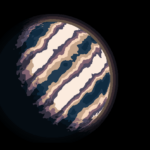
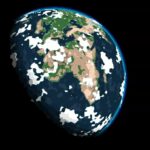
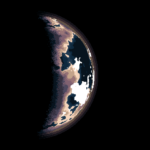

Wow, this shader is awesome 😀 I tried making something inspired by it if you want to take a look: https://ille.itch.io/pixel-planets-prototype
Nice 👍
I love the way this looks, but it keeps blinking to the background color only with default settings. I’ve been digging around and I’m at a loss to what is going on. Using 4.4
Very dumb of me, I didn’t check the surface pallet and it was not 1px. Resolved!
Thank you so much for all the comments!
Killer shader. I did a fork to make map uploading easier. Thank you so much for making this code public and letting others iterate on it: https://godotshaders.com/shader/easy-pixel-planet/?post_id=12825&new_post=true
Nice, I’ll have to have a look and see how you managed to improve the use of a bump map because I could not figure that out for the life of me.