
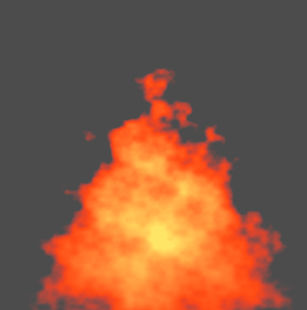
Canva Fire

Custom this to make it better
Shader code
shader_type canvas_item;

uniform float speed : hint_range(0.5, 8.0) = 3.0;
uniform float noise_scale : hint_range(1.0, 20.0) = 6.0;
uniform float distortion : hint_range(0.0, 1.0) = 0.45;
uniform float flame_height : hint_range(0.3, 1.0) = 0.85;
uniform vec4 core_color : source_color = vec4(1.0, 0.9, 0.4, 1.0);
uniform vec4 outer_color : source_color = vec4(1.0, 0.25, 0.05, 1.0);

float hash(vec2 p) {
	return fract(sin(dot(p, vec2(127.1, 311.7))) * 43758.5453123);
}

float noise(vec2 p) {
	vec2 i = floor(p);
	vec2 f = fract(p);
	vec2 u = f * f * (3.0 - 2.0 * f);
	return mix(
		mix(hash(i + vec2(0.0, 0.0)), hash(i + vec2(1.0, 0.0)), u.x),
		mix(hash(i + vec2(0.0, 1.0)), hash(i + vec2(1.0, 1.0)), u.x),
		u.y
	);
}

float fbm(vec2 p) {
	float val = 0.0;
	float amp = 0.5;
	for (int i = 0; i < 4; i++) {
		val += amp * noise(p);
		p *= 2.02;
		amp *= 0.5;
	}
	return val;
}

void fragment() {
	float y_norm = clamp((0.9 - UV.y) / flame_height, 0.0, 1.5);
	float taper = mix(0.8, 3.2, y_norm); // Càng lên cao càng nhọn
	vec2 shape_uv = vec2((UV.x - 0.5) * 2.0 * taper, (UV.y - 0.72) * 2.0);
	float dist = length(shape_uv);

	float n = fbm(UV * noise_scale + vec2(0.0, TIME * speed));
	float warped_dist = dist + (n - 0.45) * distortion * (0.4 + y_norm);

	float radius = 0.65;
	float edge_softness = 0.1;
	float mask = 1.0 - smoothstep(radius - edge_softness, radius + edge_softness, warped_dist);

	float top_fade = 1.0 - smoothstep(0.65, 1.05, y_norm);

	float heat = clamp(1.0 - (warped_dist / radius), 0.0, 1.0);
	vec3 col = mix(outer_color.rgb, core_color.rgb, pow(heat, 1.8));
	float alpha = mask * top_fade;

	COLOR = vec4(col, alpha);
}
Comments 0
No comments yet.