
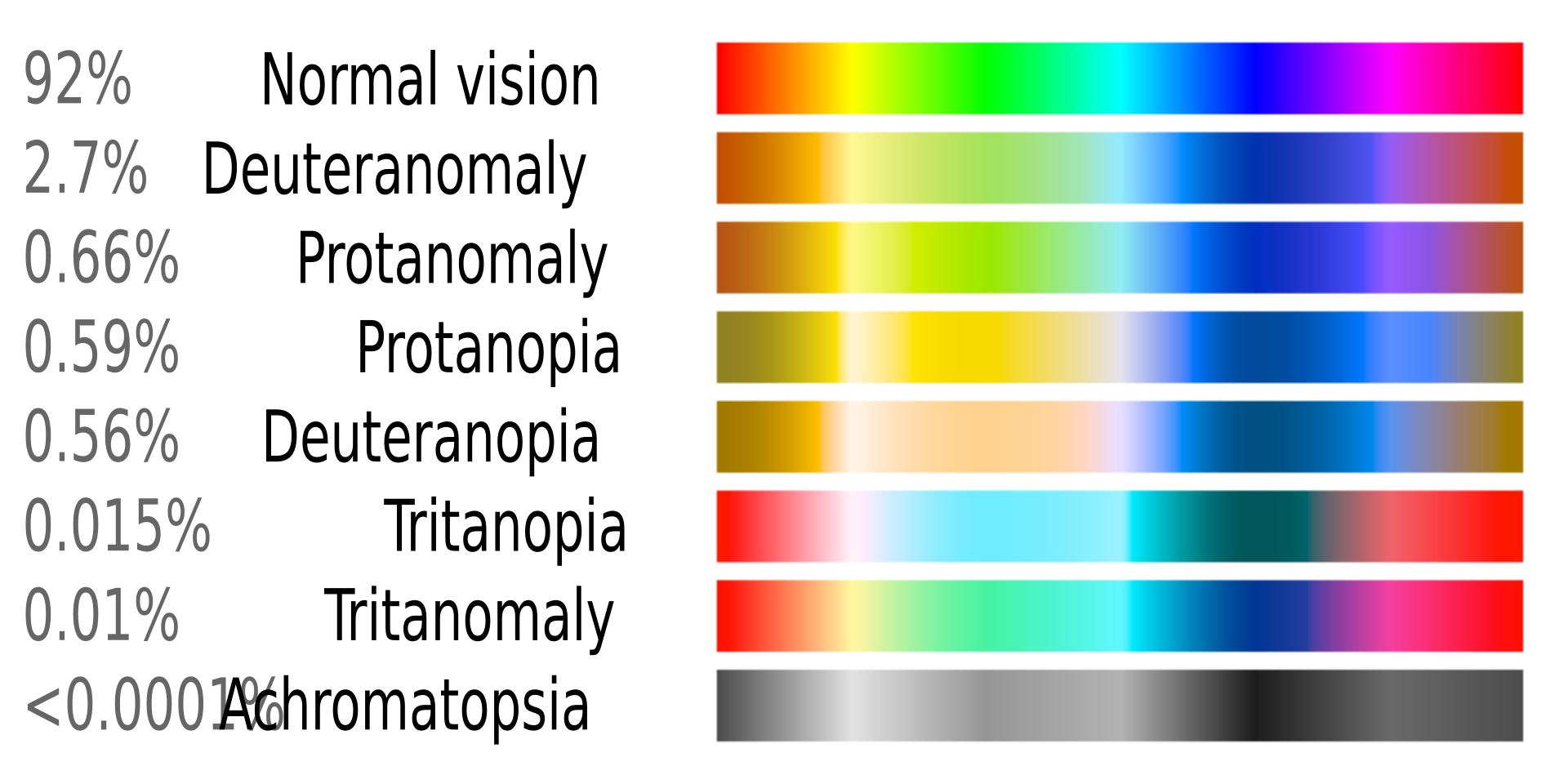
Color Vision Deficiency (CVD) Simulation Shader

This shader simulates different types of color blindness: Protanopia, Deuteranopia, Tritanopia and Achromatopsia. It supports two scientific models for one-color blindness:
- Brettel, H., Viénot, F., & Mollon, J. D. (1997). Computerized simulation of color appearance for dichromats. Journal of the Optical Society of America A, 14(10), 2647–2655. https://doi.org/10.1364/josaa.14.002647
- Viénot, F., Brettel, H., & Mollon, J. D. (1999). Digital video colourmaps for checking the legibility of displays by dichromats. Color Research & Application, 24(4), 243–252. https://vision.psychol.cam.ac.uk/jdmollon/papers/colourmaps.pdf
And it also use lightness calculation from ITU-R BT.601 (https://www.itu.int/rec/R-REC-BT.601-7-201103-I) for Achromatopsia filter.
The Viénot method is faster and more lightweight, but its Tritanopia simulation (blue–yellow color blindness) is known to be inaccurate. I recommend using the Viénot method for Protanopia and Deuteranopia, and the Brettel method for Tritanopia.
Great overview of these methods: daltonlens.org/opensource-cvd-simulation
These shaders are based on the excellent open-source library: github.com/DaltonLens/libDaltonLens
Cool app called Chroma for Windows to detect color blindness-related issues : https://github.com/ubisoft/Chroma
A severity parameter is provided to interpolate the degree of simulated color deficiency. Internally, this is a simple mix() between normal and simulated vision. While not physically accurate, it provides a useful approximation—see the article above for deeper insights.
To use a specific algorithm, just uncomment the corresponding #define in the shader file.
There is also editor plugin that uses this shader: https://github.com/Ultipuk/godot-eyesee-color
Cover image: By SyntaxTerror – File:Color blindness.png, Public Domain, https://commons.wikimedia.org/w/index.php?curid=119071262
Shader code
shader_type canvas_item;

// Color Vision Deficiency (CVD) Simulation Shader
// ------------------------------------------------
// This shader simulates different types of color blindness:
// Protanopia, Deuteranopia, Tritanopia and Achromatopsia.
//
// It supports two scientific models:
// - Brettel et al. (1997): Generally good implementation.
// - Viénot et al. (1999): Faster and behaves a bit better with extreme values.
//
// WARNING: Viénot 1999 is not accurate for tritanopia. Use Brettel 1997 instead.
//
// Usefull links and references:
// - https://daltonlens.org/colorblindness-simulator (online implementation)
// - https://daltonlens.org/opensource-cvd-simulation (explanation)
// - https://github.com/DaltonLens/libDaltonLens (my implementation based on this)
// - Brettel, H., Viénot, F., & Mollon, J. D. (1997). Computerized simulation of color appearance for dichromats. Journal of the Optical Society of America. A, Optics, Image Science, and Vision, 14(10), 2647–2655. https://doi.org/10.1364/josaa.14.002647
// - Viénot, F., Brettel, H., & Mollon, J. D. (1999). Digital video colourmaps for checking the legibility of displays by dichromats. Color Research & Application, 24(4), 243–252. https://vision.psychol.cam.ac.uk/jdmollon/papers/colourmaps.pdf
// - https://github.com/ubisoft/Chroma (solution for detecting color blindness-related issues in games, developed by Ubisoft)
// - https://www.itu.int/rec/R-REC-BT.601-7-201103-I (tough staff with standarts; there is a formula to calculate lightness from color)

// Uncomment one of the following define to use this algorithm:

 //#define PROTAN_BRETTEL   // Red-blindness (Brettel 1997)
 //#define DEUTAN_BRETTEL   // Green-blindness (Brettel 1997)
 //#define TRITAN_BRETTEL   // Blue-blindness (Brettel 1997)

 //#define PROTAN_VIENOT    // Red-blindness (Viénot 1999)
 //#define DEUTAN_VIENOT    // Green-blindness (Viénot 1999)
 //#define TRITAN_VIENOT    // Blue-blindness (Viénot 1999) — not accurate!

 //#define ACHROMATOPSIA    // Luminance from ITU-R BT.601

/** A severity of 1 means full protanopia/deuteranopia/tritanopia. */
uniform float severity: hint_range(0.0, 1.0) = 1.0;

// Brettel Protanopia
const mat3 brettel_protan_1 = mat3(
    vec3(0.14980, 0.10764, 0.00384),
    vec3(1.19548, 0.84864, -0.00540),
    vec3(-0.34528, 0.04372, 1.00156)
);
const mat3 brettel_protan_2 = mat3(
    vec3(0.14570, 0.10816, 0.00386),
    vec3(1.16172, 0.85291, -0.00524),
    vec3(-0.30742, 0.03892, 1.00139)
);
const vec3 brettel_protan_plane_normal = vec3(0.00048, 0.00393, -0.00441);

// Brettel Deuteranopia
const mat3 brettel_deutan_1 = mat3(
    vec3(0.36477, 0.26294, -0.02006),
    vec3(0.86381, 0.64245, 0.02728),
    vec3(-0.22858, 0.09462, 0.99278)
);
const mat3 brettel_deutan_2 = mat3(
    vec3(0.37298, 0.25954, -0.01980),
    vec3(0.88166, 0.63506, 0.02784),
    vec3(-0.25464, 0.10540, 0.99196)
);
const vec3 brettel_deutan_plane_normal = vec3(-0.00281, -0.00611, 0.00892);

// Brettel Tritanopia
const mat3 brettel_tritan_1 = mat3(
    vec3(1.01277, -0.01243, 0.07589),
    vec3(0.13548,  0.86812, 0.80500),
    vec3(-0.14826, 0.14431, 0.11911)
);
const mat3 brettel_tritan_2 = mat3(
    vec3(0.93678, 0.06154, -0.37562),
    vec3(0.18979, 0.81526,  1.12767),
    vec3(-0.12657, 0.12320,  0.24796)
);
const vec3 brettel_tritan_plane_normal = vec3(0.03901, -0.02788, -0.01113);

// Vienot Protanopia
const mat3 vienot_protan = mat3(
	vec3(0.11238, 0.11238, 0.00401),
	vec3(0.88762, 0.88762, -0.00401),
	vec3(0.00000, -0.00000, 1.00000)
);

// Vienot Deuteranopia
const mat3 vienot_deutan = mat3(
	vec3(0.29275, 0.29275, -0.02234),
	vec3(0.70725, 0.70725,  0.02234),
	vec3(0.00000, -0.00000, 1.00000)
);

// Vienot Tritanopia
// WARNING: Viénot 1999 is not accurate for tritanopia. Use Brettel 1997 instead.
const mat3 vienot_tritan = mat3(
	vec3(1.00000, 0.00000, -0.00000),
	vec3(0.14461, 0.85924, 0.85924),
	vec3(-0.14461, 0.14076, 0.14076)
);

// This is Godot implementation, which I took from this issue:
// https://github.com/godotengine/godot-proposals/issues/9150
vec3 linear_to_srgb(vec3 color) {
	// If going to srgb, clamp from 0 to 1.
	color = clamp(color, vec3(0.0), vec3(1.0));
	const vec3 a = vec3(0.055f);
	return mix(
		(vec3(1.0f) + a) * pow(color.rgb, vec3(1.0f / 2.4f)) - a,
		12.92f * color.rgb,
		lessThan(color.rgb, vec3(0.0031308f))
	);
}
vec3 srgb_to_linear(vec3 color) {
	return mix(
		pow((color.rgb + vec3(0.055)) * (1.0 / (1.0 + 0.055)), vec3(2.4)),
		color.rgb * (1.0 / 12.92),
		lessThan(color.rgb, vec3(0.04045))
	);
}

vec3 apply_brettel_filter(vec3 color, mat3 m1, mat3 m2, vec3 plane_normal) {
	float d = dot(color, plane_normal);
	mat3 m = d >= 0.0 ? m1 : m2;
	return clamp(m * color, 0.0, 1.0);
}

vec3 apply_vienot_filter(vec3 color, mat3 m) {
	return m * color;
}

void fragment() {
	#if not defined(ACHROMATOPSIA)
	vec3 lin_rgb = srgb_to_linear(COLOR.rgb);
	#endif
	vec3 rgb_cvd;

	#if defined(PROTAN_BRETTEL)
	rgb_cvd = apply_brettel_filter(lin_rgb, brettel_protan_1, brettel_protan_2, brettel_protan_plane_normal);

	#elif defined(DEUTAN_BRETTEL)
	rgb_cvd = apply_brettel_filter(lin_rgb, brettel_deutan_1, brettel_deutan_2, brettel_deutan_plane_normal);

	#elif defined(TRITAN_BRETTEL)
	rgb_cvd = apply_brettel_filter(lin_rgb, brettel_tritan_1, brettel_tritan_2, brettel_tritan_plane_normal);

	#elif defined(PROTAN_VIENOT)
	rgb_cvd = apply_vienot_filter(lin_rgb, vienot_protan);

	#elif defined(DEUTAN_VIENOT)
	rgb_cvd = apply_vienot_filter(lin_rgb, vienot_deutan);

	#elif defined(TRITAN_VIENOT)
	rgb_cvd = apply_vienot_filter(lin_rgb, vienot_tritan);

	#elif defined(ACHROMATOPSIA)
	rgb_cvd = vec3(0.299 * COLOR.r + 0.587 * COLOR.g + 0.114 * COLOR.b);

	#else
	rgb_cvd = lin_rgb; // No simulation

	#endif

	#if not defined(ACHROMATOPSIA)
	rgb_cvd = mix(lin_rgb, rgb_cvd, severity);

	vec3 result = linear_to_srgb(rgb_cvd);
	COLOR.rgb = result;
	#else
	COLOR.rgb = mix(COLOR.rgb, rgb_cvd, severity);
	#endif
}
Judging by the description, this is a well-calibrated scientific masterpiece. which node should the shader be applied to?
It’s for SubViewportContainer, because it takes color from COLOR variable, which is viewport content.
If you just want to check your game, you can use a plugin:
– github: https://github.com/Ultipuk/godot-eyesee-color
– godot assets: https://godotengine.org/asset-library/asset/3961
The plugin applyes this (kinda) shader to editor viewports.