
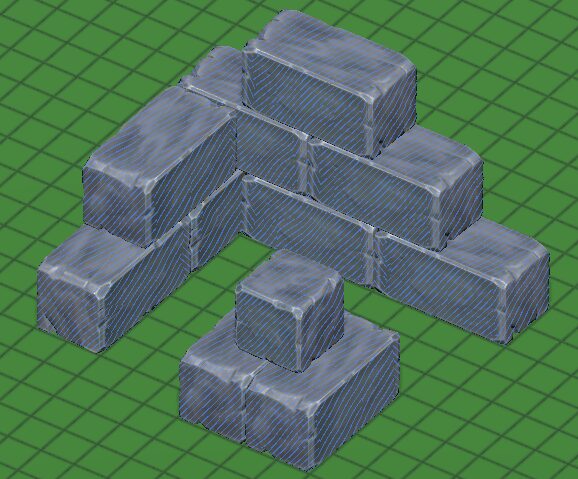
hand-drawn color highlighting shader for e.g. blueprints

Hand-Drawn Blueprint Shader
This spatial shader creates a dynamic, screen-space crosshatching effect that gives objects a technical “sketch” or “blueprint” look.
Key Features:
Directional Hatching: It identifies the dominant axis of each face (World Normal). Each of the six directions is assigned a specific angle (e.g., 30°, 45°, 135°), ensuring that adjacent faces are visually distinct.
Screen-Space Consistency: The lines are calculated based on screen coordinates (FRAGCOORD). This means the line width and spacing remain constant on your screen, regardless of how far the object is from the camera.
Organic “Wobble”: It uses a value noise function combined with a time parameter to add slight distortions. This makes the lines look hand-drawn rather than mathematically perfect.
Overlay Style: Using the discard command, it removes all fragments that aren’t part of a line. This allows the underlying texture or material of the object to remain visible.
Usage Note:
To see the “wobbling” animation, you must pass the elapsed time from a script to the real_time uniform. It is best used as a Next Pass material in Godot to layer the lines over your base mesh.
Shader code
// Wirkung: Schraffiert jede Seite der Objekt-Boundingbox (anhand der
//   dominierenden Achse der interpolierten Weltnormalen) mit blauen
//   1-Pixel-Linien im 5-Pixel-Screenspace-Raster. Pro BB-Seite wird eine
//   andere Winkelrichtung gewählt, sodass benachbarte Flächen
//   unterscheidbar bleiben. Unshaded; Nicht-Linien-Fragmente werden
//   verworfen, damit die darunterliegende Originaltextur sichtbar
//   bleibt.
shader_type spatial;
render_mode unshaded, cull_back, depth_draw_never, blend_mix;

uniform vec4 line_color : source_color = vec4(0.25, 0.55, 1.0, 1.0);
uniform float line_spacing = 5.0;
uniform float line_width = 1.0;
uniform float noise_scale = 0.035;
uniform float noise_amplitude = 2.5;
uniform float noise_speed = 0.6;
uniform float real_time = 0.0;

varying vec3 v_world_normal;

float hash(vec2 p) {
    return fract(sin(dot(p, vec2(127.1, 311.7))) * 43758.5453);
}

float value_noise(vec2 p) {
    vec2 i = floor(p);
    vec2 f = fract(p);
    vec2 u = f * f * (3.0 - 2.0 * f);
    float a = hash(i);
    float b = hash(i + vec2(1.0, 0.0));
    float c = hash(i + vec2(0.0, 1.0));
    float d = hash(i + vec2(1.0, 1.0));
    return mix(mix(a, b, u.x), mix(c, d, u.x), u.y);
}

void vertex() {
    v_world_normal = normalize((MODEL_MATRIX * vec4(NORMAL, 0.0)).xyz);
}

void fragment() {
    vec3 n = normalize(v_world_normal);
    vec3 a = abs(n);

    float angle;
    if (a.x >= a.y && a.x >= a.z) {
        angle = n.x > 0.0 ? radians(30.0) : radians(150.0);
    } else if (a.y >= a.z) {
        angle = n.y > 0.0 ? radians(60.0) : radians(120.0);
    } else {
        angle = n.z > 0.0 ? radians(45.0) : radians(135.0);
    }

    float c = cos(angle);
    float s = sin(angle);
    vec2 sample_pos = FRAGCOORD.xy * noise_scale + vec2(real_time * noise_speed, real_time * noise_speed * 0.7);
    float wobble = (value_noise(sample_pos) - 0.5) * 2.0 * noise_amplitude;

    float projected = FRAGCOORD.x * c + FRAGCOORD.y * s + wobble;
    float m = mod(projected, line_spacing);
    if (m >= line_width) {
        discard;
    }

    ALBEDO = line_color.rgb;
    EMISSION = line_color.rgb * 0.6;
    ALPHA = line_color.a;
}
