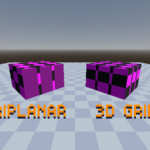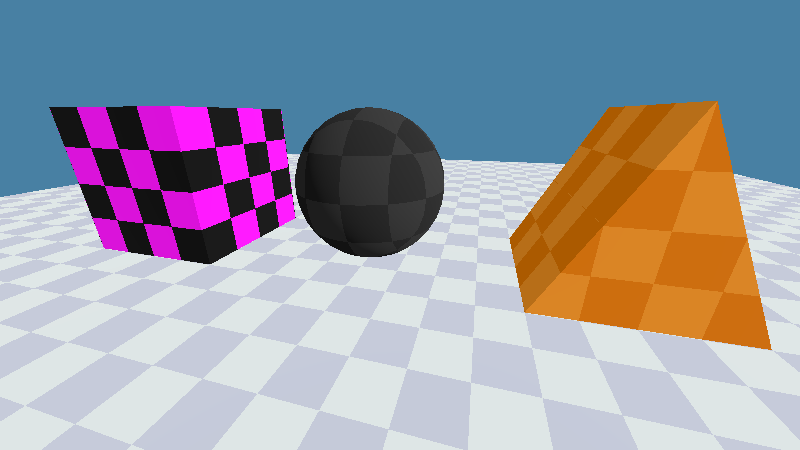
3D Grid

Produces a repeating 3D grid in either model or world coordinates as if the mesh were cut from stacks of alternating colored blocks.
Unlike a grid texture with triplanar mapping, this shader does not distort the grid cells along curved or sloped faces.
Note that faces perfectly aligned to the edge of a grid cell may shift to the next cell color due to floating point precision errors. To avoid this, shift the mesh by an imperceptably small amount in the opposite direction.
Parameters:
- color_a – The first cell color.
- color_b – The second cell color.
- cells – How many cells per meter.
- world_coordinates – Use world coordinates instead of model coordinates (ie the grid doesn’t move with the mesh).
Shader code
shader_type spatial;

// An imperceptably small value used for fuzzy float comparisons
const float EPSILON = 0.0001;

/** The first grid cell color. */
uniform vec3 color_a: source_color = vec3(0.88, 0.91, 0.91);

/** The second grid cell color. */
uniform vec3 color_b: source_color = vec3(0.78, 0.80, 0.86);

/** How many cells per UV unit. */
uniform float cells = 4.0;

/** Whether to use local (false) or world (true) coordinates. */
uniform bool world_coordinates = false;

varying vec3 local_position;

/**
 * Checks if two values are approximately equal.
 */
bool is_equal_approx(float a, float b) {
	return abs(a - b) <= EPSILON;
}

/**
 * Applies a bias to the given value to compensate for floating point
 * imprecision that would cause floor(value) to shift between two integers.
 */
float apply_floor_bias(float value) {
	if (floor(value) != floor(value + EPSILON)) {
		value += EPSILON;
	}
	return value;
}

/**
 * Applies a bias to the components of the given vector to compensate for
 * floating point imprecision that would cause floor(component) to shift between
 * two integers.
 */
vec3 apply_floor_bias(vec3 value) {
	value.x = apply_floor_bias(value.x);
	value.y = apply_floor_bias(value.y);
	value.z = apply_floor_bias(value.z);

	return value;
}

/** Snaps the given position to the integer grid. */
vec3 snap_to_grid(vec3 position) {
	// Calculate an offset to ensure the grid is centered on even sizes (ie a
	// grid of 4 cells will have all 4 cells fully visible on a 1m plane)
	vec3 grid_offset = vec3(1.0 / cells);

	// Scale and offset the position to the grid
	vec3 grid_position = (position - grid_offset) * cells;

	// Bias coordinates to compensate for floating point imprecision - not doing
	// this will cause flickering along planes perfectly between two cells
	grid_position = apply_floor_bias(grid_position);

	// Snap the position to the cell boundaries
	return floor(grid_position);
}

/** Samples the grid color at the given position. */
vec3 sample_3d_grid(vec3 position) {
	// Get the integer index of the row, column, and layer for each grid cell
	vec3 cell_index = snap_to_grid(position);

	// Determine whether each row/column/layer is even (0) or odd (1) by its
	// index
	vec3 cell_parity = mod(cell_index, 2.0);

	// If the row and column have the same parity then their cells form a
	// diagonal line in their plane. To apply to 3D, invert this check every
	// other layer so the diagonal line shifts one position.
	bool is_diagonal_cell = is_equal_approx(cell_parity.x, cell_parity.z) != is_equal_approx(cell_parity.y, 0.0);

	// Assign one color if the cell forms a diagonal line; otherwise, use the
	// other color
	return mix(color_a, color_b, float(is_diagonal_cell));
}

void vertex() {
	// Provide the model vertex position to the fragment shader.
	// Required because fragment's VERTEX is in view-space and while it does
	// have an inverse view matrix to convert to world coords, it doesn't have
	// an inverse model matrix to convert to local coords.
	//
	// The inverse can be calculated but all the computations to derive the
	// local coordinates from screen coordinates are seemingly more expensive
	// than just supplying the computation already present in the vertex shader.
	local_position = VERTEX;
}

void fragment() {
	vec3 position = local_position;
	if (world_coordinates) {
		vec4 world_position = INV_VIEW_MATRIX * vec4(VERTEX, 1.0);
		position = world_position.xyz;
	}

	ALBEDO = sample_3d_grid(position);
}
Live Preview