
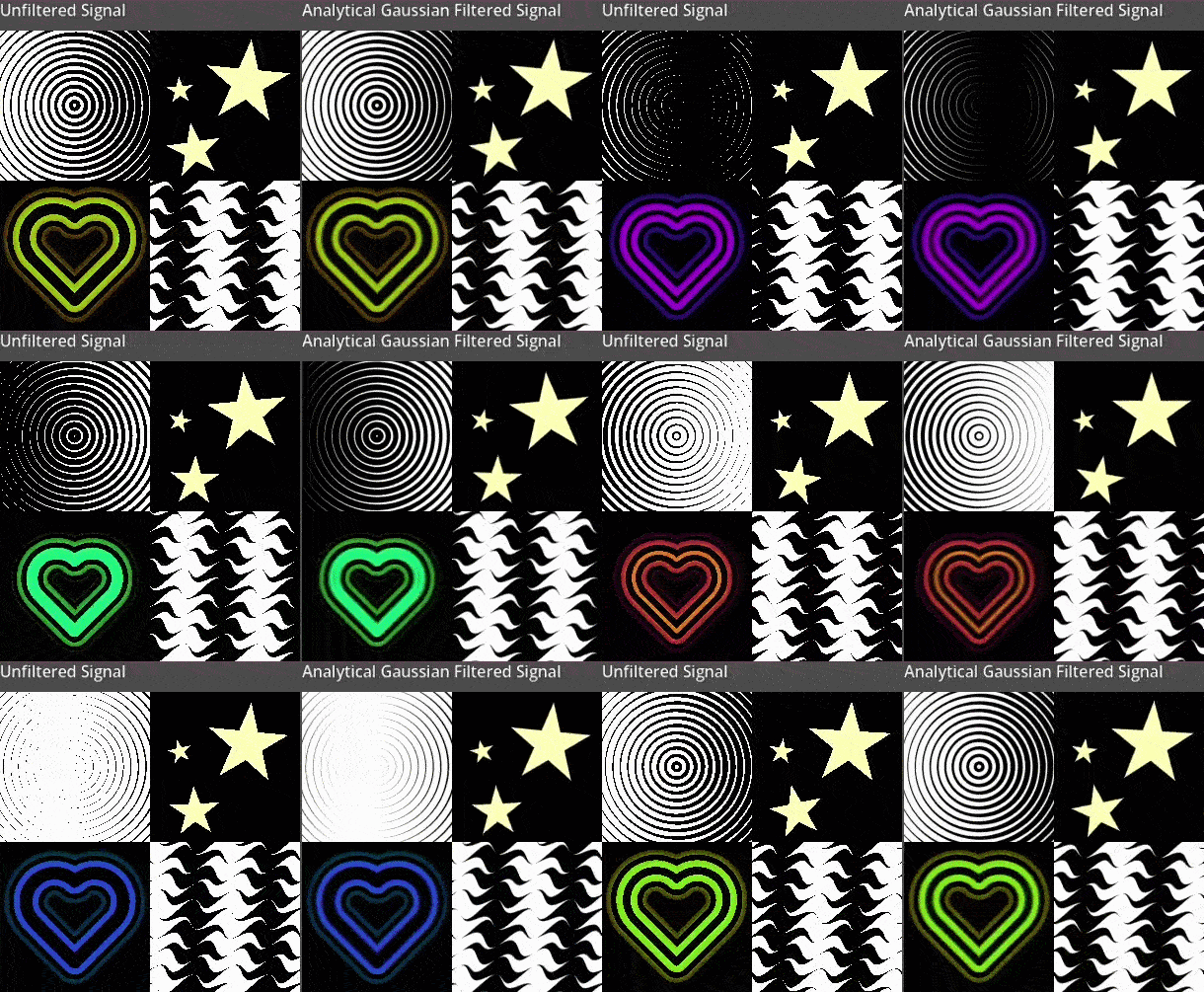
Gaussian Primitives – analytical filtering and antialiasing

Gaussian Primitives is a small library of shader functions for drawing smooth shapes in canvas_item or spatial shaders.
It gives you soft, antialiased version of common binary patterns. This includes steps, pulses, and repeating stripes. Hard edges can be drawn perfectly without using textures.
This file is a shader include (.gdshaderinc) and can be included using #include "res://gaussian_primitives.gdshaderinc".
Shader code
/*
Gaussian Primitives by vilmt

* A small library of analytic, Gaussian-integrated binary primitives (step, pulse, and periodic pulsetrain)
* Designed for antialiased rendering of hard thresholds or SDF-based shapes
* Supports both implicit derivatives (`dFdx` / `dFdy`) and explicit differentiation
* Includes component-wise overloads for `float`, `vec2`, `vec3`, and `vec4`
*/

// Greater = sharper transitions, smaller = more smoothing
#define SHARPNESS 1.5

// Magnitude of screen-space gradient (filter footprint w)
//#define NORM(dpdx, dpdy) (abs(dpdx) + abs(dpdy)) // L1 norm
#define NORM(dpdx, dpdy) sqrt(dpdx * dpdx + dpdy * dpdy) // L2 norm
//#define NORM(dpdx, dpdy) max(abs(dpdx), abs(dpdy)) // L∞ norm

// Error function approximation. Integral of gaussian.
// Source: https://github.com/Photosounder/rouziclib
#define _ERF_DEFINE(type) \
type erf(type x) { \
	type xa = abs(x); \
	type y = ((-0.06388*xa - 0.66186)*xa - 1.123613)*xa; \
	return (1.0 - exp(y)) * sign(x); \
}

_ERF_DEFINE(float)
_ERF_DEFINE(vec2)
_ERF_DEFINE(vec3)
_ERF_DEFINE(vec4)

// Step: 1 when p > edge, else 0

#define _STEP_DEFINE(type) \
type step_gaussian(type edge, type p) { \
	type dpdx = dFdx(p); \
	type dpdy = dFdy(p); \
	type inv_w = SHARPNESS / NORM(dpdx, dpdy); \
	return 0.5 + 0.5 * erf(inv_w * (p - edge)); \
}

#define _STEP_DEFINE_EXPLICIT(type) \
type step_gaussian(type edge, type p, type dpdx, type dpdy) { \
	type inv_w = SHARPNESS / NORM(dpdx, dpdy); \
	return 0.5 + 0.5 * erf(inv_w * (p - edge)); \
}

// Pulse: 1 when edge_a < p < edge_b, else 0

#define _PULSE_DEFINE(type) \
type pulse_gaussian(type edge_a, type edge_b, type p) { \
	type dpdx = dFdx(p); \
	type dpdy = dFdy(p); \
	type inv_w = SHARPNESS / NORM(dpdx, dpdy); \
	return 0.5 * (erf(inv_w * (p - edge_a)) - erf(inv_w * (p - edge_b))); \
}

#define _PULSE_DEFINE_EXPLICIT(type) \
type pulse_gaussian(type edge_a, type edge_b, type p, type dpdx, type dpdy) { \
	type inv_w = SHARPNESS / NORM(dpdx, dpdy); \
	return 0.5 * (erf(inv_w * (p - edge_a)) - erf(inv_w * (p - edge_b))); \
}

// Pulsetrain: 1 when there exists an integer k such that |p - k| < duty/2, else 0

/* Since we cannot compute an infinite sum, we sum only 3 pulses (k = -1, 0, 1) and
   blend to the average value (duty) when the filter footprint becomes large. */

#define _PULSETRAIN_DEFINE(type) \
type pulsetrain_gaussian(type duty, type p) { \
	type dpdx = dFdx(p); \
	type dpdy = dFdy(p); \
	type w = NORM(dpdx, dpdy) / SHARPNESS; \
	type inv_w = 1.0 / w, d = 0.5 * inv_w * duty; \
	p = inv_w * (p - round(p)); \
	type r = erf(p + inv_w + d) - erf(p + inv_w - d) \
		   + erf(p + d) - erf(p - d) \
		   + erf(p - inv_w + d) - erf(p - inv_w - d); \
	return mix(0.5 * r, duty, smoothstep(1.1, 1.2, w)); \
}

#define _PULSETRAIN_DEFINE_EXPLICIT(type) \
type pulsetrain_gaussian(type duty, type p, type dpdx, type dpdy) { \
	type w = NORM(dpdx, dpdy) / SHARPNESS; \
	type inv_w = 1.0 / w, d = 0.5 * inv_w * duty; \
	p = inv_w * (p - round(p)); \
	type r = erf(p + inv_w + d) - erf(p + inv_w - d) \
		   + erf(p + d) - erf(p - d) \
		   + erf(p - inv_w + d) - erf(p - inv_w - d); \
	return mix(0.5 * r, duty, smoothstep(1.1, 1.2, w)); \
}

_STEP_DEFINE(float)
_STEP_DEFINE(vec2)
_STEP_DEFINE(vec3)
_STEP_DEFINE(vec4)

_STEP_DEFINE_EXPLICIT(float)
_STEP_DEFINE_EXPLICIT(vec2)
_STEP_DEFINE_EXPLICIT(vec3)
_STEP_DEFINE_EXPLICIT(vec4)

_PULSE_DEFINE(float)
_PULSE_DEFINE(vec2)
_PULSE_DEFINE(vec3)
_PULSE_DEFINE(vec4)

_PULSE_DEFINE_EXPLICIT(float)
_PULSE_DEFINE_EXPLICIT(vec2)
_PULSE_DEFINE_EXPLICIT(vec3)
_PULSE_DEFINE_EXPLICIT(vec4)

_PULSETRAIN_DEFINE(float)
_PULSETRAIN_DEFINE(vec2)
_PULSETRAIN_DEFINE(vec3)
_PULSETRAIN_DEFINE(vec4)

_PULSETRAIN_DEFINE_EXPLICIT(float)
_PULSETRAIN_DEFINE_EXPLICIT(vec2)
_PULSETRAIN_DEFINE_EXPLICIT(vec3)
_PULSETRAIN_DEFINE_EXPLICIT(vec4)
Live Preview

Legendary use of preprocessor directives
Glad you like it! I’m not writing the pulsetrain 8 times lol