
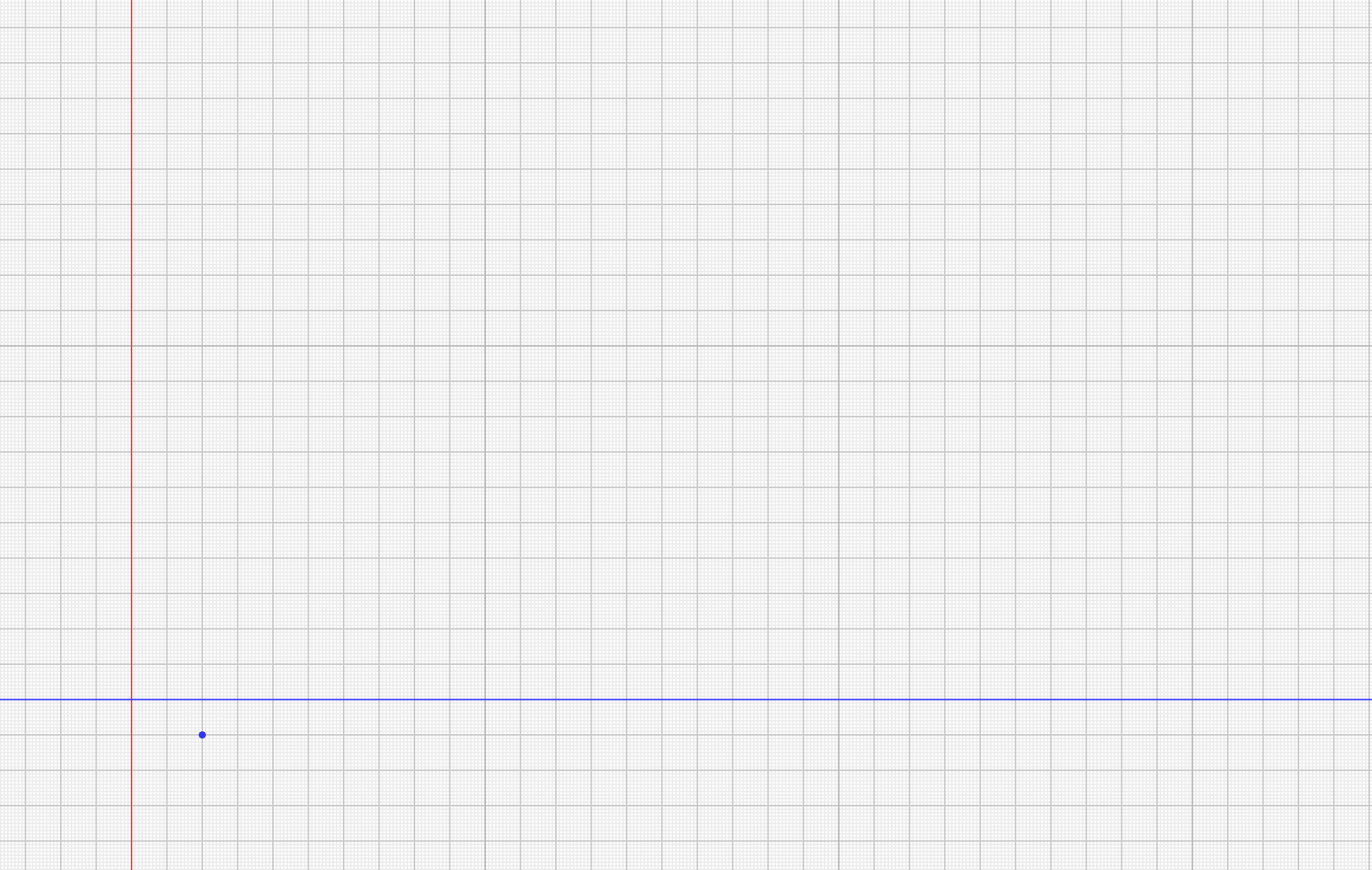
Infinite (not quite) zoom grid

Displays a grid with subdivisions.
The clever part is that as the camera zooms in on it, it will fade in new subdivisions.
I put “not quite” infinite zoom because after you zoom in 10000x it starts to glitch out from floating-point errors. If you need to have genuinely infinite zoom this runs into limits, but this has the convenience that it will get it automatically without requiring passing uniforms for camera position and zoom level.
Shader code
shader_type canvas_item;

uniform vec3 background_colour:source_color = vec3(1.0);

/** Colour of grid lines */
uniform vec3 grid_colour:source_color = vec3(0.7);

/** Colour of subdividing grid lines */
uniform vec3 subdivision_colour:source_color = vec3(0.85);

/** Colour of horizontal origin line */
uniform vec3 h_origin_colour:source_color = vec3(0.2, 0.2, 1.0);

/** Colour of vertical origin line */
uniform vec3 v_origin_colour:source_color = vec3(1.0, 0.2, 0.2);

/** Position of origin in world space pixels */
uniform vec2 origin_position = vec2(0.0, 0.0);

/** Target spacing according to pixels on screen. This is used as a target to choose what multiple */
uniform float grid_spacing_pixels = 50.0;

/** how many subdivisions the grid lines have */
uniform int subdivisions = 10;

/** thickness of lines in pixels */
uniform float line_thickness = 3.0;

/** range that line is smoothed, from 0 = no smoothing, 1.0 = most smoothing */
uniform float line_smooth:hint_range(0.0, 1.0, 0.01) = 0.5;

// compares postion to 0.0 to create consistent line, 1.0 if in line, 0.0 if not
float line_compare(float x, float uvx) {
	return 1.0 - smoothstep((1.0 - line_smooth) * line_thickness * x * 0.5, line_thickness * x * 0.5, abs(uvx));
}

// rounds off uv according to spacing of lines and returns distance to nearest line
vec2 moduloed_uv(vec2 uv, vec2 spacing) {
	vec2 m_uv = vec2(mod(uv.x + spacing.x * 0.5, spacing.x) - spacing.x * 0.5, mod(uv.y + spacing.y * 0.5, spacing.y) - spacing.y * 0.5);
	return m_uv;
}

// compare against a given grid spacing, return 1.0 if on grid, 0.0 if not
float grid_compare(vec2 uv, vec2 spacing, float ddx, float ddy) {
	vec2 g_uv = moduloed_uv(uv, spacing);
	float v_line = line_compare(ddx, g_uv.x);
	float h_line = line_compare(ddy, g_uv.y);
	return max(v_line, h_line);
}

// used to pass world position from vertex function
varying vec2 world_pos;

void vertex() {
	world_pos = (MODEL_MATRIX * vec4(VERTEX, 0.0, 1.0)).xy;
}

void fragment() {

	// get ddx and ddy from UVs
	vec2 dx = dFdx(world_pos);
	vec2 dy = dFdy(world_pos);
	float ddx = length(vec2(dx.x, dy.x));
	float ddy = length(vec2(dx.y, dy.y));

	vec2 uv = world_pos - origin_position; // make origin 0,0

	// decide the size of grid based on ddx and ddy
	// need value for space_mult that's a whole number but gets value closest to grid_spacing

	// convert to log
	float grid_ratio_log = log(ddx) / log(float(subdivisions));
	float rounded_log = round(grid_ratio_log);
	// round off to the nearest power of subdivisions
	float space_mult = pow(float(subdivisions), rounded_log);
	vec2 spacing = vec2(grid_spacing_pixels) * space_mult;

	// get whether this pixel is on the grid, on a subgrid or supergrid (subdivisions smaller or larger grid)
	float on_grid = grid_compare(uv, spacing, ddx, ddy);
	float on_subgrid = grid_compare(uv, spacing / float(subdivisions), ddx, ddy);
	float on_supgrid = grid_compare(uv, spacing * float(subdivisions), ddx, ddy);

	// fade line colour for transition between levels
	float transition = clamp((grid_ratio_log - rounded_log) * 2.0 + 0.5, 0.0, 1.0);
	// fade subgrid from background to subdivision colour
	vec3 subgrid_line_colour = mix(subdivision_colour, background_colour, transition);
	// fade grid from
	vec3 grid_line_colour = mix(grid_colour, subdivision_colour, transition);
	// pick the grid colour we're using based on which kind of line we're on
	grid_line_colour = mix(mix(subgrid_line_colour, grid_line_colour, on_grid), grid_colour, on_supgrid);

	// override grid colours for origin lines
	float ov_line = line_compare(ddx, uv.x);
	float oh_line = line_compare(ddy, uv.y);
	grid_line_colour = mix(grid_line_colour, v_origin_colour, ov_line);
	grid_line_colour = mix(grid_line_colour, h_origin_colour, oh_line);


	COLOR.rgb = mix(background_colour, grid_line_colour, on_subgrid);
}
