PSX/CRT Retro Shader for Godot

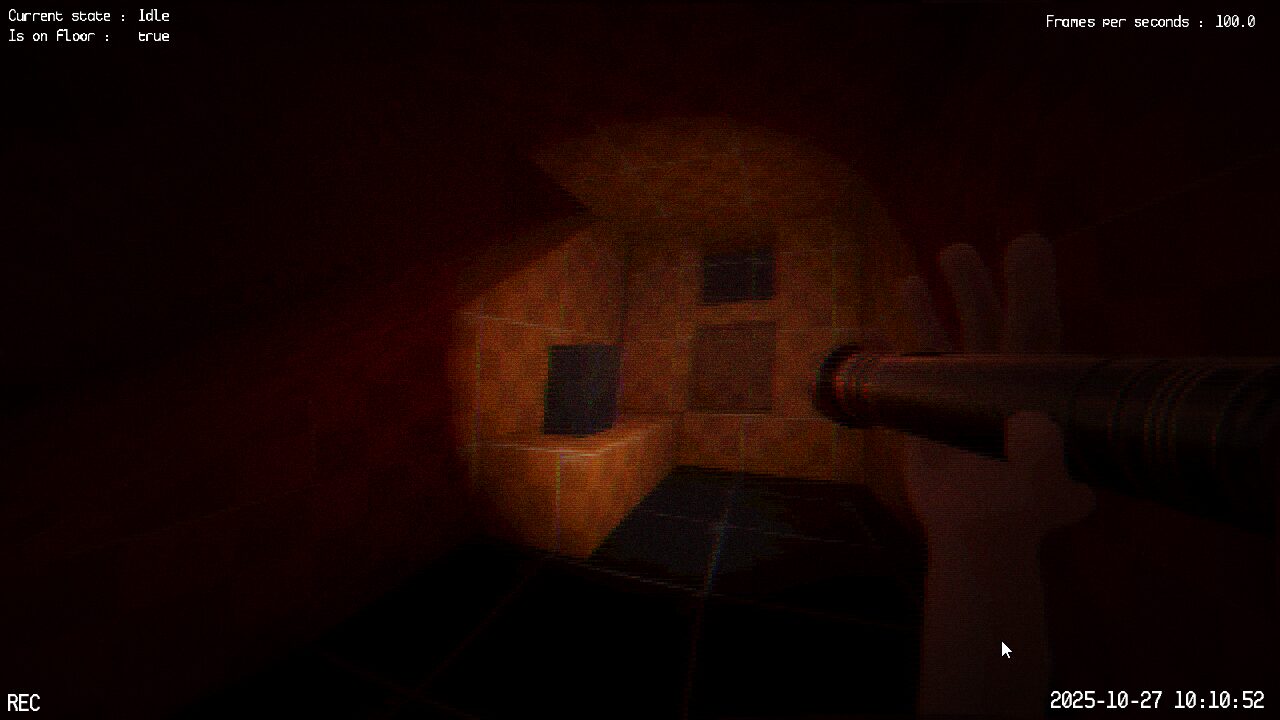
A shader for Godot 4.5 that emulates a complete PSX-era retro aesthetic. It combines multiple effects like pixelation, color quantization, PSX-style video warble, and full CRT simulation into a single, highly customizable pass. All features, including barrel distortion, scanlines, and chromatic aberration, are controllable via inspector uniforms.
Shader code
//PSX Like shader, with Grain, CRT, Vignette, Pixelation, and Warble Effects

shader_type canvas_item;

uniform sampler2D SCREEN_TEXTURE : hint_screen_texture, filter_linear_mipmap, repeat_enable;

uniform float grain_intensity : hint_range(0.0, 1.0) = 0.1;
uniform float min_lum : hint_range(0.0, 1.0) = 0.0;
uniform float max_lum : hint_range(0.0, 1.0) = 1.0;
uniform float time_scale : hint_range(0.0, 1.0) = 0.5;

uniform float vignette_darkness : hint_range(0.0, 1.0) = 0.5;
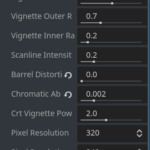
uniform float vignette_outer_radius : hint_range(0.1, 2.0) = 0.7;
uniform float vignette_inner_radius : hint_range(0.0, 1.9) = 0.2;

uniform float scanline_intensity : hint_range(0.0, 1.0) = 0.2;
uniform float barrel_distortion : hint_range(0.0, 0.5) = 0.15;
uniform float chromatic_aberration : hint_range(0.0, 0.01) = 0.005;
uniform float crt_vignette_power : hint_range(0.0, 5.0) = 2.0;

uniform int pixel_resolution_x : hint_range(32, 640) = 320;
uniform int pixel_resolution_y : hint_range(24, 480) = 240;
uniform bool enable_color_quantization = true;
uniform float color_quant_steps : hint_range(2.0, 64.0) = 32.0;

uniform float warble_amount : hint_range(0.0, 0.01) = 0.002;
uniform float warble_speed : hint_range(0.0, 10.0) = 5.0;


float noise(vec2 p) {
    return (fract(sin(dot(p, vec2(12.9898, 78.233))) * 43758.5453) - 0.5) * 2.0;
}

vec3 soft_light(vec3 A, vec3 B) {
    vec3 branch1 = 2.0 * A * B + A * A * (1.0 - 2.0 * B);
    vec3 branch2 = 2.0 * A * (1.0 - B) + sqrt(A) * (2.0 * B - 1.0);
    vec3 condition = step(0.5, B);
    return mix(branch1, branch2, condition);
}

vec3 quantize_color(vec3 color, float steps) {
    return floor(color * steps) / steps;
}


void fragment() {
    vec2 uv = SCREEN_UV;
    vec2 screen_size = 1.0 / SCREEN_PIXEL_SIZE;

    vec2 pixel_uv = floor(uv * vec2(float(pixel_resolution_x), float(pixel_resolution_y)))
                  / vec2(float(pixel_resolution_x), float(pixel_resolution_y));

    vec2 center_uv = pixel_uv - 0.5;
    float r2 = dot(center_uv, center_uv);

    vec2 distorted_uv = center_uv * (1.0 + barrel_distortion * r2);
    distorted_uv += 0.5;

    if (distorted_uv.x < 0.0 || distorted_uv.x > 1.0 || distorted_uv.y < 0.0 || distorted_uv.y > 1.0) {
        COLOR = vec4(0.0, 0.0, 0.0, 1.0);
    } else {
        vec2 warble_offset = vec2(
            sin(TIME * warble_speed + uv.x * 10.0) * cos(TIME * warble_speed * 0.7 + uv.y * 7.0),
            cos(TIME * warble_speed * 0.8 + uv.y * 11.0) * sin(TIME * warble_speed * 0.9 + uv.x * 8.0)
        ) * warble_amount;

        vec2 final_sample_uv = distorted_uv + warble_offset;

        final_sample_uv = clamp(final_sample_uv, vec2(0.0), vec2(1.0));

        vec3 original_color;

        vec3 col;
        col.r = texture(SCREEN_TEXTURE, final_sample_uv + vec2(chromatic_aberration, 0.0)).r;
        col.g = texture(SCREEN_TEXTURE, final_sample_uv).g;
        col.b = texture(SCREEN_TEXTURE, final_sample_uv - vec2(chromatic_aberration, 0.0)).b;

        original_color = col;

        if (enable_color_quantization) {
            original_color = quantize_color(original_color, color_quant_steps);
        }

        float lum = dot(original_color, vec3(0.299, 0.587, 0.114));
        float factor = 1.0 - smoothstep(min_lum, max_lum, lum);

        vec2 offset = vec2(sin(TIME * time_scale), cos(TIME * time_scale)) * 20.0;
        vec2 noise_uv = uv + offset;

        float noise_r = noise(noise_uv);
        float noise_g = noise(noise_uv + vec2(0.1, 0.2));
        float noise_b = noise(noise_uv + vec2(0.3, 0.4));
        vec3 grain = vec3(noise_r, noise_g, noise_b) * grain_intensity * factor;

        vec3 grain_color = clamp(vec3(0.5) + grain, 0.0, 1.0);
        vec3 processed_color = soft_light(original_color, grain_color);

        float aspect_ratio = screen_size.x / screen_size.y;
        vec2 adjusted_uv = uv - 0.5;
        adjusted_uv.x *= aspect_ratio;

        float inner_rad = min(vignette_inner_radius, vignette_outer_radius - 0.01);
        float dist = length(adjusted_uv);
        float vignette_pct = smoothstep(vignette_outer_radius, inner_rad, dist);
        float vignette_factor = mix(1.0 - vignette_darkness, 1.0, vignette_pct);

        processed_color *= vignette_factor;

        float scanline_alpha = sin(uv.y * screen_size.y * 3.0);
        scanline_alpha = clamp(scanline_alpha * 0.5 + 0.5, 0.0, 1.0);
        scanline_alpha = 1.0 - (scanline_alpha * scanline_intensity);
        processed_color *= scanline_alpha;

        float crt_vignette = pow(1.0 - r2, crt_vignette_power);
        processed_color *= crt_vignette;

        COLOR = vec4(processed_color, 1.0);
    }
}
Live Preview