
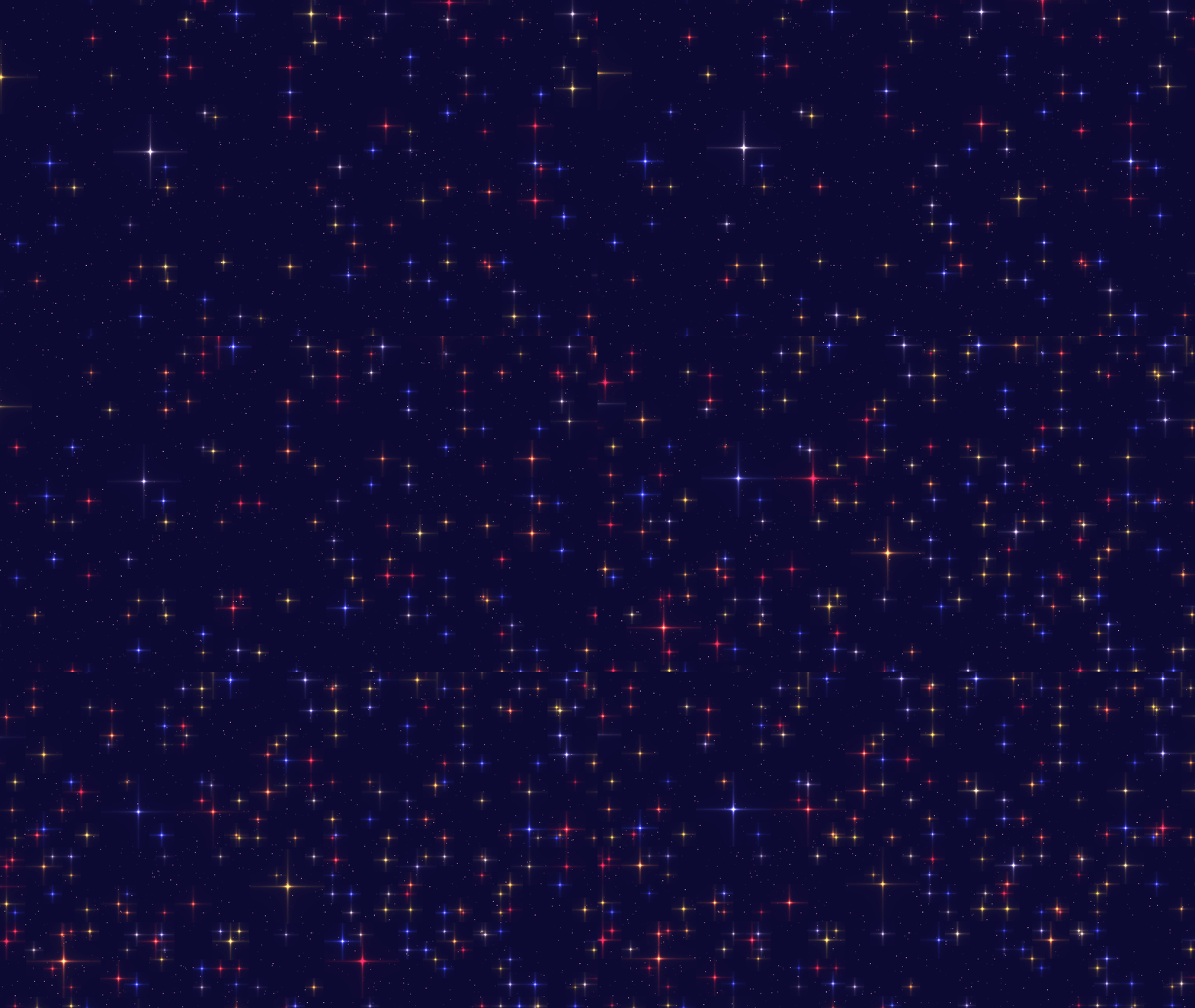
Stars shaders v2.0

Expanded upon gerardogc2378’s work on https://godotshaders.com/shader/stars-shader/
More intuitive support for features such as:
Movement over time;
Adjustment for characteristics of the main stars and background stars;
Iteration through for loops;
Support for different color schemes, gradient 2D used in the examples;
Seeding to alter the initial noise.
Shader code
shader_type canvas_item;

group_uniforms MainStars;
//Main star adjustments: Color, movement direction, shine, brightnessStar, periodicity, size, and quantity.
uniform sampler2D gradientA;
uniform float horizontalMovement: hint_range(-2.0, 2.0, 0.1) = 0.1;
uniform float verticalMovement: hint_range(-2.0, 2.0, 0.1) = 0.1;
uniform float frequencyStar: hint_range(0.0, 1.0, 0.01) = 0.1;
uniform float sizeStar: hint_range(10.0, 200.0, 10.0) = 100.0;
uniform float brightnessStar: hint_range(1.0, 5.0, 1.0) = 3.0;
uniform float shineFrequencyStar: hint_range(1.0, 20.0, 1.0) = 8.0;
uniform float transparencyStar: hint_range(0.0, 1.0, 0.01) = 0.0;
uniform int starIterations: hint_range(1, 10, 1) = 3;
group_uniforms BackgroundStars;
//Background star adjustments
uniform sampler2D gradientB;
uniform float frequencyBgStar: hint_range(0.950, 1.0, 0.001) = 0.996;
uniform float shineFrequencyBgStar: hint_range(0.0, 5.0, 1.0) = 1.0;
uniform float transparencyBgStar: hint_range(0.0, 1.0, 0.01) = 0.0;
group_uniforms Background;
//Background color and transparency
uniform vec4 colorBackground: source_color = vec4(0.05, 0.04, 0.20, 1.0);
uniform float transparencyBackground: hint_range(0.0, 1.0, 0.01) = 0.0;
group_uniforms Noise;
//Seeding for different noise generation, mainly to eliminate background star patterns
uniform float seed: hint_range(0.0, 100.0, 1.0) = 0.0;

float rand(vec2 st) {
	return fract(sin(dot(st.xy, vec2(seed+12.9898,78.233))) * 43758.5453123);
	}

float remap(float prob, float starValue) {
	return (starValue - prob)/(1.0-prob);
	}

void fragment() {
	float prob = 1.0 - frequencyStar;
	float travelx = TIME*horizontalMovement;
	float travely = TIME*verticalMovement;
	float color = 0.0;
	COLOR = vec4(colorBackground.rgb, 1.0 - transparencyBackground);

	for(int i = 1; i < 1 + starIterations; i++) {
		float size = sizeStar/float(i);
		vec2 pos = vec2(floor((1.0 / size * FRAGCOORD.x)+travelx), floor((1.0 / size * FRAGCOORD.y)+travely));
		float starValue = rand(pos);

		if (starValue > prob)
		{
			vec2 center = size * pos + vec2(size, size) * 0.5;
			float t = 0.9 + 0.2 * sin(TIME * shineFrequencyStar + (starValue - prob) / (1.0 - prob) * 45.0);
			vec2 modifiedCoords = vec2(FRAGCOORD.x + travelx*size, FRAGCOORD.y + travely*size);
			color = 1.0 - distance(modifiedCoords, center) / (0.5 * size);
			color = t*t*brightnessStar/float(i) / (clamp(distance(modifiedCoords.y, center.y), 0.5, size/2.0-1.0)) / (clamp(distance(modifiedCoords.x, center.x), 0.5, size/2.0-1.0));
			vec4 colormapA = texture(gradientA, vec2(remap(prob, starValue)));
			COLOR += colormapA * color * (1.0 - transparencyStar);
		}
	}

	if (rand(SCREEN_UV.xy / 20.0) > frequencyBgStar)
		{
			float r = rand(SCREEN_UV.xy);
			color = r * (0.85 * sin(TIME * shineFrequencyBgStar * (r * 5.0) + 720.0 * r) + 0.95);
			vec4 colormapB = texture(gradientB, vec2(r));
			COLOR += color * colormapB * (1.0 - transparencyBgStar);
		}
	}
Live Preview

Anyway I can use the stars without the background? Sry I’m really noob at this and couldn’t figure it out by myself 🙁
That was my mistake, I updated the code and it should work now, just change the background transparency to 1.0. Thanks for pointing that out!
I also added uniform groups for better organization, separated the transparency from background and front stars and broadened the hint range of movement into the negatives to allow for scrolling on the down and right directions (Also changed the name of the uniform to horizontal and vertical accordingly)
If you find out any more issues, please let me know.
Also decided to change the names of most of the uniform variables so they showcase more relevant information first on lower inspector widths.
Wow great work, I will test it later!