VHS and CRT monitor effect By  pend00
the original shader
but i edit it to work in godot 4 nothing fansy and all the hard work is goes back to pend00
Shader code
shader_type canvas_item;


uniform sampler2D SCREEN_TEXTURE : hint_screen_texture, filter_linear_mipmap;


uniform bool overlay = false;

uniform float scanlines_opacity : hint_range(0.0, 1.0) = 0.4;
uniform float scanlines_width : hint_range(0.0, 0.5) = 0.25;
uniform float grille_opacity : hint_range(0.0, 1.0) = 0.3;
uniform vec2 resolution = vec2(640.0, 480.0);

uniform bool pixelate = true;

uniform bool roll = true;
uniform float roll_speed = 8.0;
uniform float roll_size : hint_range(0.0, 100.0) = 15.0;
uniform float roll_variation : hint_range(0.1, 5.0) = 1.8;
uniform float distort_intensity : hint_range(0.0, 0.2) = 0.05;

uniform float noise_opacity : hint_range(0.0, 1.0) = 0.4;
uniform float noise_speed = 5.0;

uniform float static_noise_intensity : hint_range(0.0, 1.0) = 0.06;

uniform float aberration : hint_range(-1.0, 1.0) = 0.03;
uniform float brightness = 1.4;
uniform bool discolor = true;

uniform float warp_amount : hint_range(0.0, 5.0) = 1.0;
uniform bool clip_warp = false;

uniform float vignette_intensity = 0.4;
uniform float vignette_opacity : hint_range(0.0, 1.0) = 0.5;


vec2 random(vec2 uv){
    uv = vec2(dot(uv, vec2(127.1,311.7)), dot(uv, vec2(269.5,183.3)));
    return -1.0 + 2.0 * fract(sin(uv) * 43758.5453123);
}

float noise(vec2 uv) {
    vec2 uv_index = floor(uv);
    vec2 uv_fract = fract(uv);
    vec2 blur = smoothstep(0.0, 1.0, uv_fract);

    return mix(
        mix(dot(random(uv_index + vec2(0.0,0.0)), uv_fract - vec2(0.0,0.0)),
            dot(random(uv_index + vec2(1.0,0.0)), uv_fract - vec2(1.0,0.0)), blur.x),
        mix(dot(random(uv_index + vec2(0.0,1.0)), uv_fract - vec2(0.0,1.0)),
            dot(random(uv_index + vec2(1.0,1.0)), uv_fract - vec2(1.0,1.0)), blur.x),
        blur.y
    ) * 0.5 + 0.5;
}

vec2 warp(vec2 uv){
    vec2 delta = uv - 0.5;
    float delta2 = dot(delta.xy, delta.xy);
    float delta4 = delta2 * delta2;
    float delta_offset = delta4 * warp_amount;
    return uv + delta * delta_offset;
}

float border (vec2 uv){
    float radius = min(warp_amount, 0.08);
    radius = max(min(min(abs(radius * 2.0), abs(1.0)), abs(1.0)), 1e-5);
    vec2 abs_uv = abs(uv * 2.0 - 1.0) - vec2(1.0, 1.0) + radius;
    float dist = length(max(vec2(0.0), abs_uv)) / radius;
    float square = smoothstep(0.96, 1.0, dist);
    return clamp(1.0 - square, 0.0, 1.0);
}

float vignette(vec2 uv){
    uv *= 1.0 - uv.xy;
    float vignette = uv.x * uv.y * 15.0;
    return pow(vignette, vignette_intensity * vignette_opacity);
}


void fragment()
{
    vec2 uv = overlay ? warp(SCREEN_UV) : warp(UV);
    vec2 text_uv = uv;
    vec2 roll_uv = vec2(0.0);
    float time = roll ? TIME : 0.0;

    if (pixelate){
        text_uv = ceil(uv * resolution) / resolution;
    }

    float roll_line = 0.0;
    if (roll || noise_opacity > 0.0){
        roll_line = smoothstep(0.3, 0.9, sin(uv.y * roll_size - (time * roll_speed)));
        roll_line *= roll_line * smoothstep(0.3, 0.9, sin(uv.y * roll_size * roll_variation - (time * roll_speed * roll_variation)));
        roll_uv = vec2((roll_line * distort_intensity * (1.-UV.x)), 0.0);
    }

    vec4 text;
    if (roll){
        text.r = texture(SCREEN_TEXTURE, text_uv + roll_uv * 0.8 + vec2(aberration, 0.0) * .1).r;
        text.g = texture(SCREEN_TEXTURE, text_uv + roll_uv * 1.2 - vec2(aberration, 0.0) * .1).g;
        text.b = texture(SCREEN_TEXTURE, text_uv + roll_uv).b;
        text.a = 1.0;
    } else {
        text.r = texture(SCREEN_TEXTURE, text_uv + vec2(aberration, 0.0) * .1).r;
        text.g = texture(SCREEN_TEXTURE, text_uv - vec2(aberration, 0.0) * .1).g;
        text.b = texture(SCREEN_TEXTURE, text_uv).b;
        text.a = 1.0;
    }

    float r = text.r;
    float g = text.g;
    float b = text.b;

    uv = warp(UV);

    if (grille_opacity > 0.0){
        float g_r = smoothstep(0.85, 0.95, abs(sin(uv.x * (resolution.x * 3.14159265))));
        r = mix(r, r * g_r, grille_opacity);

        float g_g = smoothstep(0.85, 0.95, abs(sin(1.05 + uv.x * (resolution.x * 3.14159265))));
        g = mix(g, g * g_g, grille_opacity);

        float b_b = smoothstep(0.85, 0.95, abs(sin(2.1 + uv.x * (resolution.x * 3.14159265))));
        b = mix(b, b * b_b, grille_opacity);
    }

    text.r = clamp(r * brightness, 0.0, 1.0);
    text.g = clamp(g * brightness, 0.0, 1.0);
    text.b = clamp(b * brightness, 0.0, 1.0);

    float scanlines = 0.5;
    if (scanlines_opacity > 0.0){
        scanlines = smoothstep(scanlines_width, scanlines_width + 0.5, abs(sin(uv.y * (resolution.y * 3.14159265))));
        text.rgb = mix(text.rgb, text.rgb * vec3(scanlines), scanlines_opacity);
    }

    if (noise_opacity > 0.0){
        float n = smoothstep(0.4, 0.5, noise(uv * vec2(2.0, 200.0) + vec2(10.0, (TIME * (noise_speed)))));
        roll_line *= n * scanlines * clamp(random((ceil(uv * resolution) / resolution) + vec2(TIME * 0.8, 0.0)).x + 0.8, 0.0, 1.0);
        text.rgb = clamp(mix(text.rgb, text.rgb + roll_line, noise_opacity), vec3(0.0), vec3(1.0));
    }

    if (static_noise_intensity > 0.0){
        text.rgb += clamp(random((ceil(uv * resolution) / resolution) + fract(TIME)).x, 0.0, 1.0) * static_noise_intensity;
    }

    text.rgb *= border(uv);
    text.rgb *= vignette(uv);

    if (clip_warp){
        text.a = border(uv);
    }

    if (discolor){
        float saturation = 0.5;
        float contrast = 1.2;
        vec3 greyscale = vec3(text.r + text.g + text.b) / 3.;
        text.rgb = mix(text.rgb, greyscale, saturation);

        float midpoint = pow(0.5, 2.2);
        text.rgb = (text.rgb - vec3(midpoint)) * contrast + midpoint;
    }

    COLOR = text;
}
Live Preview
Tags
CRT,
monitor,
retro,
tv,
VHS,
video,
video games

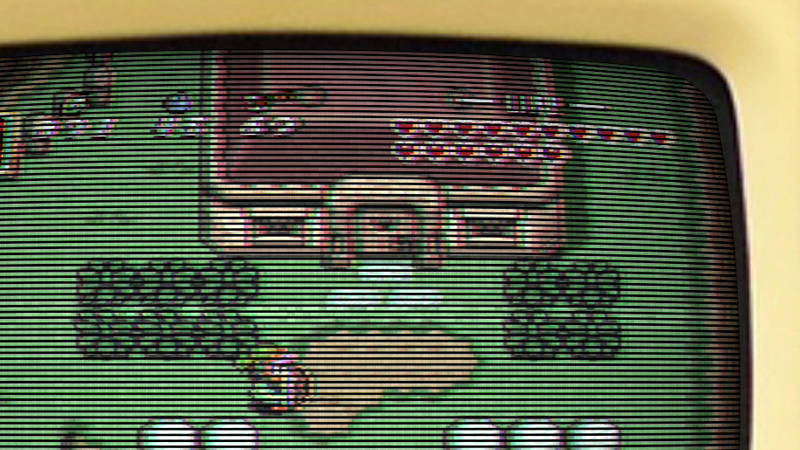


Its a great shader
nice one
Hi! Nice job!
I’m trying to use it only in UI, so it’s easier to add it individually to every UI node. Don’t know why but it only works in one of them.
Well, as always I solved it minutes from posting the comment.
Using overlay on false (putting the material in the actual node and not an overlay node, oc!)
and replacing SCREEN_TEXTURE with TEXTURE
Hi sansan, could you post the changes needed to attach this to individual UI nodes?
Hi!
Exploring further and trying to help someone using this.
I had a color modulated UI object and the shader, using TEXTURE, canceled that modulation. This has something to do with the order in which every effect is applied (I did no further research)
So the solution was:
Grabbing the modulate from the texture in the beginning of fragment()
void fragment()
{
	vec4 tex = texture(TEXTURE, UV);
	vec4 modulate = COLOR/tex;
And then at the end of fragment():
if (COLOR.a != 0.0) {
    	COLOR = text * modulate;
	}