
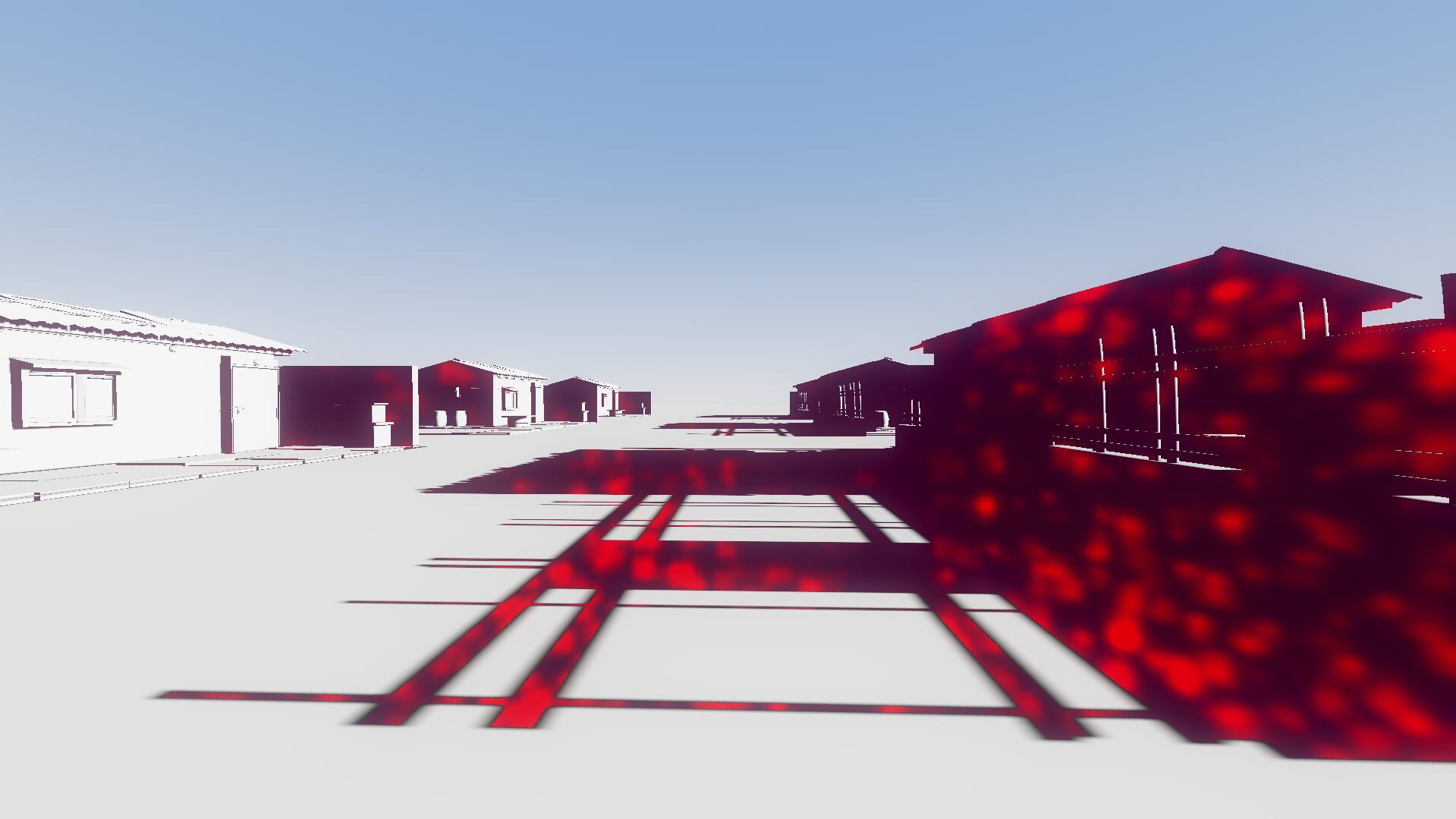
Custom Shadow Tutorial

Shadow with customizable color using the light function
The important thing to know is that the final color on the screen is
COLOR_ON_SCREEN = ALBEDO * DIFFUSE_LIGHT * LIGHT_ENERGY + EMISSION + AMBIENT_LIGHT
(There may be more to this depends on your scene illumination, but we will work with this for now)
We typically modify the color of the mesh through ALBEDO in the fragment function. But to know whether the fragment is in shadow or not, we do not have that information in the fragment stage.
In this shader, we can get the shadow information in the light function through ATTENUATION.
ATTENUATION ranges from 0 (in shadow) -> 1(in light). Any value in between like 0.5 means it is at an edge of shadow, and depends on how blurry your shadow is. Since we can not change the ALBEDO in the light function, we will change the DIFFUSE_LIGHT variable.
From the formula, since ALBEDO cannot be change, we can change other light variable to compensate. Lets say, we want the final color on screen red, we set DIFFUSE_LIGHT=vec3(1.0,0.0,0.0)/ALBEDO. This way COLOR_ON_SCREEN = ALBEDO * vec3(1.0,0.0,0.0)/ALBEDO = vec3(1.0,0.0,0.0) (assume light energy is 1, and emission and ambient_light disabled)
To avoid division by ALBEDO being zero, we just make sure it is not 0 in the first place in the fragment function.
We also set ambient light disabled to make shadow color more uniform.
Updated: handle non-directional light
Shader code
shader_type spatial;
render_mode ambient_light_disabled;
//render_mode world_vertex_coords;
uniform vec3 color:source_color;
uniform sampler2D shadow_mask2d:source_color,repeat_enable,filter_linear;
uniform sampler3D shadow_mask3d:source_color,repeat_enable,filter_linear;
uniform sampler2D color_gradient:source_color;
uniform vec3 offset;
uniform float scale=0.75;

varying vec3 world_pos;
varying vec3 local_pos;
varying vec3 local_normal;
varying vec3 cam_pos;

vec4 triplanar_texture(sampler2D p_sampler, vec3 p_weights, vec3 p_triplanar_pos) {
	vec4 samp = vec4(0.0);
	samp += texture(p_sampler, p_triplanar_pos.xy) * p_weights.z;
	samp += texture(p_sampler, p_triplanar_pos.xz) * p_weights.y;
	samp += texture(p_sampler, p_triplanar_pos.zy * vec2(-1.0, 1.0)) * p_weights.x;
	return samp;
}

vec4 sample_text3d(sampler3D mask, vec3 pos){
	return texture(mask, pos);
}


vec3 tile(vec3 p, float size) {
    return mod(p, size) - size * 0.5;
}

vec4 volume_march(vec3 ro, vec3 rd, int steps, float stepd){
	float sample_scale=scale;
	ro+=rd*40.0;
	vec4 value=vec4(0.0);
	for (int i=0;i<steps;i++){
		value+=sample_text3d(shadow_mask3d,ro*sample_scale)*stepd;
		if (value.r>=0.9){
			break;
		}
		ro+=rd*stepd;
	}
	return value;
}


void vertex() {
	local_pos=VERTEX;
	world_pos = (MODEL_MATRIX * vec4(VERTEX, 1.0)).xyz;
	local_normal=NORMAL;
	cam_pos=CAMERA_POSITION_WORLD;
}

void fragment() {
	ALBEDO=color;
	if (abs(ALBEDO.r)<=0.0001) ALBEDO.r=0.0001;
	if (abs(ALBEDO.g)<=0.0001) ALBEDO.g=0.0001;
	if (abs(ALBEDO.b)<=0.0001) ALBEDO.b=0.0001;

	SPECULAR=0.0;
	//AO=0.0;
	//EMISSION=vec3(0.01);
	//IRRADIANCE=vec4(0.0);
}

void light() {
	float NdotL = max(dot(NORMAL, LIGHT), 0.0);
	float lit_intensity=smoothstep(0.0,0.5,NdotL*ATTENUATION);
	//toon light, relatively flat color, no smooth blur edge
	vec3 light_col=lit_intensity * LIGHT_COLOR / PI;

	vec3 shadow_col=vec3(0.0);
	{///////////////////////YOUR COLOR LOGIC IN HERE//////////////////
		//SOME EXAMPLES:

		//ray march polka dots
		//vec3 ro=cam_pos+vec3(0.0,TIME*0.0,0.0);
		//vec3 rd=normalize(world_pos-cam_pos);
		//float ray_march_val=volume_march(ro,rd,100,0.1).r;
		//shadow_col=mix(vec3(0.03,0.0,0.02),vec3(0.25,0.01,0.01),ray_march_val);

		//RED shadow
		shadow_col=vec3(1.0,0.0,0.0);

		//triplanar texture
		//shadow_col=triplanar_texture(shadow_mask2d,abs(local_normal),local_pos).rgb*0.1;
	}
	//TODO: handle cases where albedo.rgb is0
	//divide by albedo to cancel out all color. may be weird when albedo.rgb is 0
	//due to division by 0. could try to avoid albedo becoming absolute 0 in fragment
	vec3 _shadow_col=shadow_col/ALBEDO;

	if (LIGHT_IS_DIRECTIONAL)
		DIFFUSE_LIGHT+=mix(_shadow_col,light_col,smoothstep(0.01,1.0,lit_intensity));
	else//non directional light can be a bit funky
		DIFFUSE_LIGHT+=mix(_shadow_col,light_col,smoothstep(0.01,1.0,lit_intensity))*ATTENUATION;
}
Live Preview

And you don’t seem to understand…
a shame you seemed an honest man
lmao screenshot 3
Hi, could you post a step-by-step tutorial?
It doesn’t work with my project
serial experiments lain??