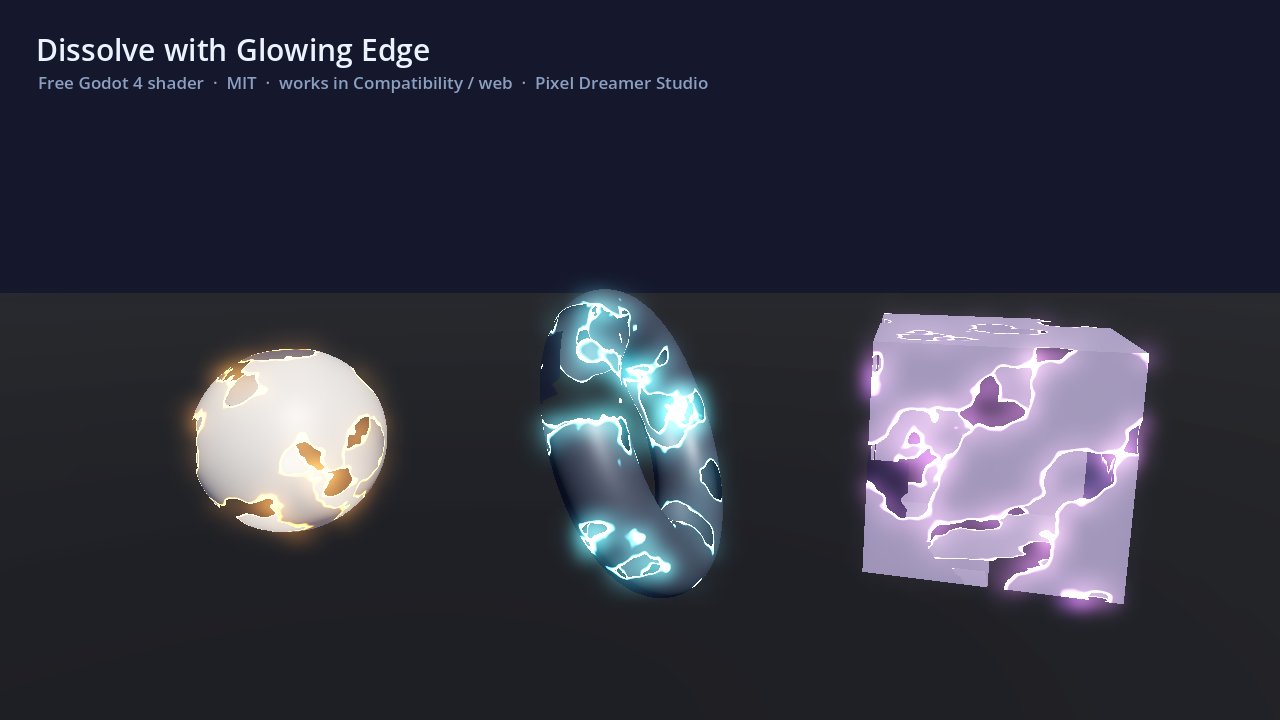
Dissolve with Glowing Edge

A dissolve shader for 3D meshes with a burning, glowing edge. Animate “dissolve” from 0 (solid) to 1 (gone).
- No noise texture needed: uses built-in 3D value noise (fbm), so there are no UV seams on spheres or tori
- edge_color + edge_energy control the glowing rim (turn on Glow in your WorldEnvironment for the best look)
- edge_width, noise_scale
- albedo, albedo_texture, roughness, metallic, so it can replace a basic StandardMaterial3D
- use_world_space: keep the pattern fixed in the world when the object moves
Tested in Godot 4.7 with the Compatibility renderer, so it also works in web exports.
Code written with AI assistance, tested by hand in Godot 4.7.
More Godot 4 packs: https://pixeldreamerstudio.itch.io/
Shader code
// Pixel Dreamer — Dissolve with Glowing Edge (Godot 4 · spatial · Forward+/Mobile/Compatibility)
// MIT License · https://pixeldreamerstudio.itch.io/
// Animate `dissolve` from 0 (solid) to 1 (gone). The burning edge glows with `edge_color`.
shader_type spatial;
render_mode cull_disabled;

uniform vec4 albedo : source_color = vec4(0.8, 0.8, 0.85, 1.0);
uniform sampler2D albedo_texture : source_color, filter_linear_mipmap, hint_default_white;
uniform float roughness : hint_range(0.0, 1.0) = 0.5;
uniform float metallic : hint_range(0.0, 1.0) = 0.0;
uniform float dissolve : hint_range(0.0, 1.0) = 0.4;
uniform float edge_width : hint_range(0.0, 0.3) = 0.06;
uniform vec4 edge_color : source_color = vec4(1.0, 0.45, 0.1, 1.0);
uniform float edge_energy : hint_range(0.0, 16.0) = 6.0;
uniform float noise_scale = 2.5;
uniform bool use_world_space = false; // true = pattern stays put when the object moves

varying vec3 npos;

float hash(vec3 p) {
	p = fract(p * 0.3183099 + 0.1);
	p *= 17.0;
	return fract(p.x * p.y * p.z * (p.x + p.y + p.z));
}
float vnoise(vec3 x) {
	vec3 i = floor(x);
	vec3 f = fract(x);
	f = f * f * (3.0 - 2.0 * f);
	return mix(mix(mix(hash(i), hash(i + vec3(1,0,0)), f.x), mix(hash(i + vec3(0,1,0)), hash(i + vec3(1,1,0)), f.x), f.y),
	           mix(mix(hash(i + vec3(0,0,1)), hash(i + vec3(1,0,1)), f.x), mix(hash(i + vec3(0,1,1)), hash(i + vec3(1,1,1)), f.x), f.y), f.z);
}
float fbm(vec3 p) {
	float v = 0.0;
	float a = 0.5;
	for (int i = 0; i < 4; i++) {
		v += a * vnoise(p);
		p *= 2.03;
		a *= 0.5;
	}
	return v;
}

void vertex() {
	npos = use_world_space ? (MODEL_MATRIX * vec4(VERTEX, 1.0)).xyz : VERTEX;
}

void fragment() {
	float n = clamp((fbm(npos * noise_scale) - 0.22) / 0.56, 0.0, 1.0);
	// stretch so dissolve 0 = solid and 1 = fully gone
	float d = dissolve * (1.0 + edge_width) - edge_width;
	if (n < d) {
		discard;
	}
	vec4 tex = texture(albedo_texture, UV);
	ALBEDO = albedo.rgb * tex.rgb;
	ROUGHNESS = roughness;
	METALLIC = metallic;
	float edge = 1.0 - smoothstep(d, d + edge_width, n);
	EMISSION = edge_color.rgb * edge * edge_energy * step(0.001, dissolve);
}