
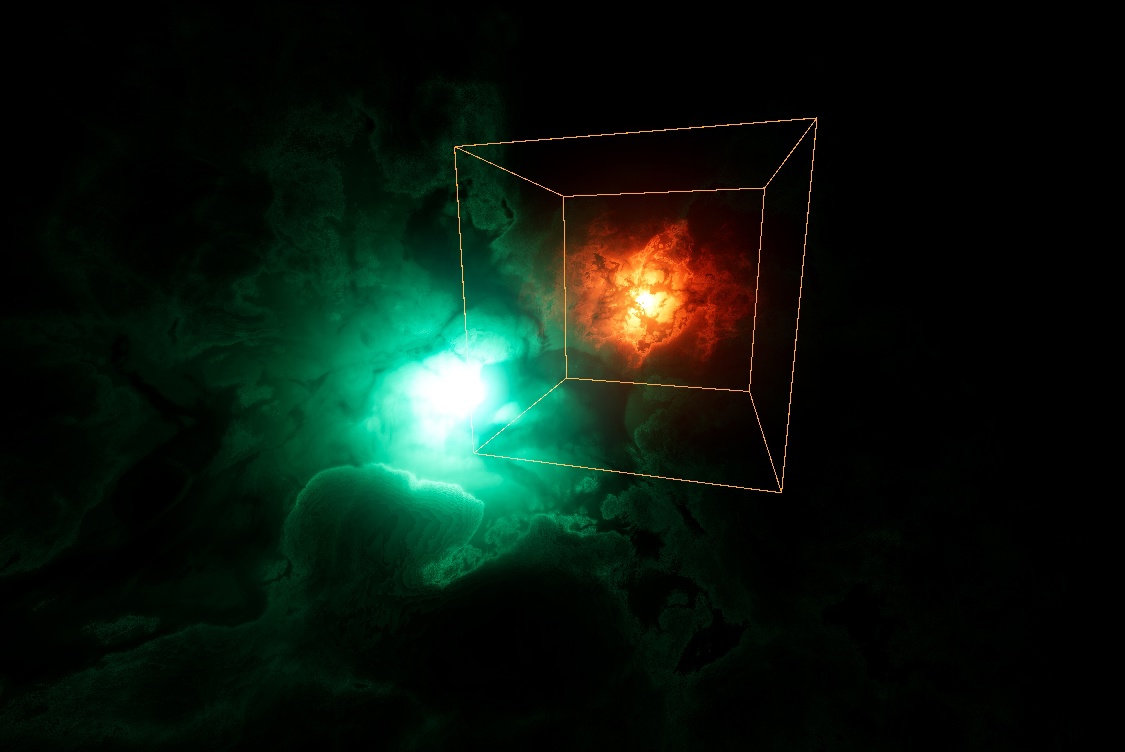
Dusty nebula

Okay, time to sleep…
I’ve been wanting to make something like this for a long time and finally I did it.
In the screenshot CSGSpere3D.
Shader is Based on:
https://www.shadertoy.com/view/MsVXWW
For best results add WorldEnviroment, Tonemap and Glow.
I’ve marked it as a Shadertoy license – However… how much would the source have to be changed so that I wouldn’t have any licensing issues if I wanted to use it in a commercial project?
Anyone know? I’m planning on using this as a jumping off point for another idea and there’s a lot of possibilities here…
Shader code
// Based on:
// https://www.shadertoy.com/view/MsVXWW
shader_type spatial;
render_mode blend_mix, diffuse_burley, specular_schlick_ggx, unshaded;

uniform vec4 albedo : source_color = vec4(1.0, 0.5, 0.3, 1.0);

const float nudge = 0.739513;   // size of perpendicular vector
const float normalizer = 1.0 / sqrt(1.0 + nudge*nudge);   // pythagorean theorem on that perpendicular to maintain scale

varying vec3 global_pos;

float SpiralNoiseC(vec3 p) {
    float n = 0.0; //sin(TIME);  // noise amount
    float iter = 1.0;
    for (int i = 0; i < 8; i++) { // add sin and cos scaled inverse with the frequency
        n += -abs(sin(p.y*iter) + cos(p.x*iter)) / iter;    // abs for a ridged look
        p.xy += vec2(p.y, -p.x) * nudge; // rotate by adding perpendicular and scaling down
        p.xy *= normalizer;
        p.xz += vec2(p.z, -p.x) * nudge; // rotate on other axis
        p.xz *= normalizer;
        iter *= 1.733733; // increase the frequency
    }
    return n;
}

float NebulaNoise(vec3 p) {
    float final = p.y + 4.5;
    final -= SpiralNoiseC(p.xyz);   // mid-range noise
    final += SpiralNoiseC(p.zxy*0.5123+100.0)*4.0;   // large scale features
    return final;
}

float myMap(vec3 p) {
    float NebNoise = abs(NebulaNoise(p/0.5) * 0.5) + 0.03;
    return NebNoise;
}

void vertex() {
    global_pos = NODE_POSITION_WORLD;
}

void fragment() {
    // Получаем позицию в мировых координатах
    vec3 world_pos = (INV_VIEW_MATRIX * vec4(VERTEX, 1.0)).xyz;
    vec3 ray_dir = normalize(world_pos - CAMERA_POSITION_WORLD);

    vec4 sum = vec4(0.0);
    // d:distance function, t:lengh of the ray
    float d=1.0, t=0.0;
    // local/tital density + weighting factor
    float ld=0.0, td=0.0, w=0.0;
    float min_dist=0.0, max_dist=100.0;

    ALPHA = 0.0;

    t = min_dist * step(t, min_dist);

    for (int i=0; i<30; i++){
        vec3 pos = world_pos + t * ray_dir;
        // break conditions
        if(td>0.9 || d<0.1*t || t>10.0 || sum.a > 0.99 || t>max_dist) break;

        float d = myMap(pos);
        d = max(d, 0.08);

        // STAR in CENTER
        vec3 ldst = global_pos - pos;
        float lDist = max(length(ldst), 0.001);
        sum.rgb += (albedo.rgb/(lDist*lDist) / 30.0); //STAR and BLOOM

        td += 1.0/70.0;
        d = max(d, 0.04);
        t += max(d * 0.1 * max(min(length(ldst), length(world_pos)), 1.0), 0.02);
    }
    ALBEDO = sum.rgb;
    ALBEDO *= t;
    ALPHA = ALBEDO.r;
}
Live Preview

Looks fantastic! Any chance you might happened to have a 2D canvas item version of it?
I was interested in the 3D version. The original is 2D. But there are some difficulties in conveying the rotation.
The beauty of a 3D solution is that it happens sort of… automatically.
shader_type canvas_item;

uniform vec2 iMouse = vec2(-15.0, 0.0);
uniform int loop_count = 36;
uniform vec4 albedo : source_color = vec4(1.0, 0.5, 0.3, 1.0);


const float nudge = 0.739513;   // size of perpendicular vector
const float normalizer = 1.0 / sqrt(1.0 + nudge*nudge);   // pythagorean theorem on that perpendicular to maintain scale
const float pi = 3.14159265;


vec2 R(vec2 p, float a) {
	return cos(a) * p + sin(a) * vec2(p.y, -p.x);
}


float SpiralNoiseC(vec3 p) {
	float n = 0.0; //sin(TIME);  // noise amount
	float iter = 1.0;
	for (int i = 0; i < 5; i++) { // add sin and cos scaled inverse with the frequency
		n += -abs(sin(p.y*iter) + cos(p.x*iter)) / iter;    // abs for a ridged look
		p.xy += vec2(p.y, -p.x) * nudge; // rotate by adding perpendicular and scaling down
		p.xy *= normalizer;
		p.xz += vec2(p.z, -p.x) * nudge; // rotate on other axis
		p.xz *= normalizer;
		iter *= 1.733733; // increase the frequency
	}
	return n;
}


float NebulaNoise(vec3 p) {
	float final = p.y + 4.5;
	final -= SpiralNoiseC(p.xyz);   // mid-range noise
	final += SpiralNoiseC(p.zxy*0.5123)*4.0;   // large scale features
	return final;
}


float getDist(vec3 p) {
	return abs(NebulaNoise(p/0.5) * 0.5) + 0.03;
}


void fragment() {
	vec2 iResolution = 1.0/SCREEN_PIXEL_SIZE;

	vec3 ray_orig = vec3(0., 0., -6.0);
	vec3 ray_dir = normalize(vec3((FRAGCOORD.xy - 0.5*iResolution.xy)/iResolution.y, 1.0));

	ray_dir.yz = R(ray_dir.yz, -TIME*0.04*pi*2.); //iMouse.x instead of TIME To pass rotation as a parameter.
    ray_dir.xz = R(ray_dir.xz, iMouse.x*0.01*pi*2.);
    ray_orig.yz = R(ray_orig.yz, -TIME*0.04*pi*2.);
    ray_orig.xz = R(ray_orig.xz, iMouse.x*0.01*pi*2.);

	vec4 sum = vec4(0.0, 0.0, 0.0, 1.0);
	float d=1.0, t=0.0;
	float ld=0.0, td=0.0, w=0.0;
	float min_dist=0.0, max_dist=100.0;

	t = min_dist * step(t, min_dist);
	// raymarch loop
	for (int i=0; i<loop_count; i++){
		vec3 pos = ray_orig + t * ray_dir;
		// break conditions
		if(td>0.9 || d<0.1*t || t>max_dist) break;

		float d = getDist(pos);

		vec3 ldst = vec3(0.0) - pos;
		float lDist = max(length(ldst), 0.001);
		sum.rgb += (albedo.rgb/(lDist*lDist) / 50.0); //STAR and BLOOM

		t += max(d * 0.1 * max(min(length(ldst), length(ray_orig)), 1.0), 0.02);
	}
	COLOR = sum;
}