
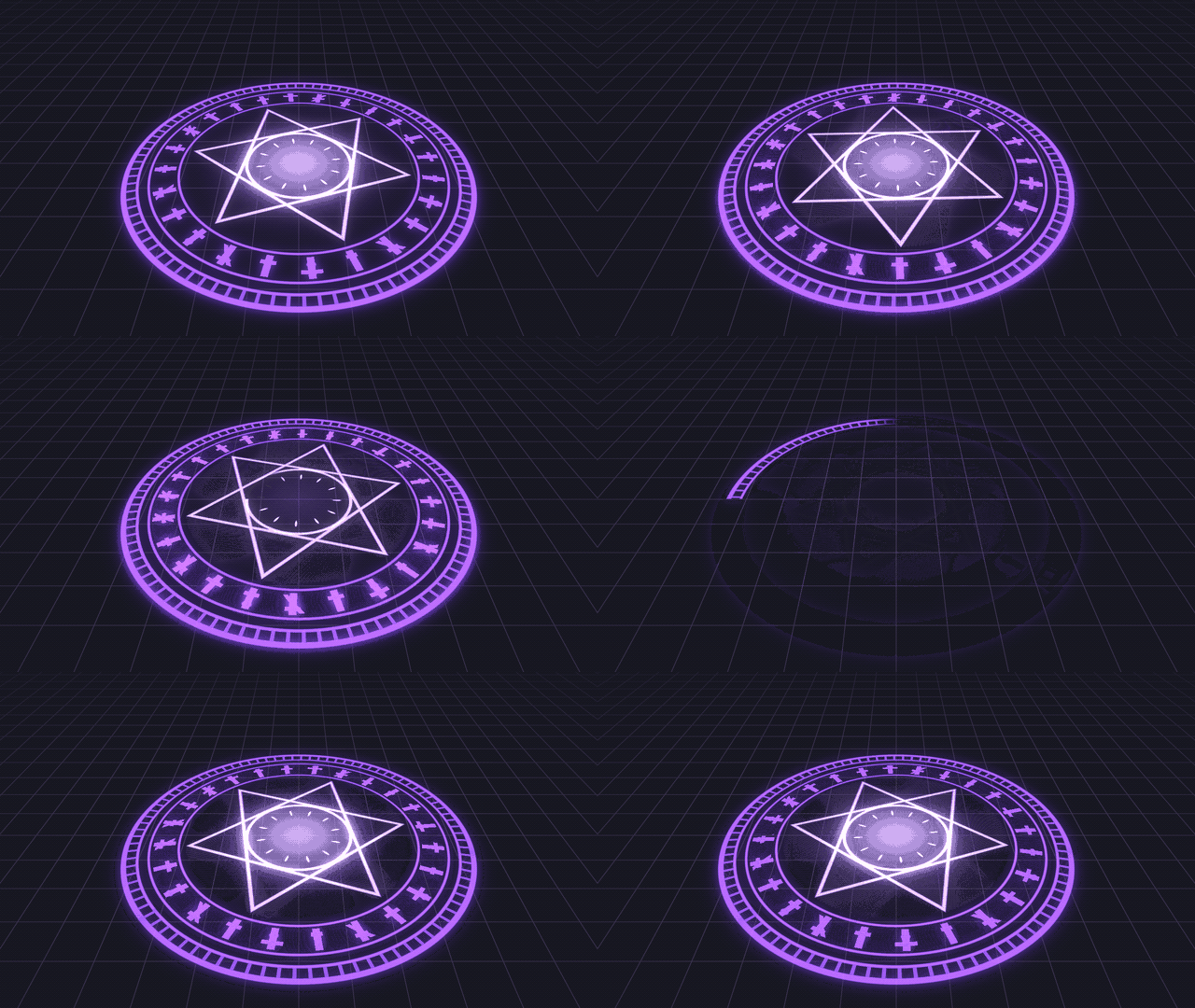
Magic Circle Shader (Procedural Runes)

A magic circle on one quad: outer rings with tick marks, a ring of rune-like marks turning one way, a six-pointed star turning the other way, a ring of dots and a soft glow in the middle.
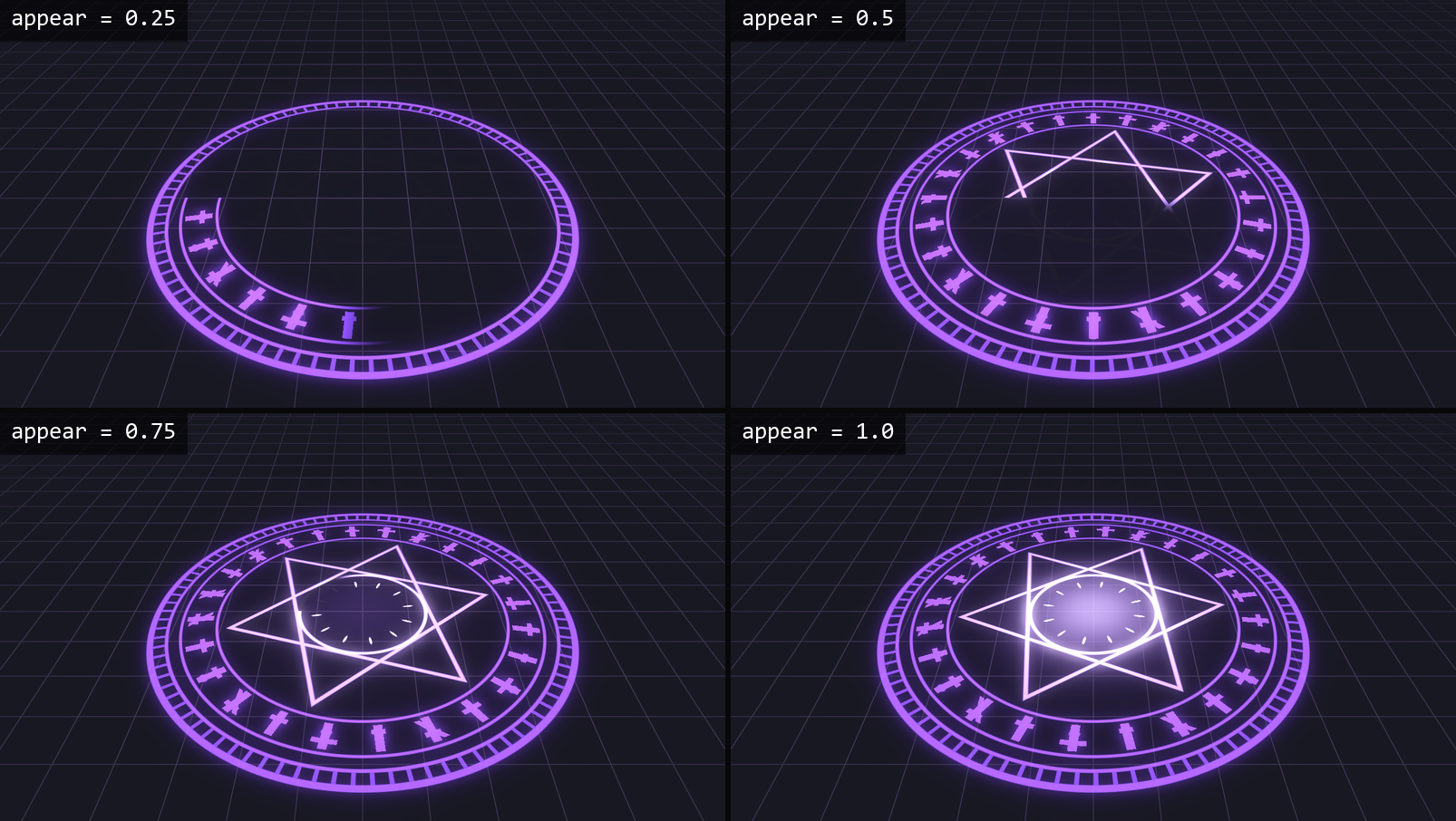
Put it on a QuadMesh or PlaneMesh of about 4 x 4 as Material Override. Lay it flat for a summoning circle or stand it up in front of a caster. Animate appear from 0 to 1 and the rings draw in one after another. The runes come from a hash, so a new seed gives you a different circle. The main knobs are rune_count, line_width, rotation_speed and the two colors.
It’s additive and unshaded, so it glows on a dark floor. Turn Glow on. No textures, and it looked the same on Forward+, Mobile and Compatibility in 4.4 and 4.7.
The code was written with the help of an AI coding assistant.
I wrote this as a small take on the magic circles in my Dark Magic, Holy & Arcane VFX pack for Godot 4, which also has curses and spell bolts. The free version is the first link and the full pack is the second.
https://gennai.itch.io/free-magic-bolt-vfx-godot-4?utm_source=godotshaders&utm_medium=referral&utm_campaign=magiccircle
https://gennai.itch.io/magic-spell-vfx-godot-4?utm_source=godotshaders&utm_medium=referral&utm_campaign=magiccircle
Shader code
// Procedural Magic Circle for Godot 4
// MIT License. Copyright (c) 2026 gennai (https://gennai.itch.io)
//
// A magic circle drawn on a single quad: outer rings with tick marks, a ring of rune-like
// marks that turns one way, a two-triangle star that turns the other way, an inner ring of
// dots and a soft glow in the middle. Put it on a MeshInstance3D with a QuadMesh or a
// PlaneMesh (for example 4 x 4) as Geometry > Material Override. Lay it on the floor for
// a summoning circle, or stand it up as a spell cast in front of a character.
//
// Animate appear from 0 to 1 to draw the rings one after another, and back to 0 to
// close them. The runes are made from a hash, so changing seed gives a different circle.
// It is additive and unshaded, so it glows on a dark floor. Values above 1 in
// intensity bloom when Glow is on in the WorldEnvironment.
// No textures: everything is computed in the shader with sin-free hashes, so it looks
// the same on every renderer.
shader_type spatial;
render_mode unshaded, blend_add, depth_draw_never, cull_disabled, shadows_disabled, fog_disabled;

group_uniforms circle;
// 0 = nothing drawn, 1 = fully drawn. Animate this to open and close the circle.
uniform float appear : hint_range(0.0, 1.0) = 1.0;
// Turning speed of the rings, in turns per second. The star turns the other way.
uniform float rotation_speed : hint_range(-1.0, 1.0) = 0.06;
// Number of rune marks in the ring.
uniform int rune_count : hint_range(8, 40) = 24;
// Line thickness.
uniform float line_width : hint_range(0.003, 0.03) = 0.011;
// Changes the runes.
uniform float seed : hint_range(0.0, 100.0) = 0.0;

group_uniforms look;
// Colour of the lines.
uniform vec4 color : source_color = vec4(0.55, 0.3, 1.0, 1.0);
// Colour of the brightest parts and the centre.
uniform vec4 color_hot : source_color = vec4(0.9, 0.8, 1.0, 1.0);
// Brightness. Values above 1 bloom when glow is on.
uniform float intensity : hint_range(0.0, 8.0) = 2.2;
// Soft glow inside the circle.
uniform float fill_glow : hint_range(0.0, 1.0) = 0.35;
// Slow pulse of the brightness.
uniform float pulse : hint_range(0.0, 1.0) = 0.25;

float mc_hash(float p) {
	p = fract(p * 0.1031);
	p *= p + 33.33;
	p *= p + p;
	return fract(p);
}

float mc_line(float d, float w, float aa) {
	return 1.0 - smoothstep(w - aa, w + aa, abs(d));
}

// Signed distance of a regular triangle edge (0 on the edge, negative inside).
float mc_tri(vec2 p, float R) {
	float d = -1e5;
	for (int i = 0; i < 3; i++) {
		float an = float(i) * TAU / 3.0 + PI * 0.5;
		d = max(d, dot(p, vec2(cos(an), sin(an))));
	}
	return d - R * 0.5;
}

vec2 mc_rot(vec2 p, float a) {
	float c = cos(a);
	float s = sin(a);
	return vec2(c * p.x - s * p.y, s * p.x + c * p.y);
}

// How much of a part is drawn: parts open one after another and sweep round the circle.
float mc_reveal(float k, float ang01) {
	float rev = clamp(appear * 5.0 - k, 0.0, 1.0);
	return smoothstep(0.0, 0.06, rev - ang01 * 0.9) * step(0.001, rev);
}

void fragment() {
	vec2 p = (UV - 0.5) * 2.0;
	float r = length(p);
	float aa = max(fwidth(r) * 1.2, 0.0015);
	float ang = atan(p.y, p.x);
	float a01 = fract(ang / TAU + 0.5);
	float spin = TIME * rotation_speed * TAU;
	float w = line_width;
	float v = 0.0;
	float hot = 0.0;

	// outer rings with tick marks between them
	float ring_a = max(mc_line(r - 0.97, w * 1.3, aa), mc_line(r - 0.9, w * 0.7, aa));
	float tick_x = abs(fract((ang + spin * 0.5) / TAU * 90.0) - 0.5);
	float ticks = (1.0 - smoothstep(0.1, 0.16, tick_x)) * step(0.9, r) * step(r, 0.97);
	v += max(ring_a, ticks * 0.8) * mc_reveal(0.0, a01);

	// rune ring: turns one way
	float n = float(rune_count);
	float ar = ang + spin;
	float u = fract(ar / TAU * n);
	float id = floor(ar / TAU * n);
	float vr = (r - 0.68) / 0.16;
	float inside = step(0.0, vr) * step(vr, 1.0);
	float h0 = mc_hash(id + seed * 7.0);
	float h1 = mc_hash(id * 1.7 + seed * 3.0 + 5.0);
	float h2 = mc_hash(id * 2.3 + seed + 11.0);
	float h3 = mc_hash(id * 3.1 + seed * 5.0 + 19.0);
	float rw = w * 6.0 / max(r, 0.2);
	float stem = step(abs(u - 0.5), rw) * step(0.12, vr) * step(vr, 0.88);
	float bar = step(abs(vr - mix(0.3, 0.7, h0)), 0.07) * step(abs(u - 0.5), mix(0.12, 0.3, h1));
	float dot_a = 1.0 - smoothstep(0.08, 0.12, length(vec2((u - 0.5) * 0.9, vr - mix(0.25, 0.8, h2))));
	float dot_m = step(0.5, h3);
	float diag = step(abs((u - 0.5) * 1.6 - (vr - 0.5) * mix(-1.0, 1.0, step(0.5, h1))), 0.1) * step(0.3, h2) * step(abs(u - 0.5), 0.3) * step(0.18, vr) * step(vr, 0.82);
	float runes = max(max(stem, bar), max(dot_a * dot_m, diag * (1.0 - dot_m))) * inside;
	float frame = max(mc_line(r - 0.68, w * 0.6, aa), mc_line(r - 0.84, w * 0.6, aa));
	float rune_all = max(runes, frame);
	v += rune_all * mc_reveal(1.0, 1.0 - a01);

	// two-triangle star: turns the other way
	vec2 ps = mc_rot(p, -spin * 1.5);
	float t1 = mc_line(mc_tri(ps, 0.62), w * 0.9, aa);
	float t2 = mc_line(mc_tri(-ps, 0.62), w * 0.9, aa);
	float star = max(t1, t2) * step(r, 0.64);
	v += star * mc_reveal(2.0, a01);

	// inner ring and dots
	float inner = mc_line(r - 0.3, w * 0.8, aa);
	float dn = 12.0;
	vec2 pd = mc_rot(p, spin * 2.0);
	float da = fract(atan(pd.y, pd.x) / TAU * dn);
	vec2 dp = vec2((da - 0.5) * TAU * 0.22 / dn * 4.0, r - 0.22);
	float dots = 1.0 - smoothstep(0.018, 0.03, length(vec2(dp.x * 1.0, dp.y)) );
	v += max(inner, dots) * mc_reveal(3.0, 1.0 - a01);
	hot += max(inner, dots) * 0.5;

	// centre glow
	float glow = exp(-r * r * 9.0) * clamp(appear * 5.0 - 3.5, 0.0, 1.0);
	float fill = fill_glow * 0.18 * (1.0 - smoothstep(0.85, 0.97, r)) * clamp(appear * 2.0, 0.0, 1.0);
	hot += glow * 0.7;

	float pu = 1.0 - pulse * (0.5 + 0.5 * cos(TIME * 2.2 + r * 5.0));
	vec3 col = mix(color.rgb, color_hot.rgb, clamp(hot + star * 0.35, 0.0, 1.0));
	float total = clamp(v, 0.0, 1.0) + glow * 0.6 + fill;
	ALBEDO = col * total * intensity * pu;
	ALPHA = clamp(total, 0.0, 1.0);
}
Live Preview
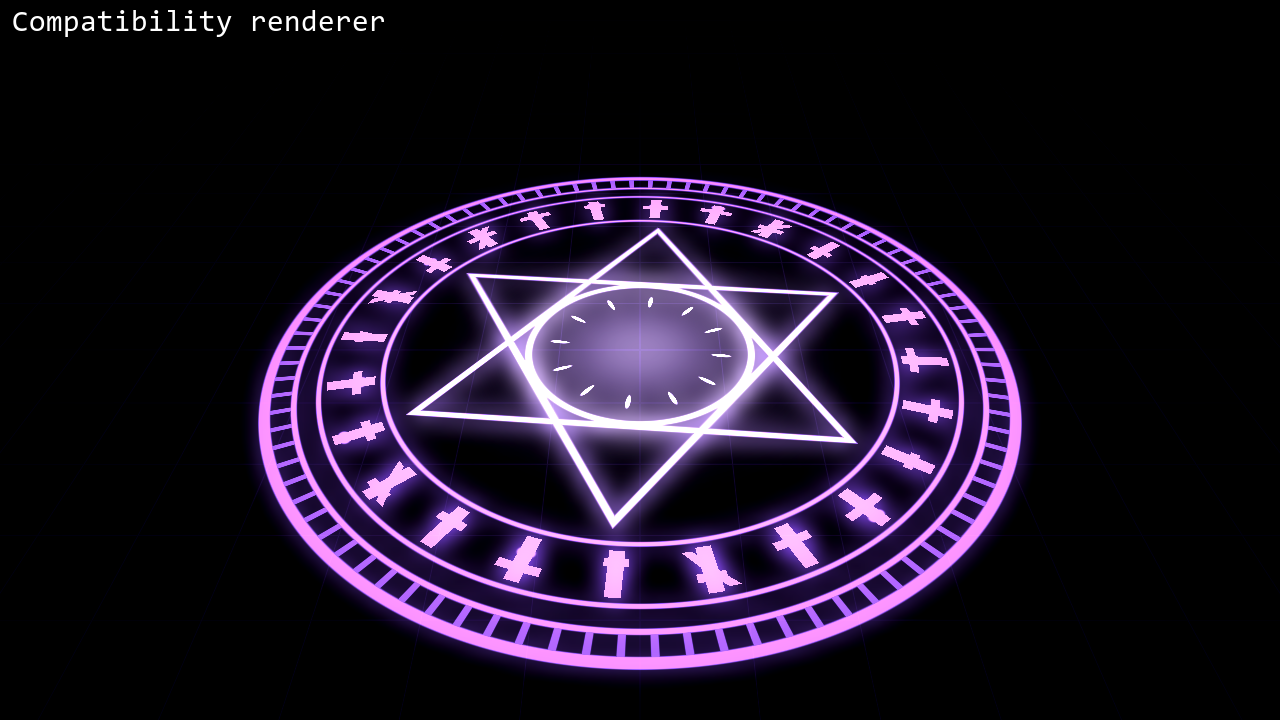

Comments 0
No comments yet.