
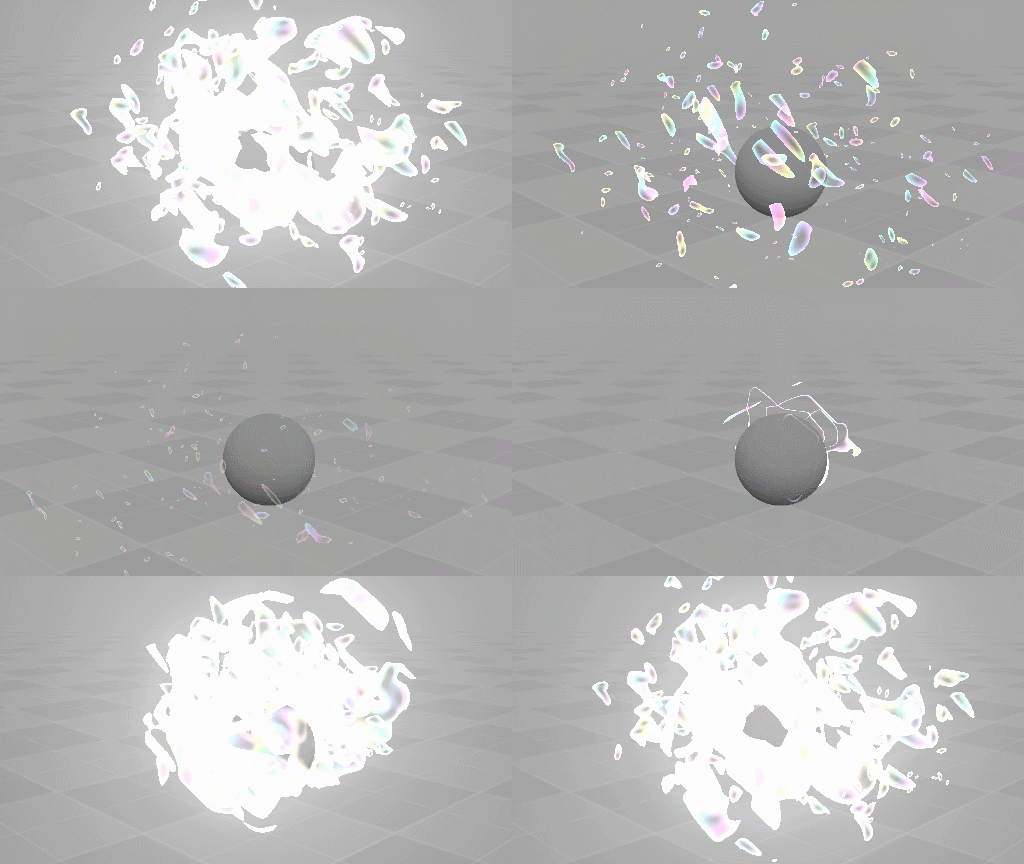
Procedural Metaballic Splash

This is a spatial shader designed to help you create all sorts of liquid esq effects. You just need to apply it to a quad-mesh and you’ll be golden! (Not really…)
After you apply the shader, you will be face to face with uniform hell. I’ve tried my best to document what all the uniforms do (hover the uniform in the inspector to see the tooltip, or read the code if you want). Here is more information about the shader (https://www.tumblr.com/alkaliii/796528066107228160/procedural-metaballic-splash?source=share)
Here are some values to get you started with the glass effect:
Open Animate
Start by setting ‘derive_progress’ to “Lifetime”
Set ‘ease_progress’ to “Ease Out”
Open Colorize
Set ‘shading’ to “Faux32”
Set ‘color_gradient’ to a GradientTexture1D. You want to start with white, transition into a hue, and then transition that hue into itself with no alpha. ( #ffffff@0.0 , #a3ffff@0.671 , #a3cfff00@1.0 )
Set ’emission_intensity’ to 1.5
Open Colorize>Iridescence
Set ‘apply_iridescence’ to “Smoothstep”
Set “iridescence’ to ( 2.0 , 0.0 , 0.0 , 1.0 )
Set “iridescence_size’ to 0.5
Open Particle Options
Set ‘particle_size’ to 0.025
Set ‘size_curve’ to a GradientTexture1D. Try and make it like a long slide. ( 0.0,0.0 -> 0.1,1.0 -> 1.0,0.0 )
Set ‘randomize_size’ to ( 1.0 , 5.0 )
Set ‘particle_feather’ to 0.5
Set ‘randomize_feather’ to ( 0.6 , 1.0 )
Set ‘feather_curve’ to a GradientTexture1D. Sorta a linear ramp up. ( 0.0,0.0 -> 0.9,1.0 )
Open System
Set ‘inital_particle_velocity” to -0.3
Set ‘ease_ipv’ to “Progress”
Enable ‘index_shift_randomness
Open System>Emission
Set ’emission_dir’ to ( 1.0 , 1.0 )
Set ‘acceleration’ to ( 0.5 , 0.5 , 0.1 , 0.1 )
Set ‘acceleration_curve’ to a GradientTexture1D. ( 0.35,0.0 (rt : 4.0) -> 1.0,0.5 )
Open Blobby
Set ‘blob_step’ to 0.01
Set ‘feather_interpolation’ to “Custom”
Set ‘custom_feather_interp’ to a GradientTexture1D. ( 0.0,0.0 -> 0.125,0.875 -> 0.25,0.8 -> 0.75,0.875 -> 0.875,0.625 -> 1.0,1.0 (lt : 3.0) )
Open Distortion
Set ‘uv_scale’ to ( 1.3 , 1.3 )
Open Distortion>Texture Distortion
Set ‘enable_texture_distortion’ to “A”
Set ‘txdistort_str’ to 0.1
Set ‘txdistort_a’ to seamless cellular noise. Disable FBM.
Set ‘index_shift_distort’ to “Yes”
Open Dissolve
Set ‘alpha_dissolve’ to “Step”
Set ‘ease_alpha_dissolve’ to “gcA”
Set ‘alpha_edge’ to ( 0.99 , 1.0 )
Open Dissolve>Proximity Fade
Set ‘proximity_fade_distance’ to 0.5
Open Vertex
Set ‘billboard’ to “Yes”
Set ‘camera_offset’ to 0.1
Open Curves
Set ‘generic_curve_a’ to a GradientTexture1D. Ease up sharp drop. ( 0.0,0.0 -> 0.95,1.0 (rt : -20.0) -> 1.0,0.0 (lt : -20.0)
—
This is supposed to be a general purpose shader. It’s capable of producing a varaity of looks if you wield it well! The effects you see on this page are produced with just this shader and a GPUParticles3D node spawning around 8 instances. This shader is not optimized and honestly a little on the heavy side. Sorry it’s a bit difficult to use!
If you have any questions, you can mention me on bsky! (@yoctosphere.bsky.social) or Discord (@aiwi).
Shader code
shader_type spatial;
render_mode unshaded, cull_disabled;

// procedural metaballic splash
// particle system in a shader that "clips" feathered particles to achieve a metaballic effect

/*
	Copyright 2025 Ali

	Permission is hereby granted, free of charge, to any person obtaining a copy of
	this software and associated documentation files (the “Software”), to deal in
	the Software without restriction, including without limitation the rights to use,
	copy, modify, merge, publish, distribute, sublicense, and/or sell copies of the
	Software, and to permit persons to whom the Software is furnished to do so,
	subject to the following conditions:

	The above copyright notice and this permission notice shall be included in all
	copies or substantial portions of the Software.

	THE SOFTWARE IS PROVIDED “AS IS”, WITHOUT WARRANTY OF ANY KIND, EXPRESS OR
	IMPLIED, INCLUDING BUT NOT LIMITED TO THE WARRANTIES OF MERCHANTABILITY,
	FITNESS FOR A PARTICULAR PURPOSE AND NONINFRINGEMENT. IN NO EVENT SHALL THE
	AUTHORS OR COPYRIGHT HOLDERS BE LIABLE FOR ANY CLAIM, DAMAGES OR OTHER LIABILITY,
	WHETHER IN AN ACTION OF CONTRACT, TORT OR OTHERWISE, ARISING FROM, OUT OF OR IN
	CONNECTION WITH THE SOFTWARE OR THE USE OR OTHER DEALINGS IN THE SOFTWARE.
*/

/** Toggle Front Culling. Front face will not appear. */
uniform bool front_cull = false;

/** Toggle Back Culling. Back face will not appear. */
uniform bool back_cull = false;

group_uniforms animate;

/**
	* This value animates the shader as it changes when [param derive_progress] == 1.
	* Modify it with an animation player or edit it from gdScript with:
	[code]material.set_shader_parameter("progress", new_value)[/code]
*/
uniform float progress : hint_range(0.0, 1.0, 0.001);

/**
	* Different ways to drive the shader's animation.
	* <0> [enum Time], Shader animates with global [constant TIME]
	* <1> [enum Progress], Shader animates with [param progress]
	* <2> [enum Lifetime], Shader animates with particle lifetime, [member INSTANCE_CUSTOM.y]
*/
uniform int derive_progress : hint_enum("Time","Progress","Lifetime") = 1;

/**
	* Different ways to interpolate the shader's animation.
	* <0> [enum Custom Ease], Use by setting a [CurveTexture] in [param custom_ease]
	* <1> [enum Ease In], Exponetial Ease In
	* <2> [enum Linear], Linear
	* <3> [enum Ease Out], Exponetial Ease Out
	* <4> [enum Ease In Out], Exponetial Ease In and Out
*/
uniform int ease_progress : hint_enum("Custom Ease","Ease In","Linear","Ease Out","Ease In Out") = 2;

/**
	* Set a [CurveTexture] here and change [param ease_progress] to 0.
	* The shader will sample the texture red channel to interpolate the animation.
*/
uniform sampler2D custom_ease : hint_default_white, filter_linear, repeat_disable;

/** Modifies animation length when [param derive_progress] == 1 */
uniform float time_scale : hint_range(0.0, 8.0, 0.01) = 1.0;

group_uniforms colorize;

/**
	* Shade the shader! This setting changes gray values for gradient mapping.
	* <0> [enum Flat], Shader will be a single color and will not graduate.
	* <1> [enum Faux], Shader will sorta graduate, Edges will be darker.
	* <2> [enum Faux8], Like previous, Edges will be even darker. [code]pow(Faux,8.0)[/code]
	* <3> [enum Faux32], Like previous, Edges will be dark. [code]pow(Faux,32.0)[/code]
	* <4> [enum Faux64], Like previous, Edges will be really dark. [code]pow(Faux,64.0)[/code]
	* <5> [enum Faux256], Like previous, Edges will be [b]very dark[/b]. [code]pow(Faux,256.0)[/code]
*/
uniform int shading : hint_enum("Flat", "Faux", "Faux8", "Faux32", "Faux64", "Faux256") = 0;

/**
	* Color the shader with gradient mapping!
	Set a [GradientTexture1D] here to sample from by gray value.
	By default the right-most color value will be used when [param shading] == 0
*/
uniform sampler2D color_gradient : source_color, hint_default_white, repeat_disable;

/** This value will shift how the shader samples [param color_gradient]. */
uniform float shift_gradient : hint_range(-1.0, 1.0, 0.1) = 0.0;

/** This value will shift how the shader samples [param color_gradient], when interpolation is 'finished'. */
uniform float final_shift_gradient : hint_range(-1.0, 1.0, 0.1) = 0.0;

/**
	* Control how the shader interpolates [param shift_gradient].
	<0> [enum No], Shader will not interpolate shift gradient.
	<1> [enum Progress], Shader will interpolate shift gradient using progress.
	<2>,<3>,<4>,<5> [enum gcN], Shader will interpolate shift gradient using specified [b]generic curve[/b].
*/
uniform int ease_shift_gradient : hint_enum("No", "Progress", "gcA", "gcB", "gcC", "gcD") = 0;

/**
	* This value will make the shader glow/darken.
	Works best when [member WorldEnvironment.Glow] is enabled.
*/
uniform float emission_intensity : hint_range(0.1, 16.0, 0.1) = 1.0;

/**
	* This value will posterize the shading resulting in value bands.
	A zero value will disable the calculation.
	A higher value will result in [i]less[/i] banding.
*/
uniform int chunky_color : hint_range(0, 100, 1) = 0;

group_uniforms colorize.iridescence;

/**
	* Control how the shader applies an iridescence effect to the image.
	<0> [enum No], Shader will not apply iridescence.
	<1> [enum Step], Shader will apply effect with hard edge.
	<2> [enum Smoothstep], Shader will apply effect with a soft edge.
	<3> [enum ValueStep], Shader will apply effect with a hard edge as a multiplier.
	<4> [enum ValueSmoothstep], Shader will apply effect with a soft edge as a multiplier.
*/
uniform int apply_iridescence : hint_enum("No", "Step", "Smoothstep", "ValueStep", "ValueSmoothstep") = 0;

/**
	* Control the features of the iridescence effect.
	X: Rainbow Brightness (sorta)
	Y: Edge 1 (Used in Step and Smoothstep)
	Z: Edge 2 (Used in Smoothstep)
	W: idk, scale sorta but different from [param iridescence_size]

	* Tips:
	While [param apply_iridescence] in [2,4] you can make Edge 1 greater than Edge 2 to have the effect begin from the inside.
*/
uniform vec4 iridescence = vec4(0.0,0.1,0.25,0.0); //X: rainbow amount, Y: Edge 1, Z: Edge 2, W: Calc (none,step,smoothstep)

/** Effect band size kinda... */
uniform float iridescence_size = 0.2;

/** Effect animation speed. This effect is driven by global time, [constant TIME]. */
uniform float iridescence_time_scale = 1.0;

group_uniforms colorize.chromatic_aberration;
// Note: Very heavy on performance.

/**
	* Control how the shader applies a chromatic aberration effect to the image.
	Warn (!), Very heavy on performance! (For loops are increased by a factor of [param chroma_samples]/2.0])
	<0> [enum No], Shader will not apply chromatic aberration.
	<1> [enum Linear], Shader will apply effect in a linear fashion.
	<2> [enum Radial], Shader will apply effect in a radial manner.
	<3> [enum Twist], Shader will apply effect with a twist.

	* Chroma is based on example by XOR
	@source: [url]https://mini.gmshaders.com/p/gm-shaders-mini-chromatic-aberration[/url]
*/
uniform int apply_chroma : hint_enum("No", "Linear", "Radial", "Twist");

/** Number of samples used to produce chroma effect. (More samples results in a smoother effect) */
uniform int chroma_samples : hint_range(0, 10, 2);

/** Distance between samples in effect. */
uniform vec2 chroma_offset = vec2(0.01);

group_uniforms particle_options;

/** Number of particles used in the effect. Less is usually more. */
uniform int particles : hint_range(0, 100, 1) = 25;

/** Size of the particles in the system. (Diameter) */
uniform float particle_size : hint_range(0.0, 1.0, 0.001) = 0.05;

/**
	* Set a [CurveTexture] here to change the particle size as the shader animates.
	[code]size_curve.r@animation_state * particle_size[/code]
*/
uniform sampler2D size_curve : hint_default_white, filter_linear, repeat_disable;

/**
	* Randomize particle sizes within this range.
	[code]mix(randomize_size.xy, rand(particle_index))[/code]
*/
uniform vec2 randomize_size = vec2(1.0);

/** Control how "soft" the particles are. Influences metaball behaviour. */
uniform float particle_feather : hint_range(0.0, 1.0, 0.001) = 0.05;

/**
	* Set a [CurveTexture] here to change the particle softness as the shader animates.
	[code]size_curve.r@animation_state * particle_feather[/code]
*/
uniform sampler2D feather_curve : hint_default_white, filter_linear, repeat_disable;

/**
	* Randomize particle softness within this range.
	[code]mix(randomize_size.xy, rand(particle_index))[/code]
*/
uniform vec2 randomize_feather = vec2(1.0);

/** Factor particle distance from (0,0) into it's appearance. */
uniform float factor_distance : hint_range(0.0, 1.0, 0.1) = 0.0;

/**
	* Control how distance is factored into particle appearance.
	X: Particles closer to (0.0) than X will not be impacted at all by [param factor_distance]
	Y: Particles farther from (0.0) than Y will be maximally impacted by [param factor_distance]
*/
uniform vec2 distance_edges = vec2(0.0,0.5);

group_uniforms particle_options.trail_options;

/** Add a faux trail to each particle. Not dynamically calculated. */
uniform int use_trail : hint_enum("No", "Yes") = 0;

/** Length of the trail. Can be interpolated between X and Y with [param ease_trail_length] */
uniform vec2 trail_length = vec2(1.0,0.0);

/**
	* Control how the shader interpolates [param trail_length].
	<0> [enum No], Shader will not interpolate trail length.
	<1> [enum Progress], Shader will interpolate trail length using progress.
	<2>,<3>,<4>,<5> [enum gcN], Shader will interpolate trail length using specified [b]generic curve[/b].
*/
uniform int ease_trail_length : hint_enum("No", "Progress", "gcA", "gcB", "gcC", "gcD") = 0;

/** Width of the trail. Can be interpolated between X and Y with [param ease_trail_width] */
uniform vec2 trail_width = vec2(0.1,0.0);

/**
	* Control how the shader interpolates [param trail_width].
	<0> [enum No], Shader will not interpolate trail width.
	<1> [enum Progress], Shader will interpolate trail width using progress.
	<2>,<3>,<4>,<5> [enum gcN], Shader will interpolate trail width using specified [b]generic curve[/b].
*/
uniform int ease_trail_width : hint_enum("No", "Progress", "gcA", "gcB", "gcC", "gcD") = 0;

/** Factor parent particle distance from (0,0) into trail appearance. */
uniform bool trail_factor_distance = false;

group_uniforms system;

/** Where the particle starts randomized with particle index and relative to [param emission_dir]. */
uniform float initial_particle_position = 0.02;

/** Toggle whether particles can appear on the "other side" of [param particle_origin]. */
uniform bool maintain_ip_domain = false;

/**
	* Inital particle velocity randomized with particle index.
	* Intended to influence particles at the beginning of the animation.
	* Can be interpolated with [param ease_ipv]
*/
uniform float initial_particle_velocity = 1.0;

/**
	* Control how the shader interpolates [param initial_particle_velocity].
	<0> [enum No], Shader will not interpolate.
	<1> [enum Progress], Shader will interpolate using progress.
	<2>,<3>,<4>,<5> [enum gcN], Shader will interpolate using specified [b]generic curve[/b].
*/
uniform int ease_ipv : hint_enum("No", "Progress", "gcA", "gcB", "gcC", "gcD") = 0;

/**
	* Control how the shader produces random values.
	<0> [enum BoSh] fract(sin(dot())) as described in the Book of Shaders
	@tutorial: [url]https://thebookofshaders.com/10/[/url]
	<1> [enum Sinless] fract() & dot() then fract(), an implementation by Dave Hoskins.
	@source: [url]https://www.shadertoy.com/view/4djSRWp[/url]
*/
uniform int randomness : hint_enum("BoSh", "Sinless") = 0;

/** Offset the randomness, the possibilities are finte, but varied! */
uniform int randomness_seed = 0;

/** Offset the randomness using particle index, [member INSTANCE_ID]. */
uniform int index_shift_randomness : hint_enum("No", "Yes") = 0;

group_uniforms system.emission;

/** Initial direction of particles, relative to a particle's [b]axis rotation[/b]. */
uniform vec2 emission_dir = vec2(0.0,1.0);

/** Particles will be emited with an axis rotation (in degrees) inbetween the negative and positive value here. */
uniform float emission_spread : hint_range(0.0, 180.0, 0.1) = 180.0;

/** Position particles start from. In this context, (0,0) is the center of the UV. */
uniform vec2 particle_origin = vec2(0.0);

/**
	* Particle velocity is influenced by this value over time.
	* Can be interpolated between XY and ZW with [param acceleration_curve].
	XY: Initial acceleration.
	ZW: Final accerlation.
*/
uniform vec4 acceleration = vec4(0.0,1.0,0.0,1.0);

/**
	* Set a [CurveTexture] here to interpolate acceleration as the shader animates.
	Note, acceleration is kinda borked and quirky. Try 0 -> 0.5 instead of 0 -> 1 on the Y.
*/
uniform sampler2D acceleration_curve : hint_default_black, filter_linear, repeat_disable;

group_uniforms blobby;

/** Metaballic threshold. Intended to control how gooey particles are in combination with [param particle_feather]. */
uniform float blob_step : hint_range(0.0, 1.0, 0.001) = 0.5;

/**
	* Control the [param particle_feather] falls off!
	<0> [enum Linear], doesn't work...
	<1> [enum Hermite], Feather falloff using Hermite (Smoothstep) interpolation.
	<2> [enum Cubic], doesn't work...
	<3> [enum Cosine], doesn't work...
	<4> [enum Custom], Feather falloff using curve defined in [param custom_feather_interp].
*/
uniform int feather_interpolation : hint_enum("Linear","Hermite","Cubic","Cosine","Custom") = 1;

/** Additional values to control [param feather_interpolation], when it is set to [enum Cubic]. */
uniform vec2 feather_cubic_handles = vec2(0.0,1.0);

/**
	* Set a [CurveTexture] here to define [param particle_feather] fall off.
	* This only works when [param feather_interpolation] == 4
	Note, a wavy line works well here.
*/
uniform sampler2D custom_feather_interp : hint_default_black, filter_linear, repeat_disable;

group_uniforms overlay;

/**
	* Control the addition of textures ontop of the image.
	<0> [enum No], Do not overlay.
	<1> [enum A*B*M], Overlays textures [b]A[/b], [b]B[/b], and [b]M[/b] ontop after multiplying them together.
	<2> [enum A&B*M], Overlays textures [b]A[/b], [b]B[/b], and [b]M[/b] ontop after mixing [b]A[/b] and [b]B[/b] and multiplying the result by [b]M[/b].
	<3> [enum A*B], Overlays textures [b]A[/b] & [b]B[/b] ontop after multiplying them together.
	<4> [enum A&B], Overlays textures [b]A[/b] & [b]B[/b] ontop after mixing them together.
	<5>,<6>,<7> [enum N], Overlays specified texture on it's own.
*/
uniform int enable_overlay : hint_enum("No","A*B*M","A&B*M","A*B","A&B","A","B","M");

/** Strength of the overlayed textures. */
uniform float overlay_str : hint_range(-3.0, 3.0, 0.001) = 1.0;

/** Set a texture here to use as an overlay. */
uniform sampler2D overlay_a : source_color, hint_default_white, filter_linear;

/**
	* Polarizes overlay A. (Polar Coordinates)
	XY: Polar center.
	Z: Polar zoom.
	W: Polar repetition.
*/
uniform vec4 polarize_overlay_a = vec4(0.5,0.5,0.6,0.0);

/**
	* Animates overlay A.
	XY: Scroll Direction.
	Z: Floor animation (Display rate).
	W: Animation Driver (0: None, 1: Time, 2: Progress, 3,4,5,6: gcN)
*/
uniform vec4 animate_overlay_a = vec4(0.0); //xy dir, z floor, w driver (none,time,progress,gcN)

/** Set a texture here to use as an overlay. */
uniform sampler2D overlay_b : source_color, hint_default_white, filter_linear;

/**
	* Polarizes overlay B. (Polar Coordinates)
	XY: Polar center.
	Z: Polar zoom.
	W: Polar repetition.
*/
uniform vec4 polarize_overlay_b = vec4(0.5,0.5,0.6,0.0);

/**
	* Animates overlay B.
	XY: Scroll Direction.
	Z: Floor animation (Display rate).
	W: Animation Driver (0: None, 1: Time, 2: Progress, 3,4,5,6: gcN)
*/
uniform vec4 animate_overlay_b = vec4(0.0); //xy dir, z floor, w driver (none,time,progress,gcN)

/** Set a texture here to use as an overlay mask. */
uniform sampler2D overlay_mask : source_color, hint_default_white, filter_linear;

/**
	* Polarizes overlay mask. (Polar Coordinates)
	XY: Polar center.
	Z: Polar zoom.
	W: Polar repetition.
*/
uniform vec4 polarize_overlay_mask = vec4(0.5,0.5,0.6,0.0);

/** Tweak overlay sharpness? [code]pow(N,sharpen_oabm.n)[/code] */
uniform vec3 sharpen_oabm = vec3(1.0);

/** Tweak overlay blending. */
uniform vec4 mix_oabm = vec4(vec3(1.0),0.5);

/** Offset A,B sample using particle index, [member INSTANCE_ID]. */
uniform int index_shift_overlay_texture : hint_enum("No", "Yes") = 0;

group_uniforms distortion;

/**
	* Strength of fisheye distortion.
	* Can be interpolated between X and Y with [param ease_fisheye]
*/
uniform vec2 fisheye = vec2(1.0,0.0);

/**
	* Control how the shader interpolates [param fisheye].
	<0> [enum No], Shader will not interpolate.
	<1> [enum Progress], Shader will interpolate using progress.
	<2>,<3>,<4>,<5> [enum gcN], Shader will interpolate using specified [b]generic curve[/b].
*/
uniform int ease_fisheye : hint_enum("No", "Progress", "gcA", "gcB", "gcC", "gcD") = 0;

/** Origin of fisheye distortion. */
uniform vec2 fisheye_origin = vec2(0.5);

/** UV is multiplied by this value, use it to zoom the image in or out. */
uniform vec2 uv_scale = vec2(1.0);

/** Amount (in degrees) to rotate the UV by. */
uniform float uv_rot : hint_range(-360.0, 360.0, 0.01) = 0.0;

group_uniforms distortion.texture_distortion;

/**
	* Control the distortion of UVs using textures.
	<0> [enum No], Do not distort.
	<1> [enum A*B*M], Distorts using textures [b]A[/b], [b]B[/b], and [b]M[/b] ontop after multiplying them together.
	<2> [enum A&B*M], Distorts using textures [b]A[/b], [b]B[/b], and [b]M[/b] ontop after mixing [b]A[/b] and [b]B[/b] and multiplying the result by [b]M[/b].
	<3> [enum A*B], Distorts using textures [b]A[/b] & [b]B[/b] ontop after multiplying them together.
	<4> [enum A&B], Distorts using textures [b]A[/b] & [b]B[/b] ontop after mixing them together.
	<5>,<6>,<7> [enum N], Distorts using specified texture on it's own.
*/
uniform int enable_texture_distortion : hint_enum("No","A*B*M","A&B*M","A*B","A&B","A","B","M");

/** Offsets original UV to counteract distortion offseting... sorta... */
uniform float distortion_fix = 2.0;

/** Strength of the texture distortion. */
uniform float txdistort_str : hint_range(-3.0, 3.0, 0.001) = 1.0;

/** Set a texture here to use for distortion. */
uniform sampler2D txdistort_a : source_color, hint_default_white, filter_linear;

/**
	* Polarizes tx Distort A. (Polar Coordinates)
	XY: Polar center.
	Z: Polar zoom.
	W: Polar repetition.
*/
uniform vec4 polarize_txdist_a = vec4(0.5,0.5,0.6,0.0);

/**
	* Animates tx Distort A.
	XY: Scroll Direction.
	Z: Floor animation (Display rate).
	W: Animation Driver (0: None, 1: Time, 2: Progress, 3,4,5,6: gcN)
*/
uniform vec4 animate_txdist_a = vec4(0.0);

/** Set a texture here to use for distortion. */
uniform sampler2D txdistort_b : source_color, hint_default_white, filter_linear;

/**
	* Polarizes tx Distort B. (Polar Coordinates)
	XY: Polar center.
	Z: Polar zoom.
	W: Polar repetition.
*/
uniform vec4 polarize_txdist_b = vec4(0.5,0.5,0.6,0.0);

/**
	* Animates tx Distort B.
	XY: Scroll Direction.
	Z: Floor animation (Display rate).
	W: Animation Driver (0: None, 1: Time, 2: Progress, 3,4,5,6: gcN)
*/
uniform vec4 animate_txdist_b = vec4(0.0);

/** Set a texture here to use as a distortion mask. */
uniform sampler2D txdistort_mask : source_color, hint_default_white, filter_linear;

/**
	* Polarizes distortion mask. (Polar Coordinates)
	XY: Polar center.
	Z: Polar zoom.
	W: Polar repetition.
*/
uniform vec4 polarize_txdist_mask = vec4(0.5,0.5,0.6,0.0);

/** Tweak distortion sharpness? [code]pow(N,sharpen_dabm.n)[/code] */
uniform vec3 sharpen_dabm = vec3(1.0);

/** Tweak texture distortion blending. */
uniform vec4 mix_dabm = vec4(vec3(1.0),0.5);

/** Offset A,B sample using particle index, [member INSTANCE_ID]. */
uniform int index_shift_distort_texture : hint_enum("No", "Yes") = 0;

group_uniforms dissolve;

/**
	* Control how the shader dissolves the image.
	<0> [enum No], Shader will not dissolve.
	<1> [enum Step], Shader dissolves with a hard edge.
	<2> [enum Smoothstep], Shader dissolves with a soft edge.
*/
uniform int alpha_dissolve : hint_enum("No", "Step", "Smoothstep") = 0;

//uniform int dissolve_with : hint_enum("Image","Textures") = 0;

/**
	 * Control how the shader interpolates the dissolving effect.
	<0> [enum Progress], Interpolate with progress.
	<1>,<2>,<3>,<4> [enum gcN], Interpolate with a [b]generic curve[/b].
*/
uniform int ease_alpha_dissolve : hint_enum("Progress", "gcA", "gcB", "gcC", "gcD") = 0;

/**
	* Control the alpha values the shader eases between. (smoothstep?)
	The difference between X and Y in this value should match [param blob_step] or be less than it.
*/
uniform vec2 alpha_edge = vec2(0.9,1.0);

//group_uniforms dissolve.texture_options;
// Couldn't get ts to work... maybe next shader
// Left some of the code in if you want to try and figure it out lol
///**
	//* Control dissolving the image with a texture.
	//<0> [enum No], Do not dissolve.
	//<1> [enum A*B*M], Dissolve using textures [b]A[/b], [b]B[/b], and [b]M[/b] ontop after multiplying them together.
	//<2> [enum A&B*M], Dissolve using textures [b]A[/b], [b]B[/b], and [b]M[/b] ontop after mixing [b]A[/b] and [b]B[/b] and multiplying the result by [b]M[/b].
	//<3> [enum A*B], Dissolve using textures [b]A[/b] & [b]B[/b] ontop after multiplying them together.
	//<4> [enum A&B], Dissolve using textures [b]A[/b] & [b]B[/b] ontop after mixing them together.
	//<5>,<6>,<7> [enum N], Dissolve using specified texture on it's own.
//*/
//uniform int enable_texture_dissolve : hint_enum("No","A*B*M","A&B*M","A*B","A&B","A","B","M");
//
/////** Strength of the overlayed textures. */
////uniform float overlay_str : hint_range(-3.0, 3.0, 0.001) = 1.0;
//
///** Set a texture here to use for dissolving. */
//uniform sampler2D txdissolve_a : source_color, hint_default_white, filter_linear;
//
///**
	//* Polarizes tx Dissolve A. (Polar Coordinates)
	//XY: Polar center.
	//Z: Polar zoom.
	//W: Polar repetition.
//*/
//uniform vec4 polarize_txdzolv_a = vec4(0.5,0.5,0.6,0.0);
//
///**
	//* Animates tx Dissolve A.
	//XY: Scroll Direction.
	//Z: Floor animation (Display rate).
	//W: Animation Driver (0: None, 1: Time, 2: Progress, 3,4,5,6: gcN)
//*/
//uniform vec4 animate_txdzolv_a = vec4(0.0); //xy dir, z floor, w driver (none,time,progress,gcN)
//
///** Set a texture here to use for dissolving. */
//uniform sampler2D txdissolve_b : source_color, hint_default_white, filter_linear;
//
///**
	//* Polarizes tx Dissolve B. (Polar Coordinates)
	//XY: Polar center.
	//Z: Polar zoom.
	//W: Polar repetition.
//*/
//uniform vec4 polarize_txdzolv_b = vec4(0.5,0.5,0.6,0.0);
//
///**
	//* Animates tx Dissolve B.
	//XY: Scroll Direction.
	//Z: Floor animation (Display rate).
	//W: Animation Driver (0: None, 1: Time, 2: Progress, 3,4,5,6: gcN)
//*/
//uniform vec4 animate_txdzolv_b = vec4(0.0); //xy dir, z floor, w driver (none,time,progress,gcN)
//
///** Set a texture here to use as a dissolve mask. */
//uniform sampler2D txdissolve_mask : source_color, hint_default_white, filter_linear;
//
///**
	//* Polarizes tx Dissolve mask. (Polar Coordinates)
	//XY: Polar center.
	//Z: Polar zoom.
	//W: Polar repetition.
//*/
//uniform vec4 polarize_txdzolv_mask = vec4(0.5,0.5,0.6,0.0);
//
///** Tweak dissolve sharpness? [code]pow(N,sharpen_oabm.n)[/code] */
//uniform vec3 sharpen_dzabm = vec3(1.0);
//
///** Tweak dissolve blending. */
//uniform vec4 mix_dzabm = vec4(vec3(1.0),0.5);
//
///** Offset A,B sample using particle index, [member INSTANCE_ID]. */
//uniform int index_shift_dissolve_texture : hint_enum("No", "Yes") = 0;

group_uniforms dissolve.proximity_fade;

/** Shader will fade when specified distance away from something in depth buffer. */
uniform float proximity_fade_distance = 0.0;

/** Adds faux depth to the proximity fade calulation. */
uniform float proximity_fade_offset = 0.9;
uniform sampler2D depth_texture : hint_depth_texture, repeat_disable, filter_nearest;

/** How to calculate the faux depth, see [param Shading]. */
uniform int pf_offset_calculation : hint_range(0, 5, 1) = 3;

group_uniforms vertex;

/**
	* Control how the mesh follows the camera.
	<0> [enum No], Mesh will not billboard.
	<1> [enum Yes], Mesh will billboard.
	<2> [enum Y], Mesh will billboard on the Y axis.
	<3> [enum Local Y], Mesh will billboard on it's local Y axis. (acts weird with scaling...?)
*/
uniform int billboard : hint_enum("No", "Yes", "Y", "Local Y") = 0;

/** Move the mesh towards or away from the camera. */
uniform float camera_offset = 0.0;

/** Offset the mesh from it's center point. */
uniform vec3 mesh_offset = vec3(0.0);

/** Offset the mesh from it's center point, when interpolation is 'finished'. */
uniform vec3 final_mesh_offset = vec3(0.0);

/**
	* Control how the shader interpolates between [param mesh_offset] and [param final_mesh_offset].
	<0> [enum No], Shader will not interpolate.
	<1> [enum Progress], Shader will interpolate using progress.
	<2>,<3>,<4>,<5> [enum gcN], Shader will interpolate using specified [b]generic curve[/b].
*/
uniform int ease_mesh_offset : hint_enum("No", "Progress", "gcA", "gcB", "gcC", "gcD") = 0;

/** Randomly rotate mesh using particle index, [member INSTANCE_ID]. */
uniform vec3 index_rand_mesh_rot = vec3(0.0);

/** math stuff. [param index_rand_mesh_rot] will function differently. */
uniform bool maintain_irm_domain = false;

/** Rotate the mesh the shader is applied to in XYZ axis by the specified amount in degrees. */
uniform vec3 mesh_rotation = vec3(0.0);

/**
	* Control how the shader drives rotation.
	<0> [enum Nothing], Shader will not interpolate.
	<1> [enum Time], Shader will drive using global time, [constant TIME].
	<2> [enum Progress], Shader will drive using progress, [param progress].
*/
uniform int animate_mesh_rot_with : hint_enum("Nothing", "Time", "Progress") = 0;//, "gcA", "gcB", "gcC", "gcD") = 0;

/** Speed mesh will rotate with on axis. */
uniform vec3 animate_mesh_rotation = vec3(0.0);

/** Set a texture here to use when displacing vertices. */
uniform sampler2D vertex_displacement_mask : hint_default_black;

/** How much vertices are displaced on each axis. */
uniform vec3 vertex_displacement_str = vec3(0.0);

/** How much vertices are displaced on each axis, when interpolation is 'finished'. */
uniform vec3 final_vertex_displacement_str = vec3(1.0);

/**
	* Control how the shader interpolates between [param vertex_displacement_str] and [param final_vertex_displacement_str].
	<0> [enum No], Shader will not interpolate.
	<1> [enum Progress], Shader will interpolate using progress.
	<2>,<3>,<4>,<5> [enum gcN], Shader will interpolate using specified [b]generic curve[/b].
*/
uniform int ease_vert_disp_str_with : hint_enum("Nothing", "Time", "Progress", "gcA", "gcB", "gcC", "gcD") = 0;

group_uniforms curves;

/** Set a curve texture here to define a new interpolation based on [param derive_progress]. */
uniform sampler2D generic_curve_A : hint_default_black, filter_linear, repeat_disable;

/** Set a curve texture here to define a new interpolation based on [param derive_progress]. */
uniform sampler2D generic_curve_B : hint_default_black, filter_linear, repeat_disable;

/** Set a curve texture here to define a new interpolation based on [param derive_progress]. */
uniform sampler2D generic_curve_C : hint_default_black, filter_linear, repeat_disable;

/** Set a curve texture here to define a new interpolation based on [param derive_progress]. */
uniform sampler2D generic_curve_D : hint_default_black, filter_linear, repeat_disable;

varying float LIFETIME;
varying float INDEX;
varying flat int pid;

float random(vec2 uv) {
	// provides a random number given a vec2
	// seed setup sucks lol
	float seed = float(randomness_seed) / PI;
	if (index_shift_randomness == 1) {seed += float(pid);}
	switch (randomness) {
		case 0:
			return fract(sin(dot(uv.xy,vec2(12.9898 + seed,78.233))) * 43758.5453123 + seed);
		case 1:
			// https://www.shadertoy.com/view/4djSRW
			vec3 p3  = fract(vec3(uv.xyx + seed) * .1031);
			p3 += dot(p3, p3.yzx + 33.33);
			return fract((p3.x + p3.y) * p3.z + seed);
	}
}

float grayscale(vec3 rgb, int type) {
	// average
	if (type == 1) {
		return (rgb.r + rgb.g + rgb.b) / 3.0;
	}
	// weighted
	const float rw = 0.299;
	const float gw = 0.587;
	const float bw = 0.114;
	rgb *= vec3(rw,gw,bw);
	return rgb.r + rgb.g + rgb.b;
}

float remap(float value, vec2 original, vec2 new) {
	return original.y + (value - original.x) * (new.y - original.y) / (new.x - original.x);
}

vec2 spherize(vec2 uv, vec2 center, float strength, vec2 offset) {
	// https://godotshaders.com/shader/uv-spherize/
	// Вектор от центра искажения к текущим UV
	vec2 delta = uv - center;
	// Квадрат длины вектора delta (эквивалент length(delta)^2)
	float delta2 = dot(delta.xy, delta.xy);
	// delta4 — четвёртая степень расстояния (усиливает искажение ближе к краям)
	float delta4 = delta2 * delta2;
	// Смещение вектора delta в зависимости от delta4 и силы
	vec2 delta_offset = vec2(delta4, delta4) * strength;
	// Добавляем искажение и смещение
	return uv + (delta * delta_offset) + offset;
}

vec2 polar_coordinates(vec2 uv, vec2 center, float zoomm, float repeat) {
	vec2 dir = uv - center;
	float radius = length(dir) * 2.0;
	float angle = atan(dir.y, dir.x) * 1.0/(3.1416 * 2.0);
	return mod(vec2(radius * zoomm, angle * repeat), 1.0);
}

float customstep(sampler2D interp,float edge0,float edge1,float value) {
	float t = clamp((value - edge0)/(edge1 - edge0),0.0,1.0);
	return texture(interp,vec2(t,0.0)).r;
}

float cosinestep(float edge0, float edge1, float value) {
	// https://paulbourke.net/miscellaneous/interpolation/
	float v2 = (1.0-cos(value * PI) / 2.0);
	return mix(edge0,edge1,v2);
}

float cubicstep(float edge0, float edge1, vec2 handles, float value) {
	// https://paulbourke.net/miscellaneous/interpolation/
	float a0,a1,a2,a3,v2;
	v2 = value * value;
	a0 = handles.y - edge1 - handles.x + edge0;
	a1 = handles.x - edge0 - a0;
	a2 = edge1 - handles.x;
	a3 = edge0;
	return (a0*value*v2+a1*v2+a2*value+a3);
}

vec2 scale(vec2 uv, float x, float y) {
	mat2 scalee = mat2(vec2(x, 0.0), vec2(0.0, y));
	uv -= 0.5;
	uv = uv * scalee;
	uv += 0.5;
	return uv;
}

vec2 rotate(vec2 uv, vec2 pivot, float angle) {
	mat2 rotation = mat2(vec2(sin(angle), -cos(angle)),
						vec2(cos(angle), sin(angle)));
	uv -= pivot;
	uv = uv * rotation;
	uv += pivot;
	return uv;
}

mat3 rotateX(float theta) {
	float cosa = cos(theta);
	float sina = sin(theta);

	mat3 rotate_x  = mat3(
	   vec3(1.0, 0.0, 0.0),
	   vec3(0.0, cosa, -sina),
	   vec3(0.0, sina, cosa)
	);
	return rotate_x;
}

mat3 rotateY(float theta) {
	float cosa = cos(theta);
	float sina = sin(theta);

	mat3 rotate_y  = mat3(
	   vec3(cosa, 0.0, sina),
	   vec3(0.0, 1.0, 0.0),
	   vec3(-sina, 0.0, cosa)
	);
	return rotate_y;
}

mat3 rotateZ(float theta) {
	float cosa = cos(theta);
	float sina = sin(theta);

	mat3 rotate_z  = mat3(
	   vec3(cosa,-sina, 0.0),
	   vec3(sina, cosa, 0.0),
	   vec3(0.0, 0.0, 1.0)
	);
	return rotate_z;
}

float easeInOutExpo(float x) {
	float result;
	if (x <= 0.0) {result = 0.0;}
	else if (x >= 1.0) {result = 1.0;}
	else if (x < 0.5) {result = pow(2.0, 20.0 * x - 10.0) / 2.0;}
	else {result = (2.0 - pow(2.0, -20.0 * x + 10.0)) / 2.0;}
	return result;
}

float get_progress() {
	float p;
	float final;
	if (derive_progress == 2) {p = LIFETIME;}
	else if (derive_progress == 0) {p = mod(TIME * time_scale,1.0);}
	// abs(sin(TIME * time_scale)) [Back and Forth]
	// mod(TIME * time_scale,1.0) [Over and Over]
	else {p = progress;}

	if (ease_progress == 4) {final = easeInOutExpo(p);} //EASE IN OUT (2.0)
	else if (ease_progress == 0) {final = texture(custom_ease,vec2(p,0.0)).r;} //CUSTOM EASE (-2.0)
	else if (ease_progress == 3) {final = 1.0 - pow(2.0, -10.0 * p);} //EASE OUT (1.0)
	else if (ease_progress == 1) {final = pow(2.0, 10.0 * p - 10.0);} //EASE IN (-1.0)
	else {final = p;}

	return final;
}

float get_eased_valuef(sampler2D ease, float init, float final) {
	float sample = texture(ease,vec2(get_progress(),0.0)).r;
	return mix(init,final,sample);
}

vec2 get_eased_valuev2(sampler2D ease, vec2 init, vec2 final) {
	float sample = texture(ease,vec2(get_progress(),0.0)).r;
	return mix(init,final,sample);
}

vec3 get_eased_valuev3(sampler2D ease, vec3 init, vec3 final) {
	float sample = texture(ease,vec2(get_progress(),0.0)).r;
	return mix(init,final,sample);
}

//vec4 get_eased_valuev4(sampler2D ease, vec4 init, vec4 final) {
	//float sample = texture(ease,vec2(get_progress(),0.0)).r;
	//return mix(init,final,sample);
//}

struct Particle2D {
	// data for particles, mostly used to calculate a position
	vec2 acceleration; // sampled from a curve
	vec2 inital_velocity; // provided on config (usually 0)
	vec2 inital_position; // provided on config (usually 0)
	vec2 velocity; // calculated with inital_velocity + (acceleration * change in time)
	vec2 position; // calculated with inital_position + (d=v*t)
	mat4 draw_info;
};

vec2 get_emission_dir() {
	switch (ease_ipv) {
		case 0: return normalize(emission_dir);
		case 1: return normalize(emission_dir) * get_progress();
		case 2: return get_eased_valuev2(generic_curve_A,normalize(emission_dir),vec2(0.0));
		case 3: return get_eased_valuev2(generic_curve_B,normalize(emission_dir),vec2(0.0));
		case 4: return get_eased_valuev2(generic_curve_C,normalize(emission_dir),vec2(0.0));
		case 5: return get_eased_valuev2(generic_curve_D,normalize(emission_dir),vec2(0.0));
	}
}

Particle2D make_p2d(float inital_vel, float inital_pos) {
	// creates a new particle with decent inits quickly
	return Particle2D(
		get_eased_valuev2(acceleration_curve,acceleration.xy,acceleration.zw),
		get_emission_dir() * inital_vel,normalize(emission_dir) * inital_pos,vec2(0.0),vec2(0.0),mat4(0.0));
}

Particle2D get_p2d(Particle2D p2d) {
	// updates data in given particle and returns it
	p2d.velocity = p2d.inital_velocity + (p2d.acceleration * get_progress());
	p2d.position = p2d.inital_position + (p2d.velocity * get_progress());
	return p2d;
}

//float cutout_operate(float main, float cut, int apply_cutout) {
	//cut = clamp(1.0-cut,0.0,1.0);
	//switch (apply_cutout) {
		//case 0: return main;
		//case 1: return main - cut;
		//case 2: return main + cut;
	//}
//}

float circle(vec2 uv,float radius,float feather) {
	float d = length(uv - vec2(0.5));
	float c = 1.0;
	switch (feather_interpolation) {
		case 0: c = mix(radius, radius + feather, d); break;
		case 2: c = cubicstep(radius, radius + feather, feather_cubic_handles, d); break; //broken
		case 3: c = cosinestep(radius, radius + feather, d); break; //broken
		case 4: c = customstep(custom_feather_interp, radius, radius + feather, d); break;
		default: c = smoothstep(radius, radius + feather, d); break;
	}
	return c;
}

//float simplecircle(vec2 uv,float radius,float feather) {
	//float d = length(uv - vec2(0.5));
	//float c = smoothstep(radius, radius + feather, d);
	//return c;
//}
//
//float cutcircle(vec2 uv,float radius,float feather, vec3 cps) {
	//// cps, cut position & size (size is a percent)
	//float circ = circle(uv,radius,feather);
	//float cut = simplecircle(uv + (cps.xy * radius),radius * cps.z,feather * cps.z);
	//return cutout_operate(circ,cut,2);
//}


float sdSegment(vec2 p,vec2 a,vec2 b,float feather) {
	// draws a line
	p += 0.5;
	vec2 pa = p-a, ba = b-a;
	float h = clamp(dot(pa,ba)/dot(ba,ba), 0.0, 1.0);
	float d = length(pa - ba*h);
	return clamp(smoothstep(0.0,feather,d),0.0,1.0);
}

vec3 get_mesh_offset() {
	switch (ease_mesh_offset) {
		case 0: return mesh_offset;
		case 1: return mix(mesh_offset,final_mesh_offset,get_progress());
		case 2: return get_eased_valuev3(generic_curve_A,mesh_offset,final_mesh_offset);
		case 3: return get_eased_valuev3(generic_curve_B,mesh_offset,final_mesh_offset);
		case 4: return get_eased_valuev3(generic_curve_C,mesh_offset,final_mesh_offset);
		case 5: return get_eased_valuev3(generic_curve_D,mesh_offset,final_mesh_offset);
	}
}

vec3 get_vertex_disp_amt() {
	switch (ease_vert_disp_str_with) {
		case 0: return vertex_displacement_str;
		case 1: return mix(vertex_displacement_str,final_vertex_displacement_str,get_progress());
		case 2: return get_eased_valuev3(generic_curve_A,vertex_displacement_str,final_vertex_displacement_str);
		case 3: return get_eased_valuev3(generic_curve_B,vertex_displacement_str,final_vertex_displacement_str);
		case 4: return get_eased_valuev3(generic_curve_C,vertex_displacement_str,final_vertex_displacement_str);
		case 5: return get_eased_valuev3(generic_curve_D,vertex_displacement_str,final_vertex_displacement_str);
	}
}

vec3 get_animated_mesh_rotation() {
	switch (animate_mesh_rot_with) {
		case 0: return vec3(0.0);
		case 1: return radians(animate_mesh_rotation) * TIME;
		case 2: return radians(animate_mesh_rotation) * get_progress();
		//case 3: return animate_mesh_rotation
	}
}

void vertex() {
	// Called for every vertex the material is visible on.
	LIFETIME = INSTANCE_CUSTOM.y;
	INDEX = float(INSTANCE_ID);
	pid = int(INDEX);

	float r = random(vec2(float(pid)));
	float r2 = (random(vec2(float(pid))) - 0.5) * 2.0;

	VERTEX += get_mesh_offset();
	VERTEX += texture(vertex_displacement_mask,UV).r * get_vertex_disp_amt();

	vec3 rot_rand = radians(index_rand_mesh_rot) * r2;
	if (maintain_irm_domain) { rot_rand = radians(index_rand_mesh_rot) * r;}
	vec3 rotation_offset = radians(mesh_rotation) + get_animated_mesh_rotation() + rot_rand;

	mat3 rotation_matrix = rotateX(rotation_offset.x) * rotateY(rotation_offset.y) * rotateZ(rotation_offset.z);
	VERTEX *= rotation_matrix;
	NORMAL *= rotation_matrix;

	if (billboard == 1) { //Global billboard
		MODELVIEW_MATRIX = VIEW_MATRIX * mat4(INV_VIEW_MATRIX[0], INV_VIEW_MATRIX[1], INV_VIEW_MATRIX[2], MODEL_MATRIX[3]);
	} if (billboard == 2) { //Global Y billboard
		MODELVIEW_MATRIX = VIEW_MATRIX * mat4(vec4(normalize(cross(vec3(0.0, 1.0, 0.0), INV_VIEW_MATRIX[2].xyz)), 0.0), vec4(0.0, 1.0, 0.0, 0.0), vec4(normalize(cross(INV_VIEW_MATRIX[0].xyz, vec3(0.0, 1.0, 0.0))), 0.0), MODEL_MATRIX[3]);
	} if (billboard == 3) { //Local Y billboard, Kalcen - https://godotshaders.com/shader/local-space-y-billboard-shader/
		vec3 local_up = MODEL_MATRIX[1].xyz;
		//cross of:
		//	local_transform.basis.y     and    to_world(view_space.forward)
		//normalized
		//(represents right direction)
		vec4 ax = vec4(normalize(cross(local_up, INV_VIEW_MATRIX[2].xyz)), 0.0);
		//local_transform.basis.y
		//(represents up direction)
		vec4 ay = vec4(local_up.xyz, 0.0);
		//cross of:
		//	to_world(view_space.right)    and    local_transform.basis.y
		//(represents forward direction)
		vec4 az = vec4(normalize(cross(INV_VIEW_MATRIX[0].xyz, local_up)), 0.0);
		MODELVIEW_MATRIX = VIEW_MATRIX * mat4(ax, ay, az, MODEL_MATRIX[3]);
		MODELVIEW_NORMAL_MATRIX = mat3(MODELVIEW_MATRIX);
	}
	MODELVIEW_MATRIX = MODELVIEW_MATRIX * mat4(vec4(length(MODEL_MATRIX[0].xyz), 0.0, 0.0, 0.0), vec4(0.0, length(MODEL_MATRIX[1].xyz), 0.0, 0.0), vec4(0.0, 0.0, length(MODEL_MATRIX[2].xyz), 0.0), vec4(0.0, 0.0, 0.0, 1.0));

	// Camera Offset
	VERTEX += camera_offset * normalize((inverse(MODELVIEW_MATRIX) * vec4(0.0, 0.0, 1.0, 0.0)).xyz);
}

vec4 rainbow(float light_offset, float sin_frequency, float rtime_scale) {
	float t = dot(TIME,8.0) + fract(float(pid));
	vec4 animated_color = vec4(light_offset + sin(2.0*3.14*sin_frequency*(t*rtime_scale)),
	light_offset + sin(2.0*3.14*sin_frequency*(t*rtime_scale) + radians(120.0)),
	light_offset + sin(2.0*3.14*sin_frequency*(t*rtime_scale) + radians(240.0)),
	1.0);
	return animated_color;
}

float get_fisheye() {
	switch (ease_fisheye) {
		case 0: return fisheye.x;
		case 1: return mix(fisheye.x,fisheye.y,get_progress());
		case 2: return get_eased_valuef(generic_curve_A,fisheye.x,fisheye.y);
		case 3: return get_eased_valuef(generic_curve_B,fisheye.x,fisheye.y);
		case 4: return get_eased_valuef(generic_curve_C,fisheye.x,fisheye.y);
		case 5: return get_eased_valuef(generic_curve_D,fisheye.x,fisheye.y);
	}
}

vec2 get_trail_options() {
	float tl = 1.0;
	float tw = 1.0;
	switch (ease_trail_length) {
		case 0: tl = trail_length.x; break;
		case 1: tl = mix(trail_length.x,trail_length.y,get_progress()); break;
		case 2: tl = get_eased_valuef(generic_curve_A,trail_length.x,trail_length.y); break;
		case 3: tl = get_eased_valuef(generic_curve_B,trail_length.x,trail_length.y); break;
		case 4: tl = get_eased_valuef(generic_curve_C,trail_length.x,trail_length.y); break;
		case 5: tl = get_eased_valuef(generic_curve_D,trail_length.x,trail_length.y); break;
	} switch (ease_trail_width) {
		case 0: tw = trail_width.x; break;
		case 1: tw = mix(trail_width.x,trail_width.y,get_progress()); break;
		case 2: tw = get_eased_valuef(generic_curve_A,trail_width.x,trail_width.y); break;
		case 3: tw = get_eased_valuef(generic_curve_B,trail_width.x,trail_width.y); break;
		case 4: tw = get_eased_valuef(generic_curve_C,trail_width.x,trail_width.y); break;
		case 5: tw = get_eased_valuef(generic_curve_D,trail_width.x,trail_width.y); break;
	}
	return vec2(1.0-tl,clamp(tw,0.0,99.0));
}

float get_alpha_dissolve_driver() {
	switch (ease_alpha_dissolve) {
		case 0: return 1.0-get_progress();
		case 1: return texture(generic_curve_A,vec2(get_progress(),0.0)).r;
		case 2: return texture(generic_curve_B,vec2(get_progress(),0.0)).r;
		case 3: return texture(generic_curve_C,vec2(get_progress(),0.0)).r;
		case 4: return texture(generic_curve_D,vec2(get_progress(),0.0)).r;
	}
}

float get_shift_gradient() {
	switch (ease_shift_gradient) {
		case 0: return shift_gradient;
		case 1: return mix(shift_gradient,final_shift_gradient,get_progress());
		case 2: return get_eased_valuef(generic_curve_A,shift_gradient,final_shift_gradient);
		case 3: return get_eased_valuef(generic_curve_B,shift_gradient,final_shift_gradient);
		case 4: return get_eased_valuef(generic_curve_C,shift_gradient,final_shift_gradient);
		case 5: return get_eased_valuef(generic_curve_D,shift_gradient,final_shift_gradient);
	}
}

float get_shading(float original, int profile) {
	switch (profile) {
		case 0: return 1.0;
		case 1: return original;
		case 2: return pow(original,8.0);
		case 3: return pow(original,32.0);
		case 4: return pow(original,64.0);
		case 5: return pow(original,256.0);
	}
}

vec2 get_animated_uv(vec2 uv, vec4 animate) {
	vec2 nc = uv;
	float driver = get_progress();
	switch (int(floor(abs(animate.w)))) {
		case 0: driver = 1.0; break;
		case 1: driver = TIME; break;
		case 2: driver = get_progress(); break;
		case 3: driver = texture(generic_curve_A,vec2(get_progress(),0.0)).r; break;
		case 4: driver = texture(generic_curve_B,vec2(get_progress(),0.0)).r; break;
		case 5: driver = texture(generic_curve_C,vec2(get_progress(),0.0)).r; break;
		case 6: driver = texture(generic_curve_D,vec2(get_progress(),0.0)).r; break;
	}
	vec2 anim = animate.xy * driver;
	if (animate.z > 0.0) {anim = animate.xy * (floor(driver * animate.z)/animate.z);}
	nc += anim;
	return nc;
}

float get_transformed_sampler(vec2 uv, sampler2D sample, vec4 polarize, vec4 animate) {
	vec2 plruv = uv;
	if (polarize.w > 0.0) {plruv = polar_coordinates(uv,polarize.xy,polarize.z,polarize.w);}
	plruv = get_animated_uv(plruv,animate);
	float o = texture(sample,plruv).r;
	return o;
}

float get_overlay(vec2 uv) {
	vec2 is;
	if (index_shift_overlay_texture == 1) {
		is = vec2(
			random(vec2(float(pid),float(-pid))),
			random(vec2(float(-pid),float(pid)))
		);}
	else {is = vec2(0.0);}

	float a = get_transformed_sampler(uv + is,overlay_a,polarize_overlay_a,animate_overlay_a);
	float b = get_transformed_sampler(uv - is,overlay_b,polarize_overlay_b,animate_overlay_b);
	float m = get_transformed_sampler(uv,overlay_mask,polarize_overlay_mask,vec4(0.0));
	a = pow(a,sharpen_oabm.x) * mix_oabm.x;
	b = pow(b,sharpen_oabm.y) * mix_oabm.y;
	m = pow(m,sharpen_oabm.z) * mix_oabm.z;
	switch (enable_overlay) {
		case 0: return 0.0;
		case 1: return (a * b * m) * overlay_str;
		case 2: return (mix(a,b,mix_oabm.w) * m) * overlay_str;
		case 3: return (a*b) * overlay_str;
		case 4: return (mix(a,b,mix_oabm.w)) * overlay_str;
		case 5: return a * overlay_str;
		case 6: return b * overlay_str;
		case 7: return m * overlay_str;
	}
}

float get_distortion(vec2 uv) {
	vec2 is;
	if (index_shift_distort_texture == 1) {
		is = vec2(
			random(vec2(float(pid),float(-pid))),
			random(vec2(float(-pid),float(pid)))
		);}
	else {is = vec2(0.0);}

	float a = get_transformed_sampler(uv - is,txdistort_a,polarize_txdist_a,animate_txdist_a);
	float b = get_transformed_sampler(uv + is,txdistort_b,polarize_txdist_b,animate_txdist_b);
	float m = get_transformed_sampler(uv,txdistort_mask,polarize_txdist_mask,vec4(0.0));
	a = pow(a,sharpen_dabm.x) * mix_dabm.x;
	b = pow(b,sharpen_dabm.y) * mix_dabm.y;
	m = pow(m,sharpen_dabm.z) * mix_dabm.z;
	float d = 0.0;
	switch (enable_texture_distortion) {
		case 0: d = 0.0; break;
		case 1: d = (a * b * m); break;
		case 2: d = (mix(a,b,mix_dabm.w) * m); break;
		case 3: d = (a*b); break;
		case 4: d = (mix(a,b,mix_dabm.w)); break;
		case 5: d = a; break;
		case 6: d = b; break;
		case 7: d = m; break;
	}
	return d;
}

//float get_dissolve(vec2 uv) {
	//vec2 is;
	//if (index_shift_dissolve_texture == 1) {
		//is = vec2(
			//random(vec2(float(pid),float(-pid))),
			//random(vec2(float(-pid),float(pid)))
		//);}
	//else {is = vec2(0.0);}
	//
	//float a = get_transformed_sampler(uv - is,txdissolve_a,polarize_txdzolv_a,animate_txdzolv_a);
	//float b = get_transformed_sampler(uv + is,txdissolve_b,polarize_txdzolv_b,animate_txdzolv_b);
	//float m = get_transformed_sampler(uv,txdissolve_mask,polarize_txdzolv_mask,vec4(0.0));
	//a = pow(a,sharpen_dzabm.x) * mix_dzabm.x;
	//b = pow(b,sharpen_dzabm.y) * mix_dzabm.y;
	//m = pow(m,sharpen_dzabm.z) * mix_dzabm.z;
	//float d = 0.0;
	//switch (enable_texture_dissolve) {
		//case 0: d = 0.0; break;
		//case 1: d = (a * b * m); break;
		//case 2: d = (mix(a,b,mix_dzabm.w) * m); break;
		//case 3: d = (a*b); break;
		//case 4: d = (mix(a,b,mix_dzabm.w)); break;
		//case 5: d = a; break;
		//case 6: d = b; break;
		//case 7: d = m; break;
	//}
	//return d;
//}

float create_image(vec2 uv) {
	// creates the "splash"
	float image = 1.0;
	Particle2D[100] pArr;
	for (int i = 0; i < particles; i++) {
		float prog = get_progress();
		float r = (random(vec2(float(i))) - 0.5) * 2.0;
		float r2 = random(vec2(float(i)));
		float ip = (random(vec2(float(i),0.0)) - 0.5) * 2.0 * initial_particle_position;
		if (maintain_ip_domain) ip = random(vec2(float(i),0.0)) * initial_particle_position;
		float iv = random(vec2(0.0,float(i))) * initial_particle_velocity;// - 0.5) * 2.0;
		Particle2D p = get_p2d(make_p2d(iv,ip));
		vec2 puv = rotate(uv,vec2(0.5),(radians(emission_spread) * r) + radians(90.0));

		float df = 1.0;
		if (factor_distance > 0.0) {
			df = 1.0-smoothstep(distance_edges.x,distance_edges.y,length(p.position));
			df /= factor_distance;
		}

		float ips = particle_size;
		ips *= mix(min(randomize_size.x,randomize_size.y),max(randomize_size.x,randomize_size.y),r2);
		ips *= df;
		float ps = (ips/2.0) * texture(size_curve,vec2(prog,0.0)).r;

		float ipf = particle_feather;
		ipf *= mix(min(randomize_feather.x,randomize_feather.y),max(randomize_feather.x,randomize_feather.y),r2);
		ipf *= df;
		float pf = ipf * texture(feather_curve,vec2(prog,0.0)).r;

		float circ = circle(puv + p.position, ps, pf);
		//float foam = cutcircle(puv + p.position, ps, pf, vec3(0.0,0.0,0.06));
		//circ -= foam * 0.01;
		float line = 1.0;
		if (use_trail == 1) {
			vec2 twl = get_trail_options();
			if (trail_factor_distance) {twl *= df;}
			line = sdSegment(puv,1.0-p.position,1.0-p.position * twl.x,pf*twl.y);
		}
		p.draw_info[0].xy = puv + p.position;
		p.draw_info[0].zw = vec2(ps,pf);
		p.draw_info[1].x = (radians(emission_spread) * r) + radians(90.0);
		p.draw_info[2].xy = puv;
		p.draw_info[2].zw = p.position;
		pArr[i] = p;

		image *= clamp(circ*line,0.0,1.0);
		//image *= circ;
		//image *= line;
	}
	return image;
}

float process_image(float image, float ovly) {
	// additional modifications to the "splash", mostly clipping and shading
	float original_image = 1.0-image;
	if (blob_step > 0.0) {
		image = step(image,blob_step);
	} else {image = 1.0-image;}
	image += mix(0.0,ovly,image);

	//ALBEDO = vec3(image);//vec3(circle(UV,0.125,0.01));
	float col = get_shading(original_image, shading);
	if (chunky_color > 0) {col = floor(col * float(chunky_color)) / float(chunky_color);}
	return col;
	//vec4 _color = texture(color_gradient,vec2(col + get_shift_gradient(),0.0));
}

float blob_image(float image) {
	// clips image
	if (blob_step > 0.0) {
		image = step(image,blob_step);
	} else {image = 1.0-image;}
	return image;
}

void fragment() {
	// Called for every pixel the material is visible on.
	if (front_cull && FRONT_FACING) {discard;}
    if (back_cull && !FRONT_FACING) {discard;}

	// Get transformed UV
	vec2 moduv = rotate(scale(UV,1.0/uv_scale.x,1.0/uv_scale.y),vec2(0.5),radians(uv_rot) + radians(90.0));
	vec2 uv = spherize(moduv,fisheye_origin,get_fisheye(),vec2(0.0)) + particle_origin;
	float d = get_distortion(UV);
	if (enable_texture_distortion != 0) {uv -= vec2(txdistort_str) / distortion_fix;}
	uv += txdistort_str * d;

	float ovly = get_overlay(uv);
	//vec2 puv;

	// Draw
	float image = create_image(uv);
	float col = process_image(image,ovly);
	float original_image = 1.0-image;

	// Chromatic Aberration
	// Super bad for performance lol and not that cool honestly due to how alpha works in this shader...
	//https://mini.gmshaders.com/p/gm-shaders-mini-chromatic-aberration
	if (apply_chroma != 0 && chroma_samples != 0) {
		vec4 chroma_sum = vec4(0.0);
		vec4 weight_sum = vec4(0.0);
		vec2 chroma_uv = uv;//scale(uv,0.01,0.01)-0.5;
		for (float i = 0.0; i <= 1.0; i += 1.0/float(chroma_samples)) {
			vec2 ca_uv;
			switch (apply_chroma) {
				case 1: ca_uv = chroma_uv + (i-0.5) * chroma_offset; break;
				case 2: ca_uv = mix(chroma_uv,vec2(0.5),(i-0.5) * chroma_offset); break;
				case 3: ca_uv = chroma_uv + vec2(chroma_uv.y-0.5,0.5-chroma_uv.x) * (i-0.5) * chroma_offset; break;
			}
			vec4 ca_color = vec4(process_image(create_image(ca_uv),ovly));
			vec4 ca_weight = vec4(
				i, //R
				1.0-abs(i*2.0-1.0), //G
				1.0-i, //B
				0.5 //A
			);
			chroma_sum += ca_color * ca_color * ca_weight;
			weight_sum += ca_weight;
		}
		vec4 chroma_split = sqrt(chroma_sum/weight_sum);
		col = grayscale(chroma_split.rgb,0);
		ALBEDO.rgb = chroma_split.rgb;
		ALPHA = chroma_split.a;
	}

	// Gradient Mapping
	vec4 _color = texture(color_gradient,vec2(col + get_shift_gradient(),0.0));

	// Iridescence stuff
	//(polar_coordinates(UV,vec2(0.5),iridescence_size,1.0)) + vec2(TIME * (sin(TIME) + 1.0) * (0.0001 * iridescence_time_scale),0.0)) * 0.005
	vec2 _rainpc = polar_coordinates(UV-0.5*2.0,vec2(0.5),iridescence_size,iridescence.w-(cos(TIME * 0.2 * iridescence_time_scale) + 1.0)) + vec2(0.0,(sin(TIME * 0.2 * iridescence_time_scale) + 1.0));
	vec4 _rainbowcol = rainbow(iridescence.x,abs(length(_rainpc) * 0.001),1.0);
	float _rcut = 1.0; //1.0-step(blob_step + 0.25,1.0-col);
	switch (apply_iridescence) {
		case 0:
			ALBEDO *= _color.rgb;
			break;
		case 1:
			_rcut = 1.0-step(blob_step + iridescence.y,1.0-col);
			ALBEDO *= mix(_rainbowcol.rgb,_color.rgb,_rcut);
			break;
		case 2:
			_rcut = 1.0-smoothstep(iridescence.y,blob_step + iridescence.z,1.0-col);
			ALBEDO *= mix(_rainbowcol.rgb,_color.rgb,_rcut);
			break;
		case 3:
			_rcut = step(blob_step + iridescence.y,1.0-col);
			ALBEDO *= mix(grayscale(_rainbowcol.rgb,0)+_color.rgb,_color.rgb,1.0-_rcut);
			break;
		case 4:
			_rcut = 1.0-smoothstep(iridescence.y,blob_step + iridescence.z,1.0-col);
			ALBEDO *= mix(grayscale(_rainbowcol.rgb,0)+_color.rgb,_color.rgb,_rcut);
			break;
	}
	//ALBEDO *= mix(_rainbowcol.rgb,_color.rgb,_rcut);
	//mix(rainbow(0.5,0.5,1.0).rgb,_color.rgb,length(UV));
	ALBEDO *= emission_intensity;

	// Alpha stuff
	float image_alpha = blob_image(image);
	//float edge_diff = max(alpha_edge.x,alpha_edge.y) - min(alpha_edge.x,alpha_edge.y);
	float _dissolver = original_image;// / image2 / image3;
	//if (dissolve_with == 0) {_dissolver = original_image;}
	//else {_dissolver = get_dissolve(UV) + (1.0-original_image);}
	switch (alpha_dissolve) {
		case 1:
			image_alpha = 1.0-step(_dissolver,remap(get_alpha_dissolve_driver(),vec2(0.0,1.0),alpha_edge.yx));
			break;
		case 2:
			image_alpha = smoothstep(remap(get_alpha_dissolve_driver(),vec2(0.0,1.0),alpha_edge.yx),1.,_dissolver);
			break;
	}
	image_alpha += mix(0.0,ovly,image_alpha);
	ALPHA *= image_alpha * COLOR.a;
	if (shading != 0) {ALPHA *= _color.a;}

	// Proximity Fade
	float depth_tex = textureLod(depth_texture,SCREEN_UV,0.0).r;
	vec4 world_pos = INV_PROJECTION_MATRIX * vec4(SCREEN_UV*2.0-1.0,depth_tex,1.0);
	world_pos.xyz/=world_pos.w;
	ALPHA *= clamp(1.0-smoothstep(world_pos.z+proximity_fade_distance,world_pos.z,VERTEX.z - (1.0-get_shading(original_image, pf_offset_calculation) * proximity_fade_offset)),0.0,1.0);
}

//void light() {
//	// Called for every pixel for every light affecting the material.
//	// Uncomment to replace the default light processing function with this one.
//}
Live Preview

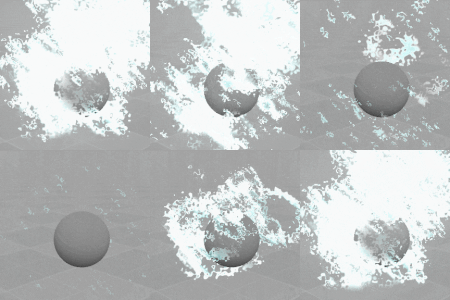
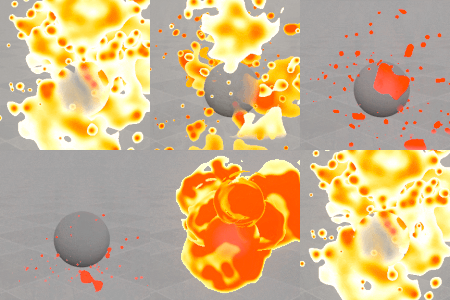
Very nice and very versatile. As said, it is a bit difficult to use and a lot of uniforms to wrap ones head around. It is also a bit heavy (the editor stutters sometimes when selecting a node that has this shader). But it is also very useful. I’ve used it to make a good looking blood splatter effect and I’m currently trying to make a sort of “water splash” for when a character jumps into water.
A great complement to the existing particle systems. Thanks for this!