Starfield Parallax Shader
✨ Starfield Parallax Shader
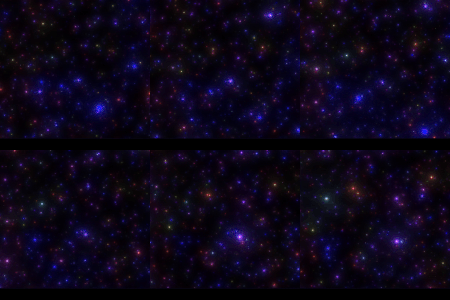
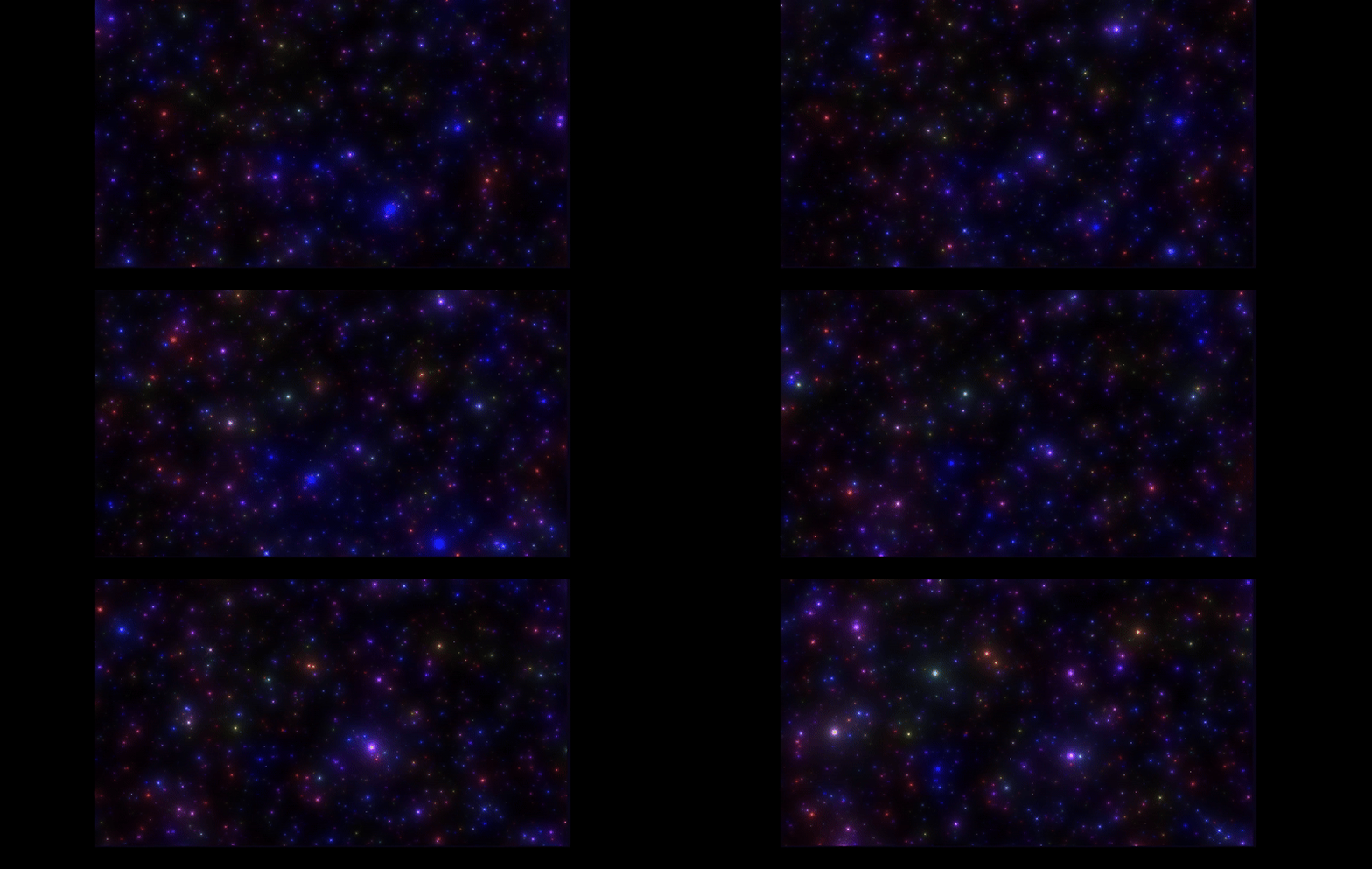
A dynamic and visually rich 2D shader that generates a deep, twinkling starfield with smooth parallax scrolling. Ideal for space-themed scenes in games or interactive media, this shader simulates depth by layering multiple star fields that move at different speeds.
📜 Description
This shader procedurally creates a field of stars that sparkle, shift color subtly, and animate with time. Each layer moves independently, giving a sense of 3D depth in a purely 2D space. The result is a mesmerizing space environment with minimal performance cost and no texture dependencies.
🔧 Features
-
Procedural star placement and coloring
-
Multi-layer parallax with smooth blending
-
Animated twinkling stars with customizable flare
-
Fully GPU-driven (no textures or CPU logic)
-
Works in
canvas_itemshaders (Godot 4.x)
🙏 Credits
This shader is adapted from a tutorial by Martijn Steinrucken, known as The Art of Code on YouTube.
All core logic, structure, and visual ideas are based on his work.
This version is provided for educational and non-commercial use within the Godot Engine.
Shader code
/**
 * Starfield Shader
 *
 * This shader is adapted from a tutorial by Martijn Steinrucken,
 * also known as "The Art of Code" on YouTube.
 *
 * All credits for the concept and implementation go to Martijn.
 * This code is shared here for educational and non-commercial purposes.
 *
 * Original tutorial: https://www.youtube.com/c/TheArtofCodeIsCool
 *
 * Shader type: canvas_item (2D)
 */

shader_type canvas_item;

uniform vec2 VIEWPORT_SIZE = vec2(1280, 720);

#define NUM_LAYERS 8.0

mat2 Rot(float theta) {
    float cosa = cos(theta);
    float sina = sin(theta);

    return mat2(
        vec2(cosa, -sina),
        vec2(sina,  cosa)
    );
}

float Star(vec2 uv, float flare) {
    float d = length(uv);
    float m = .02 / d;

    float rays = max(0.0, 1.0 - abs(uv.x * uv.y * 10000.0));
    m += rays * flare;
    uv *= Rot(PI / 4.0);
    rays = max(0.0, 1.0 - abs(uv.x * uv.y * 10000.0));
    m += rays * 0.3 * flare;

    m *= smoothstep(1.0, 0.2, d);
    return m;
}

float Hash21(vec2 p) {
    p = fract(p * vec2(123.23, 456.34));
    p += dot(p, p + 45.45);
    return fract(p.x * p.y);
}

vec3 StarLayer(vec2 uv) {
    vec3 col = vec3(0.0);

    vec2 gv = fract(uv) - 0.5;
    vec2 id = floor(uv);

    for (int y = -1; y <= 1; y++) {
        for (int x = -1; x <= 1; x++) {
            vec2 offset = vec2(float(x), float(y));
            float n = Hash21(id + offset);
            float size = fract(n * 534.0);
            float star = Star(gv - offset - vec2(n - 0.5, fract(n * 165.0) - 0.5), smoothstep(0.9, 0.1, size) * 1.0);
            vec3 colors = sin(vec3(0.2, 0.3, 0.9) * fract(n * 2434.0) * 123.0) * 0.5 + 0.5;
            colors *= vec3(1.0, 0.5, 1.0 + size);
            star *= sin(TIME * 3.0 + n * 18.3) * 0.5 + 1.0;
            col += star * size * colors;
        }
    }

    return col;
}

void fragment() {
    vec2 fragCoord = UV * VIEWPORT_SIZE;
    vec2 uv = (fragCoord - 0.5 * VIEWPORT_SIZE) / VIEWPORT_SIZE.y;
    float t = TIME * 0.05;
    uv *= Rot(t);

    vec3 col = vec3(0.0);

    for (float i = 0.0; i < 1.0; i += 1.0 / NUM_LAYERS) {
        float depth = fract(i + t);
        float scale = mix(20.0, 0.5, depth);
        float fade = depth * smoothstep(1.0, 0.9, depth);
        col += StarLayer(uv * scale + i * 343.0) * fade;
    }

    COLOR = vec4(col, 1.0);
}
Live Preview