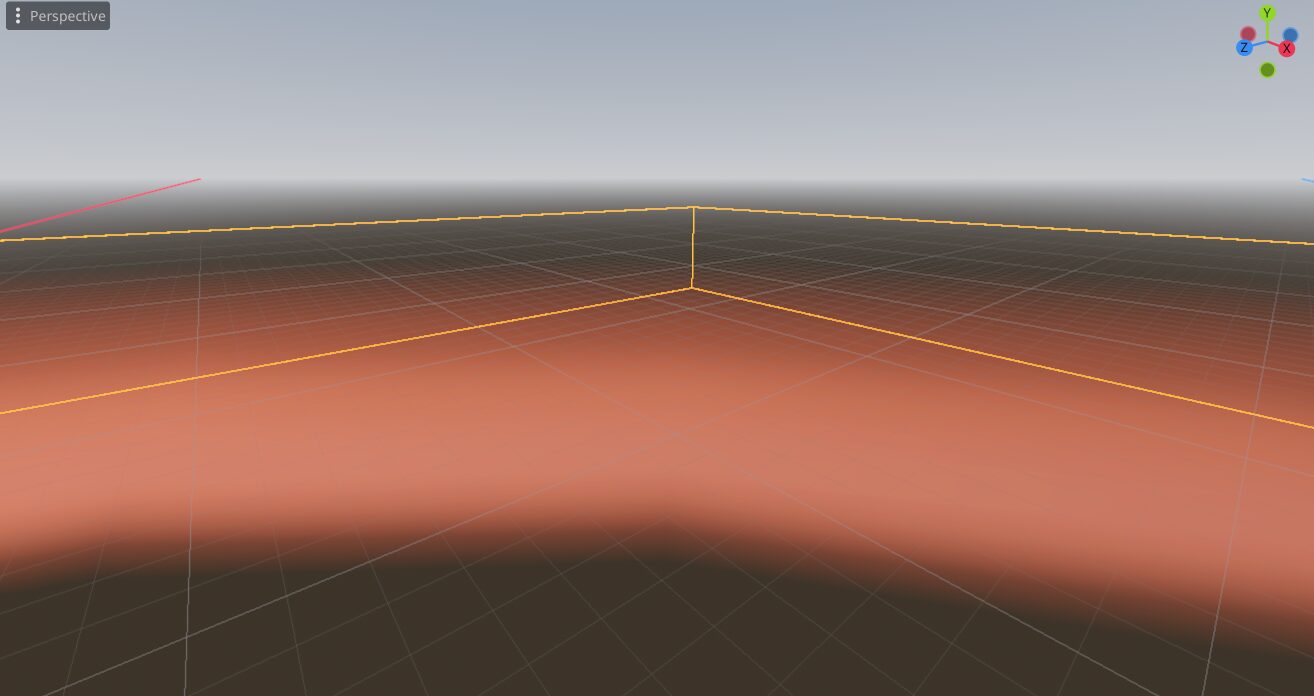
Synty Core Drop-in “Particles” Shader (Generic_ParticlesUnlit)

Synty assets use an analogue of this shader in Unity to emulate far particle movement and efficient horizon haze effects. This shader replicates the behavior of the Unity one close as possible, but due to different handling of color and transparency in the distance, you mayneed to tweak settings and colors to achieve the exact same looks.
Shader code
/******************************************************************
Generic_ParticleUnlit = Synty models transparency shader for Godot.
(C) Copyright 2025 - Giancarlo Niccolai
Published under MIT licence.

# Overview

Synty assets use an analogue of this shader in Unity to emulate far
particle movement and efficient horizon haze effects. This shader
replicates the behavior of the Unity one close as possible, but due to
different handling of color and transparency in the distance, you may
need to tweak settings and colors to achieve the exact same looks.

## Fog density

Godot and Unity have a different way to handle fog. The Unity sahder
uses the local fog density to allow the shaders to fade objects
accordingly; this is usually not necessary in Godot as fog is computed
by the engine after the shaders have run. In case it's needed, I added
a **fog_density** setting, that is applied to the shader just like the
value Unity would have provided.

For distant objects, it can just be set statically, if strictluy necessary;
for objects emerging from the fog, it should be dynamically set by a script.

*/
shader_type spatial;
render_mode blend_mix;

uniform float alpha_clip_treshold: hint_range(0.0, 1.0) = 0.5;
uniform vec4 base_color: source_color = vec4(1.0);
uniform sampler2D albedo_map: source_color, filter_linear_mipmap;
uniform vec2 tiling = vec2(1.0);
uniform vec2 offset = vec2(0.0);

uniform bool enable_soft_particles = true;
uniform float soft_power: hint_range(0.0, 10.0) = 2.0;
uniform float soft_distance: hint_range(0.0, 2.0) = 0.1;
uniform bool use_view_edge_compensation = false;
uniform float view_edge_power = 1.0;
uniform bool enable_camera_fade = false;
uniform float camera_fade_near = 0.0;
uniform float camera_fade_far = 20.0;
uniform float camera_fade_smoothness: hint_range(0.0, 100.0) = 1.5;
uniform bool enable_scene_fog = false;

uniform sampler2D DEPTH_TEXTURE : hint_depth_texture, filter_linear_mipmap;

// Fog color (alpha = density)
uniform vec4 fog_color = vec4(1.0, 1.0, 1.0, 0.0);

float scene_depth(vec2 screen_uv, mat4 inv_prj) {
	// Sample nonlinear scene depth (closest opaque surface)
	float raw_depth = texture(DEPTH_TEXTURE, screen_uv).r;

	// Reconstruct NDC (adjust for renderer)
    vec3 ndc;
    #if CURRENT_RENDERER == RENDERER_COMPATIBILITY
    ndc = vec3(screen_uv * 2.0 - 1.0, raw_depth * 2.0 - 1.0);
    #else  // Forward+/Mobile (default, reversed-Z)
    ndc = vec3(screen_uv * 2.0 - 1.0, raw_depth);
    #endif

    // Transform to view space and get linear depth
    vec4 view_pos = inv_prj * vec4(ndc, 1.0);
    view_pos.xyz /= view_pos.w;
	return -view_pos.z; // Positive distance from camera
}

float remap(float value, vec2 in_minmax, vec2 out_minmax) {
    return out_minmax.x + (value - in_minmax.x) * (out_minmax.y - out_minmax.x) / (in_minmax.y - in_minmax.x);
}

void fragment() {

	vec3 pos_world = (INV_VIEW_MATRIX * vec4(VERTEX, 1.0)).xyz;
	float cam_dist = length(pos_world - CAMERA_POSITION_WORLD);
	float eye_depth = scene_depth(SCREEN_UV, INV_PROJECTION_MATRIX);

	if (use_view_edge_compensation) {
		float view_edge_comp = view_edge_power * (1.0 - VIEW.z);
		eye_depth += view_edge_comp;
	}

	float soft_fade = 1.0;
	if(enable_soft_particles) {
		soft_fade = pow(clamp((eye_depth - cam_dist) * (soft_distance / 10.0), 0.0, 1.0), soft_power);
	}

	float camera_fade = 1.0;
	if (enable_camera_fade) {
		float camera_near = remap(cam_dist, vec2(camera_fade_near, camera_fade_near * camera_fade_smoothness), vec2(0.0, 1.0));
		float camera_far = remap(cam_dist, vec2(camera_fade_far * camera_fade_smoothness, camera_fade_far), vec2(0.0, 1.0));
		camera_fade = clamp(camera_near, 0.0, 1.0) * clamp(camera_far, 0.0, 1.0);
	}

	float fade_factor = soft_fade * camera_fade;
	vec4 albedo_color = base_color * texture(albedo_map, UV * tiling + offset);
	float albedo_alpha = albedo_color.a;
	float alpha = albedo_alpha * fade_factor * COLOR.a;
	if (alpha < alpha_clip_treshold) discard;

	if (enable_scene_fog) {
		albedo_color = mix(fog_color, albedo_color, fog_color.a);
	}

	ALBEDO = albedo_color.rgb;
	ALPHA = alpha;
	ROUGHNESS = 1.0;
}
Live Preview