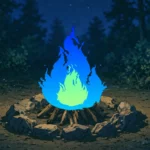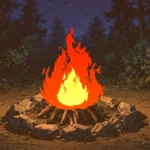
Anime Style Fire 2D
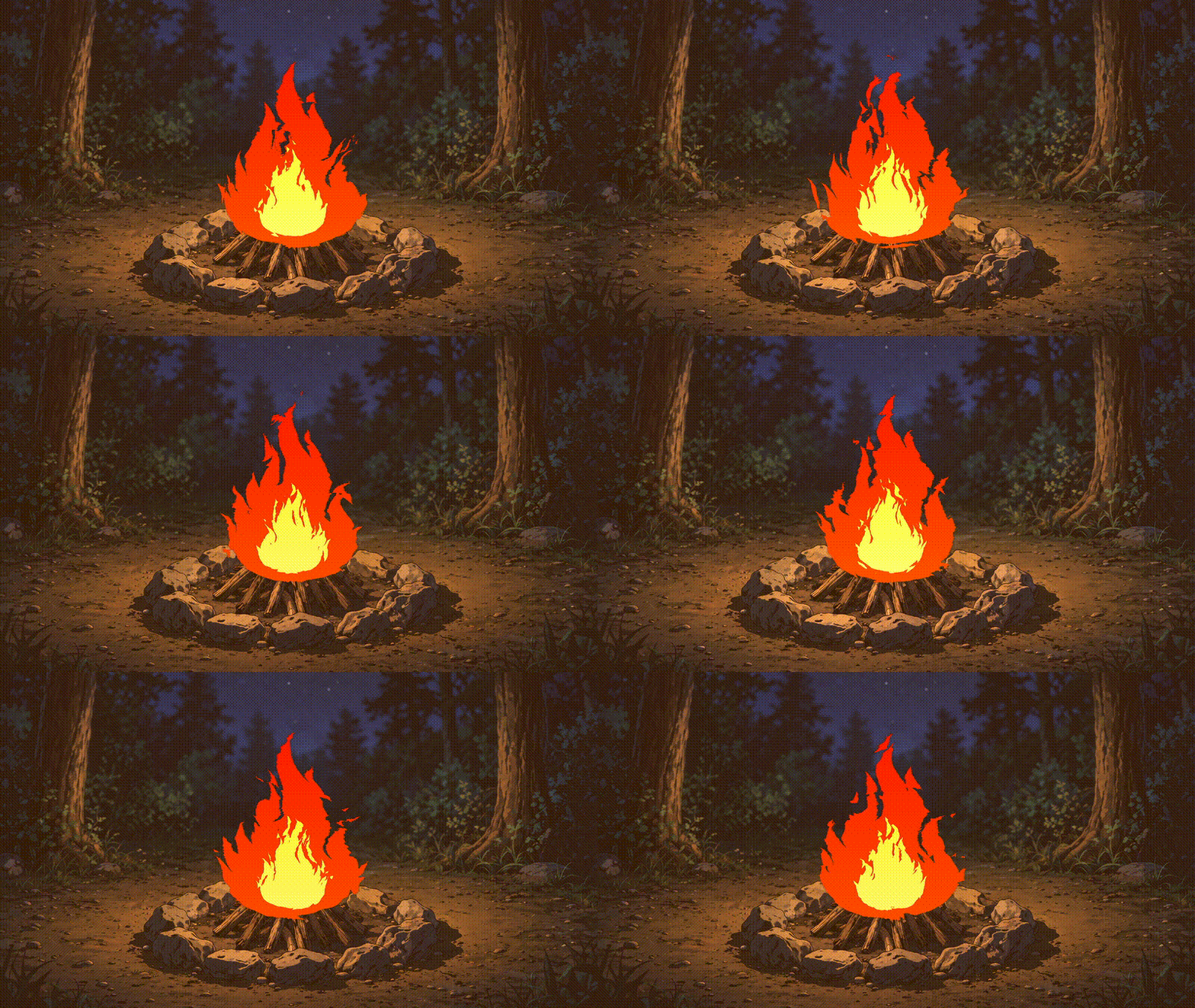
A 2D anime style fire.
You’ll need some textures for this, you can find them in the full example on my github. There is also some material maker files included that will help you to create these kind of textures. The example also includes a very simple postpo “light flickering + tint” shader.
If you want to create your own textures, or understand how this shader works, you can find more details in the video on my youtube channel (its AI dubbed).
Hope you’ll like 🔥
Inspired by:
https://github.com/CasualGarageCoder/godot-flame
https://www.youtube.com/watch?v=IcYq5ijWCVs
Shader code
shader_type canvas_item;

// enable/disable custom (low) fps
#define USE_CUSTOM_FPS 1

// enable/disalbe distortion exclusion mask
#define USE_DISTORTION_EXCLUSION_MASK 1

uniform float speed = 0.5;
uniform float normal_scl_out = 1.5;
uniform float normal_scl_in = 2.0;
uniform float noise_scl_out = 0.4;
uniform float noise_scl_in = 0.2;
uniform float distortion_scl_out = 0.10;
uniform float distortion_scl_in = 0.08;
#if USE_DISTORTION_EXCLUSION_MASK
uniform float mask_force : hint_range(0.0, 1.0) = 0.6;
#endif
#if USE_CUSTOM_FPS
uniform float fps = 12.0;
#endif

uniform sampler2D draw_tex;
uniform sampler2D normal_tex : repeat_enable;
uniform sampler2D noise_tex : repeat_enable;
#if USE_DISTORTION_EXCLUSION_MASK
uniform sampler2D mask_tex;
#endif

uniform vec4 color_out_a : source_color = vec4(1.0, 0.0, 0.0, 1.0);
uniform vec4 color_out_b : source_color = vec4(1.0, 0.25, 0.0, 1.0);
uniform vec4 color_in_a : source_color = vec4(1.0, 1.0, 0.0, 1.0);
uniform vec4 color_in_b : source_color = vec4(1.0, 1.0, 0.5, 1.0);

void fragment() {
	// get UVs
	vec2 uv_out = UV;
	vec2 uv_in = UV;

#if USE_CUSTOM_FPS
	float t = floor(TIME * fps) / fps;
#else
	float t = TIME;
#endif

	uv_out.y += t * speed;
	uv_in.y += (0.5 + t) * speed;

	// sample noise
	vec2 noi_out = (texture(noise_tex, uv_out * noise_scl_out).rg * 2.0) - 1.0;
	vec2 noi_in = (texture(noise_tex, uv_in * noise_scl_in).rg * 2.0) - 1.0;

	// sample normal map
	vec4 nrm_out = texture(normal_tex, (uv_out * normal_scl_out) + noi_out.xy);
	vec4 nrm_in = texture(normal_tex, (uv_in * normal_scl_in) + noi_in.xy);
	nrm_out.xyz = nrm_out.xyz * 2.0 - 1.0;
	nrm_in.xyz = nrm_in.xyz * 2.0 - 1.0;

	// compute distorted UVs
	vec2 distorted_uv_out = UV + vec2(nrm_out.x, -nrm_out.y) * distortion_scl_out;
	vec2 distorted_uv_in = UV + vec2(nrm_in.x, -nrm_in.y) * distortion_scl_in;

#if USE_DISTORTION_EXCLUSION_MASK
	// get distortion exclusion mask
	float msk = texture(mask_tex, UV).r * mask_force;

	// compute final distortion UVs
	vec2 final_uv_out = mix(distorted_uv_out, UV, msk);
	vec2 final_uv_in = mix(distorted_uv_in, UV, msk);
#else
	vec2 final_uv_out = distorted_uv_out;
	vec2 final_uv_in = distorted_uv_in;
#endif

	// get inside and outside masks
	float outside = texture(draw_tex, final_uv_out).r;
	float inside = texture(draw_tex, final_uv_in).g;

	// compute final color
	vec4 final_color = outside * mix(color_out_a, color_out_b, UV.y);
	final_color = mix(final_color, mix(color_in_a, color_in_b, UV.y), inside);

	COLOR = final_color;
}
Live Preview