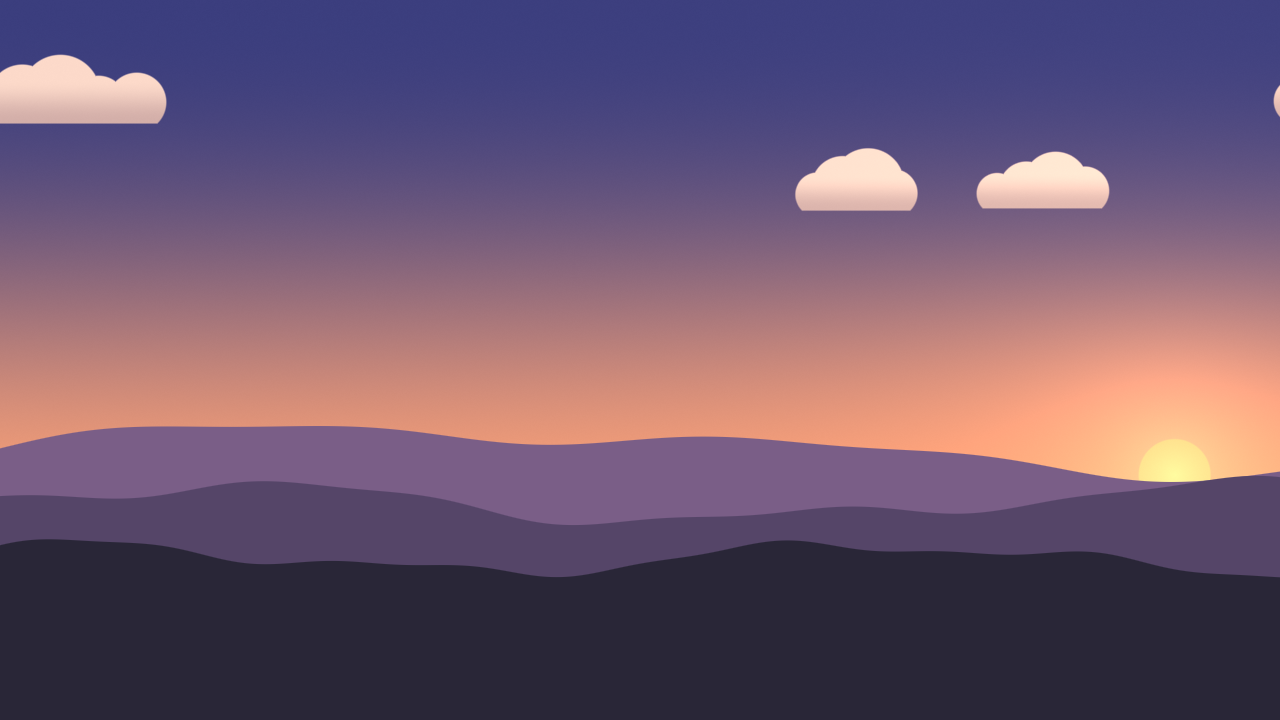
Day and night sky with sun, moon, stars and clouds

A full sky in one shader, driven by a single value: set hour from 0 to 24 and the gradient goes through night, dawn, day and dusk, the sun and the moon travel their arc and set behind the horizon, stars come out at night and puffy clouds drift by, coloured by the hour.
How to use: put the shader on a ColorRect that covers the sky (behind your level) and animate hour, from a script or an AnimationPlayer.
Settings:
- hour (0-24), horizon_y: where the horizon line is.
- Four pairs of colours (top and horizon) for night, dawn, day and dusk.
- sun_size, moon_size, moon_phase, glow, arc_height.
- star_density, twinkle.
- clouds, cloud_speed, cloud_scale.
Works with the Compatibility renderer and respects the node modulate. Dithered, so the gradients never band.
Free download with a demo project (MIT): https://dimensionalmios.itch.io/almios-free-day-night-sky
Want the whole landscape, with hills, trees and grass that follow the hour? Nature 2D: https://dimensionalmios.itch.io/almios-nature-2d
Shader code
shader_type canvas_item;

// Day and Night Sky (free) by Dimension Almios, MIT licence.
// Put it on a ColorRect that covers the sky and drive `hour` (0 to 24): the
// gradient goes through night, dawn, day and dusk, the sun and the moon travel
// their arc and set behind the horizon line, stars come out at night and puffy
// clouds drift by. The node's modulate tints or fades the whole sky.

uniform float hour : hint_range(0.0, 24.0) = 10.0;
uniform float horizon_y : hint_range(0.3, 1.0) = 0.72;   // where the horizon line is (fraction of the rect)

group_uniforms Colors;
uniform vec4 night_top : source_color = vec4(0.03, 0.05, 0.13, 1.0);
uniform vec4 night_horizon : source_color = vec4(0.17, 0.20, 0.36, 1.0);
uniform vec4 dawn_top : source_color = vec4(0.25, 0.30, 0.55, 1.0);
uniform vec4 dawn_horizon : source_color = vec4(1.0, 0.72, 0.55, 1.0);
uniform vec4 day_top : source_color = vec4(0.30, 0.53, 0.86, 1.0);
uniform vec4 day_horizon : source_color = vec4(0.84, 0.91, 0.94, 1.0);
uniform vec4 dusk_top : source_color = vec4(0.22, 0.20, 0.44, 1.0);
uniform vec4 dusk_horizon : source_color = vec4(0.98, 0.58, 0.40, 1.0);

group_uniforms Sun_and_Moon;
uniform vec4 sun_color : source_color = vec4(1.0, 0.96, 0.82, 1.0);
uniform float sun_size : hint_range(0.0, 0.2) = 0.05;    // radius, as a fraction of the rect height
uniform vec4 moon_color : source_color = vec4(0.92, 0.94, 1.0, 1.0);
uniform float moon_size : hint_range(0.0, 0.2) = 0.035;
uniform float moon_phase : hint_range(-1.0, 1.0) = 0.55; // 0 full moon, toward -1 or 1 a thinner crescent (lit on the other side)
uniform float glow : hint_range(0.0, 2.0) = 1.0;          // halo around the sun and the moon
uniform float arc_height : hint_range(0.1, 1.0) = 0.8;    // how high they climb (1 = the top of the rect)

group_uniforms Stars;
uniform float star_density : hint_range(0.0, 1.0) = 0.5;
uniform float twinkle : hint_range(0.0, 1.0) = 0.5;

group_uniforms Clouds;
uniform float clouds : hint_range(0.0, 1.0) = 0.45;       // 0 = no clouds
uniform float cloud_speed : hint_range(-0.1, 0.1) = 0.015; // drift, + to the right
uniform float cloud_scale : hint_range(0.3, 3.0) = 1.0;

float hash(vec2 p) {
	p = fract(p * vec2(0.1031, 0.1030));
	p += dot(p, p.yx + 33.33);
	return fract((p.x + p.y) * p.x);
}
// soft-edged disc, anti-aliased over one pixel
float disc(float r, float radius, float px) {
	return smoothstep(radius + px, radius - px, r);
}

void fragment() {
	vec4 node_tint = COLOR;
	vec2 uv = UV;
	float asp = fwidth(UV.y) / max(fwidth(UV.x), 1e-6);   // width / height of the rect
	float px = fwidth(UV.y);                               // one pixel, in UV.y units

	// the sun climbs from the left at 6:00 and sets on the right at 18:00; the moon
	// does the same twelve hours later
	float ang = (hour - 6.0) / 12.0 * PI;
	float sun_e = sin(ang);                                // elevation, -1 to 1
	float moon_e = -sun_e;
	float arc = horizon_y * arc_height;
	vec2 sun_p = vec2(0.5 - 0.42 * cos(ang), horizon_y - sun_e * arc);
	vec2 moon_p = vec2(0.5 + 0.42 * cos(ang), horizon_y - moon_e * arc);

	// colours: twilight (dawn before noon, dusk after) around sunrise and sunset;
	// the switch at noon and midnight is hidden by the day and night colours
	vec3 tw_top = hour < 12.0 ? dawn_top.rgb : dusk_top.rgb;
	vec3 tw_hor = hour < 12.0 ? dawn_horizon.rgb : dusk_horizon.rgb;
	float to_day = smoothstep(0.02, 0.4, sun_e);
	float to_night = smoothstep(-0.02, -0.3, sun_e);
	vec3 top = mix(mix(tw_top, day_top.rgb, to_day), night_top.rgb, to_night);
	vec3 hor = mix(mix(tw_hor, day_horizon.rgb, to_day), night_horizon.rgb, to_night);

	float y = clamp(uv.y / horizon_y, 0.0, 1.0);          // 0 top, 1 horizon
	// flat at the horizon, so the gradient meets the colour below it without a crease
	vec3 c = mix(top, hor, smoothstep(0.0, 1.0, pow(y, 1.25)));
	float twilight = (1.0 - to_day) * (1.0 - to_night);
	// at sunrise and sunset the horizon glows warmer on the sun's side
	vec2 ds = (uv - sun_p) * vec2(asp, 1.0);
	float rs = length(ds);
	c = mix(c, tw_hor * 1.05, twilight * exp(-rs * 2.5) * smoothstep(0.4, 1.0, y) * 0.6);

	// sun colour: warmer and deeper near the horizon
	vec3 sun_c = mix(sun_color.rgb * vec3(1.0, 0.66, 0.42), sun_color.rgb, smoothstep(0.0, 0.35, sun_e));
	float sun_up = smoothstep(-0.12, 0.02, sun_e);
	c += sun_c * glow * sun_up * (exp(-rs * 9.0) * 0.3 + exp(-rs * 2.6) * 0.1);

	// stars: one per cell at most, round, anti-aliased, fading toward the horizon
	float night = smoothstep(0.1, -0.2, sun_e);
	if (star_density > 0.0 && night > 0.0) {
		vec2 p = FRAGCOORD.xy / 9.0;
		vec2 cell = floor(p);
		float h1 = hash(cell);
		if (h1 < star_density * 0.35) {
			vec2 at = vec2(hash(cell + 3.1), hash(cell + 7.7)) * 0.7 + 0.15;
			float rr = length(fract(p) - at) * 9.0;             // screen pixels
			float big = hash(cell + 1.9);
			float size = mix(0.5, 1.3, big * big);
			float star = smoothstep(size + 0.7, size - 0.3, rr) * mix(0.35, 1.0, big);
			star *= 1.0 - twinkle * 0.6 * (0.5 + 0.5 * sin(TIME * mix(1.5, 3.5, h1 * 3.0) + big * 40.0));
			c += vec3(0.9, 0.93, 1.0) * star * night * (1.0 - smoothstep(0.35, 0.95, y));
		}
	}

	// moon: halo, then the disc with its shadowed part showing the sky behind
	vec2 dm = (uv - moon_p) * vec2(asp, 1.0);
	float rm = length(dm);
	float moon_up = smoothstep(-0.12, 0.02, moon_e);
	c += moon_color.rgb * glow * moon_up * night * (exp(-rm * 12.0) * 0.22 + exp(-rm * 3.5) * 0.06);

	// sun and moon discs, hidden below the horizon line (the clouds pass in front)
	float hide = smoothstep(horizon_y + px, horizon_y - px, uv.y);
	float sd = disc(rs, sun_size, px);
	// always a little brighter than its own halo, or it would read as a ring
	vec3 lw = vec3(0.3, 0.59, 0.11);
	float boost = max(1.05, dot(c, lw) / max(dot(sun_c, lw), 1e-3) + 0.08);
	c = mix(c, sun_c * boost, sd * hide);
	float md = disc(rm, moon_size, px);
	// the shadow is a disc of the same size, closer to the centre for a thinner crescent
	float shift = sign(moon_phase) * (1.0 - abs(moon_phase)) * 2.0 * moon_size;
	float shadow = disc(length(dm - vec2(shift, 0.0)), moon_size, px);
	float moon_lit = md * (1.0 - shadow * abs(sign(moon_phase)));
	vec3 moon_c = moon_color.rgb * (0.92 + 0.08 * (1.0 - length(dm) / max(moon_size, 1e-4)));
	c = mix(c, max(c, moon_c), moon_lit * hide * mix(0.35, 1.0, night));

	// clouds: flat-bottomed puffy clouds drifting in a band of the sky, lit from
	// above and coloured by the hour. Each one is a few round puffs that swell and
	// shrink slowly, so the clouds change shape as they go.
	if (clouds > 0.0) {
		float cw = 0.34 * cloud_scale;                      // one cloud slot, in rect heights
		float x = uv.x * asp + TIME * cloud_speed * 2.0;
		float id = floor(x / cw);
		float dist = 10.0;
		float base = 0.0;
		float size = 1.0;
		for (int j = -1; j <= 1; j++) {
			float cid = id + float(j);
			if (hash(vec2(cid, 1.7)) > clouds * 1.5) continue;
			float far = hash(vec2(cid, 5.3));                   // 0 high and near .. 1 low and far
			float sz = cw * mix(0.2, 0.11, far);               // puff radius
			vec2 cc = vec2((cid + 0.5 + (hash(vec2(cid, 2.9)) - 0.5) * 0.4) * cw,
				horizon_y * mix(0.18, 0.62, far));
			float len = mix(0.8, 1.5, hash(vec2(cid, 8.1)));    // longer or rounder clouds
			float bottom = cc.y + sz * 0.45;
			// a rounded body along the bottom joins the puffs
			vec2 bq = abs(vec2(x, uv.y) - vec2(cc.x, bottom - sz * 0.32)) - vec2(sz * 1.05 * len, 0.0);
			float d = length(max(bq, 0.0)) - sz * 0.32;
			for (int k = 0; k < 4; k++) {
				float fk = float(k);
				float ox = (fk - 1.5) * sz * 0.62 * len;
				float r = sz * mix(0.62, 1.05, hash(vec2(cid, fk + 11.0))) * (1.0 - 0.3 * abs(fk - 1.5) / 1.5);
				r *= 1.0 + 0.07 * sin(TIME * 0.35 + fk * 2.1 + cid * 5.0);
				vec2 q = vec2(x, uv.y) - vec2(cc.x + ox, bottom - r * 0.72);
				d = min(d, length(q) - r);
			}
			d = max(d, uv.y - bottom);                             // flat bottom
			if (d < dist) {
				dist = d;
				base = bottom;
				size = sz;
			}
		}
		float cov = smoothstep(px, -px, dist);
		if (cov > 0.0) {
			// light from above: the lower part of each cloud is in its own shade
			float lit = 1.0 - smoothstep(base - size * 0.9, base - size * 0.05, uv.y) * 0.55;
			vec3 light = mix(hor, vec3(1.0), 0.6 * (1.0 - to_night)) * mix(1.0, 0.8, to_night);
			light += sun_c * sun_up * exp(-rs * 3.0) * 0.35;
			vec3 shade = mix(mix(top, hor, 0.5), light, 0.35) * mix(0.95, 0.8, to_night);
			c = mix(c, mix(shade, light, lit), cov * smoothstep(0.0, 0.03, horizon_y - uv.y));
		}
	}

	c += (hash(FRAGCOORD.xy + fract(TIME * 7.0) * 61.0) - 0.5) / 255.0 * 1.5;   // dither: no banding
	COLOR = vec4(c, 1.0);
	COLOR *= node_tint;
}