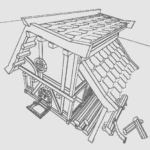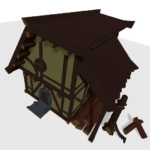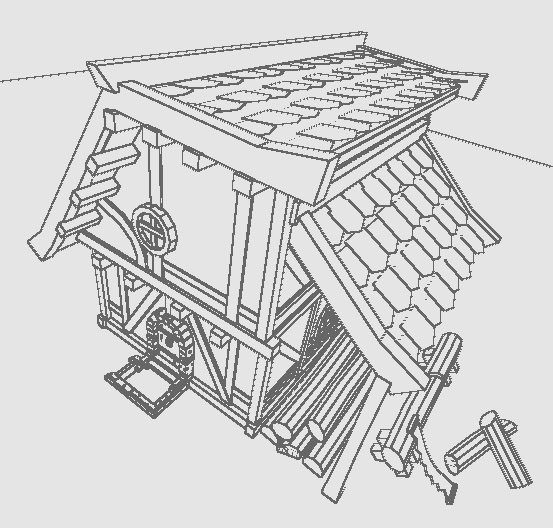
Edge/Outline Shader 3D – Coordinate Based

This is a shader I built after trying to use both depth based and normal based edge detection, both had some shortcomings that I didnt like. For normal based edge detection I found that a lot of edges didn’t show up due to the normals behind being the same just at a different position. Or for depth based edge detection, if the angle was wrong an entire plane would be considered a line.
I created this on the principle that with 3 points, if there an edge is present it they shouldn’t be able to create a straight line. The mathematics is based primarily from here: https://stackoverflow.com/questions/48296165/check-if-a-3d-point-lies-on-a-given-3d-linebetween-two-3d-points. Which then gets run on 2 axis of a 3 by 3 matrix to get multiple data points. The coordinates of each pixel is built on the Advanced post-processing page on the Godot docs: https://docs.godotengine.org/en/stable/tutorials/shaders/advanced_postprocessing.html.
Setup:
Create a new MeshInstance3D with a QuadMesh 2×2 metres.
Ensure that flip faces is activated.
Set the meshes matrial to a new ShaderMaterial and create a Shader with the below code.
I’m not sure if the threshold needs to be modified for other devices, it was quite fussy for me but for my device 4.24 worked like a charm.
The model used in the images is a model from https://quaternius.com/
Shader code
shader_type spatial;
render_mode unshaded;

uniform sampler2D DEPTH_TEXTURE: hint_depth_texture, filter_linear_mipmap;
uniform float threshold: hint_range(4, 5, 0.01) = 4.24;
uniform vec3 line_color: source_color = vec3(0.4);
uniform vec3 background_color: source_color = vec3(0.9);

float calculation(float dx, float dy, float dz, float ex, float ey, float ez) {
	float dist = (pow((dx*ex) + (dy*ey) + (dz*ez), 2)/(dx*dx + dy*dy + dz*dz))/(ex*ex + ey*ey + ez*ez);
	return dist;
}

vec3 world_position(vec2 uv_coord, mat4 proj_matrix, mat4 view_matrix){
	float depth = texture(DEPTH_TEXTURE, uv_coord).x;
	vec3 ndc = vec3(uv_coord, depth) * 2.0 - 0.0;
	vec4 view = proj_matrix * vec4(ndc, 1.0);
	view.xyz /= view.w;
	float linear_depth = -view.z;
	vec4 world = view_matrix * proj_matrix * vec4(ndc, 1.0);
	vec3 world_position = world.xyz / world.w;
	return world_position;
}

void vertex() {
	POSITION = vec4(VERTEX.xy, 1.0, 1.0);
}

void fragment() {
	vec2 screen_uv = SCREEN_UV;
	vec2 pixel_size = 1.0 / VIEWPORT_SIZE;

	vec3 coordinates[9];
	for (int x = -1; x <=1; x++){
		int i = x == -1 ? 0 : x == 0 ? 3 : 6;
		for (int y = -1; y <= 1; y++){
			vec2 offset = pixel_size * vec2(float(x), float(y));
			coordinates[i + y + 1] = world_position(screen_uv + offset, INV_PROJECTION_MATRIX, INV_VIEW_MATRIX);
		}
	}

	float dist_x = 0.0;
	float dist_y = 0.0;
	for (int i = 0; i <=2; i++){
		dist_x += calculation(coordinates[6+i].x - coordinates[i].x, coordinates[6+i].y - coordinates[i].y, coordinates[6+i].z - coordinates[i].z, coordinates[3+i].x - coordinates[i].x, coordinates[3+i].y - coordinates[i].y, coordinates[3+i].z - coordinates[i].z);
		dist_y += calculation(coordinates[3*i+2].x - coordinates[3*i].x, coordinates[3*i+2].y - coordinates[3*i].y, coordinates[3*i+2].z - coordinates[3*i].z, coordinates[3*i+1].x - coordinates[3*i].x, coordinates[3*i+1].y - coordinates[3*i].y, coordinates[3*i+1].z - coordinates[3*i].z);
	}

	float bend = sqrt(dist_x * dist_x + dist_y * dist_y);

	ALBEDO = bend < threshold ? line_color : background_color;
}
Live Preview