Fake 3D Interior Projection Shader Fixed & Tuned

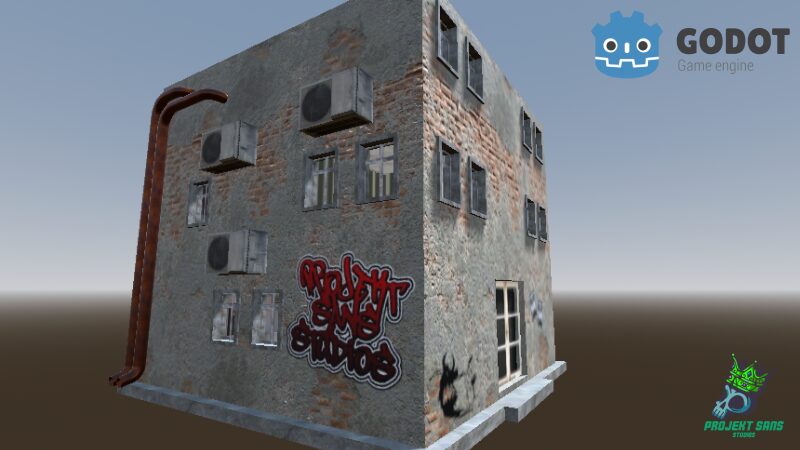
This shader has been carefully calibrated with specific offset and scale values that maximize atlas texture utilization. Each face’s parameters are tuned to extract room details perfectly from the texture grid, eliminating common issues like misalignment or improper scaling for realistic interior projection.
Based on: “Interior mapping shader” by AndreaTerenz (September 6, 2022) from https://godotshaders.com/shader/interior-mapping-shader/
What’s Fixed & Improved:
- Fixed UV calculation for proper texture mapping across all faces
- Added brightness control with a uniform parameter (range 0.0-4.0)
- Improved face detection with epsilon value to prevent edge artifacts
- Added texture clamping to prevent sampling outside atlas bounds
- Optimized ray-box intersection for better performance
How to Use:
- Apply to: MeshInstance3D (recommended mesh: QuadMesh or PlaneMesh)
- Set up:
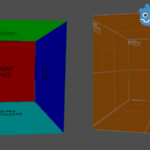
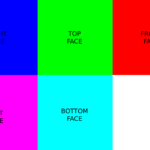
- Use the included texture templates for consistent results
- Adjust Z-scale to control interior depth (higher values = deeper rooms)
- Set brightness to match your scene lighting
- Texture: Apply your room atlas to the room_atlas uniform
Best Use Cases:
- Mass building optimization – Replace thousands of detailed meshes with simple planes
- Cityscapes – Add interior detail to distant buildings without performance cost
- Game jams – Quick interior setups for windows and buildings
- Retro/PSX style – Combine with pixel art textures for aesthetic results
Texture Templates:
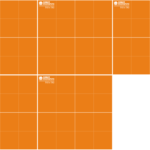
- Template textures are provided with standardized layouts:
- 6-face atlas with consistent sizing
- Grid-based organization for easy editing
- Marker guides for face alignment
Technical Details:
- Render Mode: Unshaded (full control over appearance)
- Algorithm: Ray-box intersection with per-face UV mapping
- Performance: Extremely lightweight – suitable for hundreds of instances
- Compatibility: Godot 4.0+ (spatial shader)
Shader code
// MIT License
//
// Copyright (c) 2026 [PROJEKTSANSSTUDIOS]
//
// Permission is hereby granted, free of charge, to any person obtaining a copy
// of this software and associated documentation files (the "Software"), to deal
// in the Software without restriction, including without limitation the rights
// to use, copy, modify, merge, publish, distribute, sublicense, and/or sell
// copies of the Software, and to permit persons to whom the Software is
// furnished to do so, subject to the following conditions:
//
// The above copyright notice and this permission notice shall be included in all
// copies or substantial portions of the Software.
//
// THE SOFTWARE IS PROVIDED "AS IS", WITHOUT WARRANTY OF ANY KIND, EXPRESS OR
// IMPLIED, INCLUDING BUT NOT LIMITED TO THE WARRANTIES OF MERCHANTABILITY,
// FITNESS FOR A PARTICULAR PURPOSE AND NONINFRINGEMENT. IN NO EVENT SHALL THE
// AUTHORS OR COPYRIGHT HOLDERS BE LIABLE FOR ANY CLAIM, DAMAGES OR OTHER
// LIABILITY, WHETHER IN AN ACTION OF CONTRACT, TORT OR OTHERWISE, ARISING FROM,
// OUT OF OR IN CONNECTION WITH THE SOFTWARE OR THE USE OR OTHER DEALINGS IN THE
// SOFTWARE.

// Fake 3D Interior Shader
// Description: Creates a 3D interior illusion using 2D atlas textures

shader_type spatial;
render_mode unshaded;

uniform sampler2D room_atlas;
uniform float brightness : hint_range(0.0, 4.0) = 1.0; // Brightness control clamped 0-4

varying vec3 v_pos;
varying vec3 v_cam;

vec2 face_uv(vec3 p, vec3 f) {
	if (f.x > 0.5)  return vec2(-p.z,  p.y);
	if (f.x < -0.5) return vec2( p.z,  p.y);
	if (f.y > 0.5)  return vec2( p.x, -p.z);
	if (f.y < -0.5) return vec2( p.x,  p.z);
	if (f.z > 0.5)  return vec2( p.x,  p.y);
	return vec2(-p.x,  p.y);
}

int face_index(vec3 f) {
	if (f.x > 0.5)  return 0;
	if (f.x < -0.5) return 1;
	if (f.y > 0.5)  return 2;
	if (f.y < -0.5) return 3;
	if (f.z > 0.5)  return 4;
	return 5;
}

void vertex() {
	v_pos = VERTEX;
	v_cam = inverse(MODELVIEW_MATRIX)[3].xyz;
}

void fragment() {
	vec3 ray = normalize(v_pos - v_cam);

	float tx = (ray.x > 0.0) ? (0.5 - v_cam.x) / ray.x : (-0.5 - v_cam.x) / ray.x;
	float ty = (ray.y > 0.0) ? (0.5 - v_cam.y) / ray.y : (-0.5 - v_cam.y) / ray.y;
	float tz = (ray.z > 0.0) ? (0.5 - v_cam.z) / ray.z : (-0.5 - v_cam.z) / ray.z;

	float t = min(min(tx, ty), tz);
	vec3 hit = v_cam + ray * t;

	vec3 face;
	const float EPSILON = 0.0001;
	if (abs(t - tx) < EPSILON) {
		face = vec3(sign(ray.x), 0.0, 0.0);
	} else if (abs(t - ty) < EPSILON) {
		face = vec3(0.0, sign(ray.y), 0.0);
	} else {
		face = vec3(0.0, 0.0, sign(ray.z));
	}

	vec2 uv = face_uv(hit, face) * 0.5 + 0.5;
	uv = vec2(1.0 - uv.x, 1.0 - uv.y); // Flip both axes
	uv = clamp(uv, 0.0, 1.0);

	int i = face_index(face);

	// Hardcoded offset values
	vec2 offsets[6];
	offsets[0] = vec2(-0.340, 0.75);   // +X face
	offsets[1] = vec2(-0.675, -0.75);  // -X face
	offsets[2] = vec2(0.1775, -0.5);   // +Y face
	offsets[3] = vec2(0.1775, 0.5);    // -Y face
	offsets[4] = vec2(0.0, 0.0);       // +Z face
	offsets[5] = vec2(0.515, -0.25);   // -Z face

	// Hardcoded size values
	vec2 sizes[6];
	sizes[0] = vec2(1.35, 1.0);  // +X face
	sizes[1] = vec2(1.35, 1.0);  // -X face
	sizes[2] = vec2(0.65, 2.0);  // +Y face
	sizes[3] = vec2(0.65, 2.0);  // -Y face
	sizes[4] = vec2(1.0, 1.0);   // +Z face
	sizes[5] = vec2(0.65, 1.0);  // -Z face

	// Apply offset and size scaling
	vec2 atlas_uv = offsets[i] + uv * sizes[i];

	// Sample texture and apply brightness
	vec3 color = texture(room_atlas, atlas_uv).rgb;

	// Apply brightness control with clamping
	color = color * brightness;

	// Clamp to prevent negative values
	color = max(color, 0.0);

	ALBEDO = color;
}
Live Preview