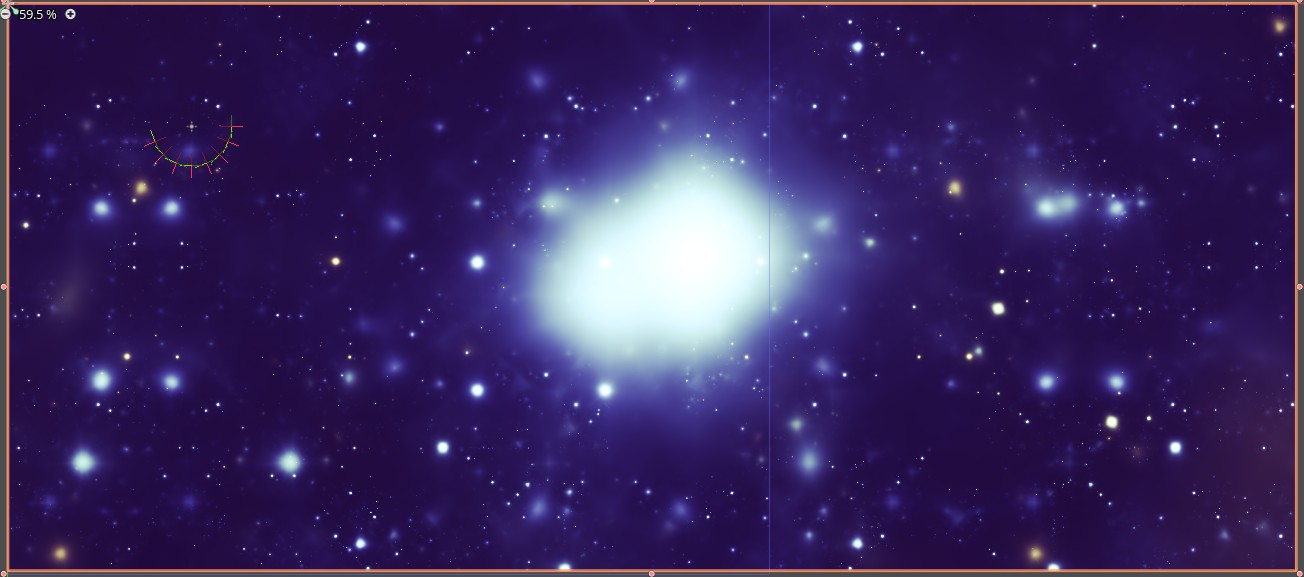
Fast Starnest

This port replace GPU branching with ternary operator so it run faster.
Use it on a ColorRect Node.
Shader code
shader_type canvas_item;

uniform int iterations = 20;
uniform float formuparam = 1.00;

uniform int volsteps = 20;
uniform float stepsize = 0.1;

uniform float zoom = 0.800;
uniform float tile = 0.5;
uniform float speed = 0.001;

uniform float brightness = 0.002;
uniform float darkmatter = 0.100;
uniform float distfading = 0.650;
uniform float saturation = 0.750;

float SCurve (float value) {
	float v = value;
	value = v < 0.5 ? value : value - 1.0;
    value = value * value * value * value * value * 16.0;
	return v < 0.5 ? value : value + 1.0;
}

void fragment() {
	vec2 iResolution = 1.0 / SCREEN_PIXEL_SIZE;
	//get coords and direction
	vec2 uv =FRAGCOORD.xy / iResolution.xy;
	uv.y *= iResolution.y / iResolution.x;
	vec3 dir = vec3(uv * zoom, 1.0);
	float time = TIME * speed;

	vec3 from = vec3(1.0, 0.5, 0.5);
	from -= vec3(0.0, time, 0.0);

	//volumetric rendering
	float s = 0.1, fade = 1.0;
	vec3 v = vec3(0.0);
	for (int r=0; r<volsteps; r++) {
		vec3 p = fma(vec3(s), dir*0.5, from);
		p = abs(vec3(tile) - mod(p,vec3(tile*2.0))); // tiling fold
		float pa, a = pa = 0.0;
		for (int i=0; i<iterations; i++) {
			p = abs(p) / dot(p,p) - formuparam; // the magic formula
			a += abs(length(p) - pa); // absolute sum of average change
			pa = length(p);
		}
		float dm = max(0.0, fma(-a, a * 0.001, darkmatter)); //dark matter
		a *= a; // add contrast
		fade = r > 6 ? fade * (1.0-dm) : fade; // dark matter, don't render near
		v += fade;
		v = fma(vec3(s,s*s,s*s*s*s), vec3(fade*a*brightness), v); // coloring based on distance
		fade *= distfading; // distance fading
		s += stepsize;
	}

	v=mix(vec3(length(v)),v,saturation); //color adjust

    vec4 C = vec4(v*.01,1.);

		C.r = pow(C.r, 0.35);
 	 	C.g = pow(C.g, 0.36);
 	 	C.b = pow(C.b, 0.38);

    vec4 L = C;

    COLOR.r = mix(L.r, SCurve(C.r), 0.7);
    COLOR.g = mix(L.g, SCurve(C.g), 1.0);
    COLOR.b = mix(L.b, SCurve(C.b), 0.2);
}
Live Preview