
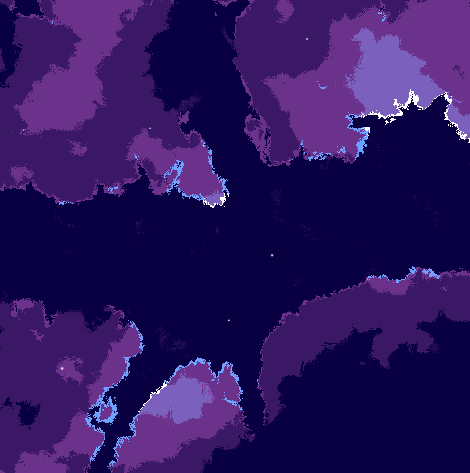
Space background shader

A shader based on DrSmey’s Space background shader.
Not terribly efficient by any means, was more of a toy/proof of concept that you can just follow a pixel art tutorial to make a shader, using noise textures to define regions in the same way the tutorial did.
For Clouds, Dither Areas, and Rifts, I used cellular noise with varying distortions.
Stars uses Cellular noise as well, with no fractal set and distance2Div as the return value. The “star cells” value is the same exact noise, but using cell value as the return instead. Star Cells is used to offset the twinkle of individual stars.
Color Ramp is a 1DGradient with colors of your choosing
Edge size determines where the edges of the layers are, and this is used for dithering placement. I’d keep it low, as per the pixel art tutorial, don’t over do it! But the actual value depends on your noise values and preferences of course.
I selected 4.6 Godot here, but in reality I’m using 4.7.1
Shader code
shader_type canvas_item;
uniform sampler2D clouds:source_color;
uniform sampler2D dither_areas:source_color;
uniform sampler2D rifts:source_color;
uniform sampler2D stars:source_color;
uniform sampler2D star_cells:source_color;
uniform sampler2D color_ramp:source_color;
uniform float steps = 8;
uniform float edge_size:hint_range(0,1.) = .01;

// these dithering and decimate functions were likely pulled from lygia, if I remember correctly. Been floating around in my shader files for a while.
#define DITHER_BAYER_PRECISION 2
vec3 decimate(vec3 v, float p){ return floor(v*p)/p; }
float ditherBayer(const in vec2 xy) {
    float kern[64];
    kern[ 0] = 0.000; kern[ 1] = 0.500; kern[ 2] = 0.124; kern[ 3] = 0.624; kern[ 4] = 0.028; kern[ 5] = 0.532; kern[ 6] = 0.156; kern[ 7] = 0.656;
    kern[ 8] = 0.752; kern[ 9] = 0.248; kern[10] = 0.876; kern[11] = 0.376; kern[12] = 0.784; kern[13] = 0.280; kern[14] = 0.908; kern[15] = 0.404;
    kern[16] = 0.188; kern[17] = 0.688; kern[18] = 0.060; kern[19] = 0.564; kern[20] = 0.216; kern[21] = 0.720; kern[22] = 0.092; kern[23] = 0.596;
    kern[24] = 0.940; kern[25] = 0.436; kern[26] = 0.812; kern[27] = 0.312; kern[28] = 0.972; kern[29] = 0.468; kern[30] = 0.844; kern[31] = 0.344;
    kern[32] = 0.044; kern[33] = 0.548; kern[34] = 0.172; kern[35] = 0.672; kern[36] = 0.012; kern[37] = 0.516; kern[38] = 0.140; kern[39] = 0.640;
    kern[40] = 0.800; kern[41] = 0.296; kern[42] = 0.924; kern[43] = 0.420; kern[44] = 0.768; kern[45] = 0.264; kern[46] = 0.892; kern[47] = 0.392;
    kern[48] = 0.232; kern[49] = 0.736; kern[50] = 0.108; kern[51] = 0.608; kern[52] = 0.200; kern[53] = 0.704; kern[54] = 0.076; kern[55] = 0.580;
    kern[56] = 0.988; kern[57] = 0.484; kern[58] = 0.860; kern[59] = 0.360; kern[60] = 0.956; kern[61] = 0.452; kern[62] = 0.828; kern[63] = 0.328;
    int index = int(mod(xy.x, 8.0)) + (int(mod(xy.y, 8.0)) * 8);
    return kern[index];
}
vec3 ditherBayer(vec3 color, const in vec2 xy, const int pres) {
    float d = float(pres);
    vec3 decimated = decimate(color, d);
    vec3 diff = (color - decimated) * d;
    vec3 ditherPattern = vec3(ditherBayer(xy));
    return decimate(color + (step(ditherPattern, diff) / d), d);
}
float ditherBayer(const in float val, const in vec2 xy) { return ditherBayer(vec3(val), xy, DITHER_BAYER_PRECISION).r; }

float get_star(in vec2 uv){

	float star_flare = texture(stars, uv).r;
	float star_cell = texture(star_cells, uv).r;
	star_flare = star_flare * clamp(sin((TIME/10.+star_cell*PI*2.))*100.-99., star_cell*.005, 1);

	return star_flare;
}

void fragment() {
	// Called for every pixel the material is visible on.
	// 1. Planning + 2. Cloud up
	// A cellular noise can make some convincing cloud shapes.
	vec3 cloud = texture(clouds, UV).rgb;

	// 3. Dither, 4. Layers
	// figure out the edges, by first doing a bit of posterization
	vec3 edges = decimate(cloud+edge_size, steps);
	cloud = decimate(cloud, steps);
	// mask out an area to dither
	vec3 dither_area = texture(dither_areas, UV).rgb;
	float dither_value = ditherBayer(dither_area.r, FRAGCOORD.xy);
	// multiply the dither area with the edges,
	float should_dither = clamp(sign(edges.r-cloud.r),0,1);
	should_dither *= dither_value;

	// 5. Rift!
	vec3 rift = texture(rifts, UV).rgb;
	float rift_mask = decimate(rift, 2).r;
	float rift_edge = step(.5, rift_mask) - rift_mask;
	rift_mask = step(.6,rift_mask);
	cloud.r = max(0, cloud.r-rift_mask);
	cloud.r = mix(cloud.r, cloud.r * 3., rift_edge);
	// Apply the dithering to our cloud effect!
	cloud = mix(cloud, vec3(cloud.r+1./steps), should_dither);
	float star = get_star(UV);
	cloud = mix(texture(color_ramp, vec2(cloud.r, 0)).rgb, vec3(1.), smoothstep(.5,1., star));
	COLOR.rgb = cloud.rgb;
}
