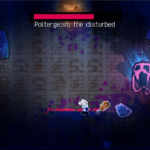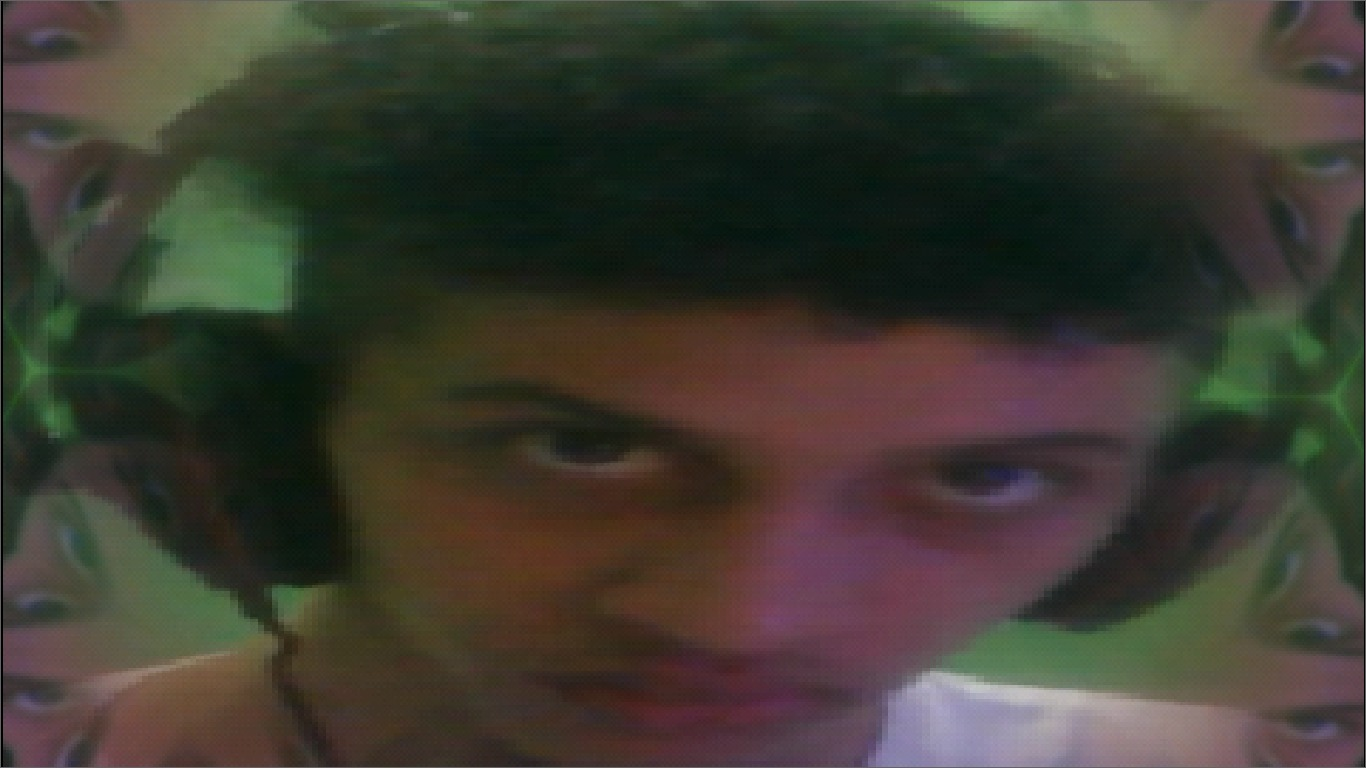
Persona 5 Royal – kaleidoscope screen-edge effect

It’s basically a hexagonal kaleidoscope filter that takes the center of the screen, smashes it into a bunch of hexagons, mirrors the shit out of it, spins the whole thing, and slaps it onto the screen edges like reality is having a fucking seizure.
If you can (and want to), please credit me when you use the shader. I like seeing the projects where you use them ;3
Shader code
shader_type canvas_item;

// ---------------------------------------------------------
// Kaleidoscope Screen-Edge Effect (post-process) — hex grid
// Apply to a ColorRect (full-rect) inside a CanvasLayer
// at the top of everything, using SCREEN_TEXTURE.
//
// Idea: the screen is divided into a grid of hexagons. Inside
// each hexagon, the coordinate is folded with 6 (or 12) mirror
// symmetry, and the sample is always taken from near the CENTER
// of the screen (not from the edge itself) — this makes the
// pattern look like a true kaleidoscope, repeating the center of the image.
// ---------------------------------------------------------

const float SQRT3 = 1.7320508;

uniform sampler2D SCREEN_TEXTURE : hint_screen_texture, filter_linear_mipmap;

uniform float hex_size : hint_range(0.02, 0.6) = 0.16;      // size of each hexagonal cell
uniform int mirror_segments : hint_range(3, 12) = 6;         // "mirror sides" inside each hexagon
uniform float rotation_speed : hint_range(-4.0, 4.0) = 0.2;  // rotation of the entire grid over time
uniform float source_zoom : hint_range(0.2, 3.0) = 1.0;      // how much of the center of the screen is pulled into each hexagon

uniform vec2 center = vec2(0.5, 0.5);

// Vignette control: where the effect starts and ends
uniform float vignette_start : hint_range(0.0, 1.0) = 0.3;  // radius where the screen is still normal
uniform float vignette_end : hint_range(0.0, 1.5) = 0.8;    // radius where the kaleidoscope is 100%

// Darkens the edges beyond the kaleidoscope itself
uniform float darken_amount : hint_range(0.0, 1.0) = 0.35;

vec2 rotate(vec2 p, float ang) {
	float s = sin(ang);
	float c = cos(ang);
	return vec2(p.x * c - p.y * s, p.x * s + p.y * c);
}

// Converts a point to axial hex grid coordinates (pointy-top)
vec2 hex_axial(vec2 p, float size) {
	float q = (SQRT3 / 3.0 * p.x - 1.0 / 3.0 * p.y) / size;
	float r = (2.0 / 3.0 * p.y) / size;
	return vec2(q, r);
}

// Rounds fractional axial coordinates to the nearest hex cell
vec2 hex_round(vec2 axial) {
	float x = axial.x;
	float z = axial.y;
	float y = -x - z;

	float rx = round(x);
	float ry = round(y);
	float rz = round(z);

	float x_diff = abs(rx - x);
	float y_diff = abs(ry - y);
	float z_diff = abs(rz - z);

	if (x_diff > y_diff && x_diff > z_diff) {
		rx = -ry - rz;
	} else if (y_diff > z_diff) {
		ry = -rx - rz;
	} else {
		rz = -rx - ry;
	}
	return vec2(rx, rz);
}

// Center (in "p" space) of a hex cell given its axial coordinate
vec2 hex_to_point(vec2 axial, float size) {
	float x = size * (SQRT3 * axial.x + SQRT3 / 2.0 * axial.y);
	float y = size * (3.0 / 2.0 * axial.y);
	return vec2(x, y);
}

void fragment() {
	vec2 uv = SCREEN_UV;
	vec2 aspect_fix = vec2(1.0, SCREEN_PIXEL_SIZE.x / SCREEN_PIXEL_SIZE.y);

	vec2 p = (uv - center) * aspect_fix;
	float dist_from_center = length(p);

	// How much the kaleidoscope effect "weighs" on this pixel (0 = normal, 1 = full effect)
	float k = smoothstep(vignette_start, vignette_end, dist_from_center);

	// Rotates the entire grid over time
	vec2 pr = rotate(p, TIME * rotation_speed);

	// Position inside the hexagonal cell (relative to its center)
	vec2 axial = hex_axial(pr, hex_size);
	vec2 cell = hex_round(axial);
	vec2 cell_center = hex_to_point(cell, hex_size);
	vec2 local = pr - cell_center;

	// Folds the local position with mirror symmetry (true kaleidoscope effect)
	float local_dist = length(local);
	float local_ang = atan(local.y, local.x);
	float seg_angle = TAU / float(mirror_segments);
	float a = mod(local_ang, seg_angle);
	a = abs(a - seg_angle * 0.5);
	vec2 folded = vec2(cos(a), sin(a)) * local_dist;

	// Always samples near the CENTER of the screen, pulling the center of the image
	// into each hexagon instead of repeating the edge itself
	vec2 kal_p = folded * source_zoom;
	vec2 kal_uv = center + kal_p / aspect_fix;
	kal_uv = clamp(kal_uv, vec2(0.001), vec2(0.999));

	vec4 normal_color = texture(SCREEN_TEXTURE, uv);
	vec4 kal_color = texture(SCREEN_TEXTURE, kal_uv);

	vec4 result = mix(normal_color, kal_color, k);

	// Slightly darkens the edge to reinforce the vignette
	result.rgb *= 1.0 - darken_amount * k;

	COLOR = result;
}
Live Preview