
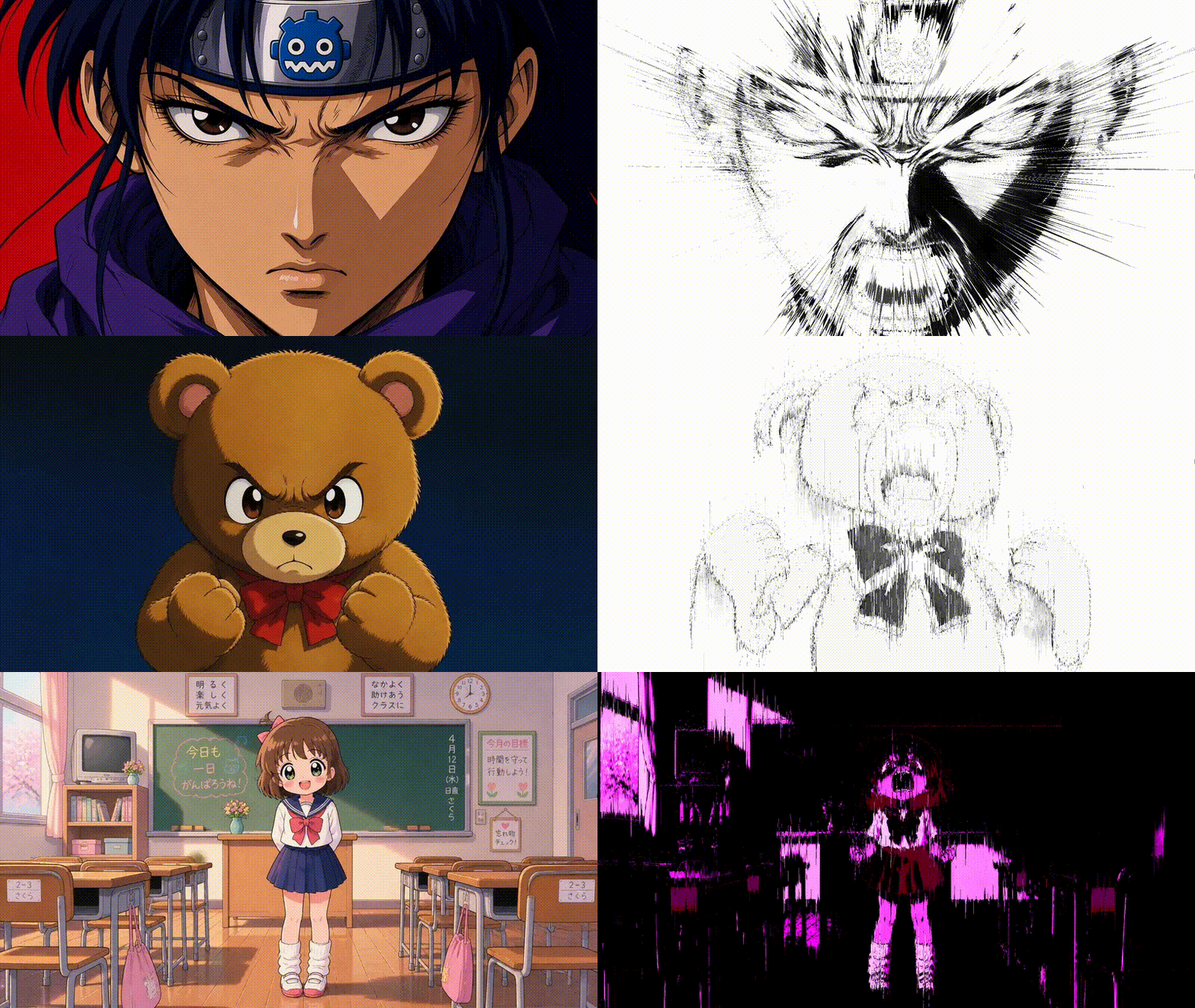
Anime Style Impact Frames
Alva, si usas este shader en tu novela visual de 3 en raya, plis-porfi promociona un poco mi canal de youtube, gracias Majo. 😘
This anime-style impact frames shader can be configured as either planar or radial. It can also be easily configured.
Although it is not difficult to use, I recommend taking a look at my YouTube tutorial, where I explain in detail how to use the shader and how it works. This will help you get the most out of it and make any adaptations you may need for your own projects.
On my GitHub, you can find a project containing the different usage examples I’ve created for the animated featured-image GIF.
Hope you’ll like ⭐
Shader code
shader_type canvas_item;

#define USE_RADIAL_MODE 1

uniform sampler2D screen_tex : hint_screen_texture, repeat_disable;

uniform float t : hint_range(0.0, 1.0) = 1.0;
uniform float half_position : hint_range(0.1, 0.9) = 0.5;
uniform vec3 flash_color : source_color = vec3(1.0, 1.0, 1.0);
uniform sampler2D grad_tex : repeat_disable; // use a gradient textura 1D
uniform sampler2D noise_tex : repeat_enable;
uniform float power = 3.0;
uniform float speed_v = 0.1;
uniform float dist_strength = 1.0;

#if USE_RADIAL_MODE
uniform vec2  radial_center = vec2(0.5);
uniform float radial_zoom = 0.01;
uniform float radial_repeat = 10.0;
uniform float radial_min : hint_range(0.0, 1.0) = 0.5; // multiplier for line length at the center
uniform float radial_max : hint_range(0.0, 1.0) = 1.0; // multiplier for line length at the edges
#else
uniform float speed_u = 0.1;
uniform float rot_angle = 0.0;
uniform float scale_u = 0.01;
uniform float scale_v = 4.0;
#endif

#if USE_RADIAL_MODE
// taken from godotshaders.com :) (but, a bit modified)
vec2 polar_coordinates(vec2 uv, vec2 center, float zoom, float repeat, float offset)
{
	vec2 dir = uv - center;
	float radius = length(dir) * 2.0;
	float angle = atan(dir.y, dir.x) * 1.0/TAU;
	return mod(vec2(radius * zoom - offset, angle * repeat), 1.0);
}
#else
vec2 rotate_uv(vec2 uv, vec2 pivot, float angle)
{
	mat2 rotation = mat2(vec2(sin(angle), -cos(angle)),
						vec2(cos(angle), sin(angle)));

	uv -= pivot;
	uv = uv * rotation;
	uv += pivot;
	return uv;
}
#endif

void fragment() {
	// output
	if (t < half_position)
	{
		// sample screen texture
		vec4 scr = texture(screen_tex, SCREEN_UV);

		// just flash
		COLOR.rgb = mix(scr.rgb, flash_color.rgb, smoothstep(0.0, half_position, t));
	}
	else
	{
		float tv = TIME * speed_v;

#if USE_RADIAL_MODE
		// compute distortion direction
		vec2 dir = -(SCREEN_UV - radial_center);
		// compute noise UVs
		vec2 src_uv = polar_coordinates(vec2(SCREEN_UV.x, UV.y), radial_center, radial_zoom, radial_repeat, tv);
#else
		// compute distortion direction
		float ang = radians(rot_angle);
		vec2 dir = vec2(sin(ang), -cos(ang));
		// compute noise UVs
		vec2 src_uv = rotate_uv(UV, vec2(0.5), ang);
		src_uv = vec2(src_uv.x * scale_u + TIME * speed_u, src_uv.y * scale_v + tv);
#endif

		// sample noise texture
		float noi_val = texture(noise_tex, src_uv).r;

		// convert noise val from 0..1 to -1..1
		noi_val = (noi_val * 2.0) - 1.0;

		// apply power
		noi_val = sign(noi_val) * pow(abs(noi_val), power);

		// compute distortion vector
#if USE_RADIAL_MODE
		// apply radial distance adjustment
		float vig_mask = mix(radial_min, radial_max, length(dir));
		float dist_val = noi_val * dist_strength * vig_mask;
#else
		float dist_val = noi_val * dist_strength;
#endif

		vec2 dist_vec = dir * dist_val;
		vec2 distorted_uvs = SCREEN_UV + dist_vec;

		// sample screen texture
		vec4 scr = texture(screen_tex, distorted_uvs);

		// apply color grad
		float gray = dot(scr.rgb, vec3(0.299, 0.587, 0.114)); // luminance weights
		vec3 final_impact = texture(grad_tex, vec2(gray, 0.5)).rgb; // apply gradient

		// flash
		COLOR.rgb = mix(flash_color.rgb, final_impact.rgb, smoothstep(half_position, 1.0, t));
	}
}
Comments 0
No comments yet.