
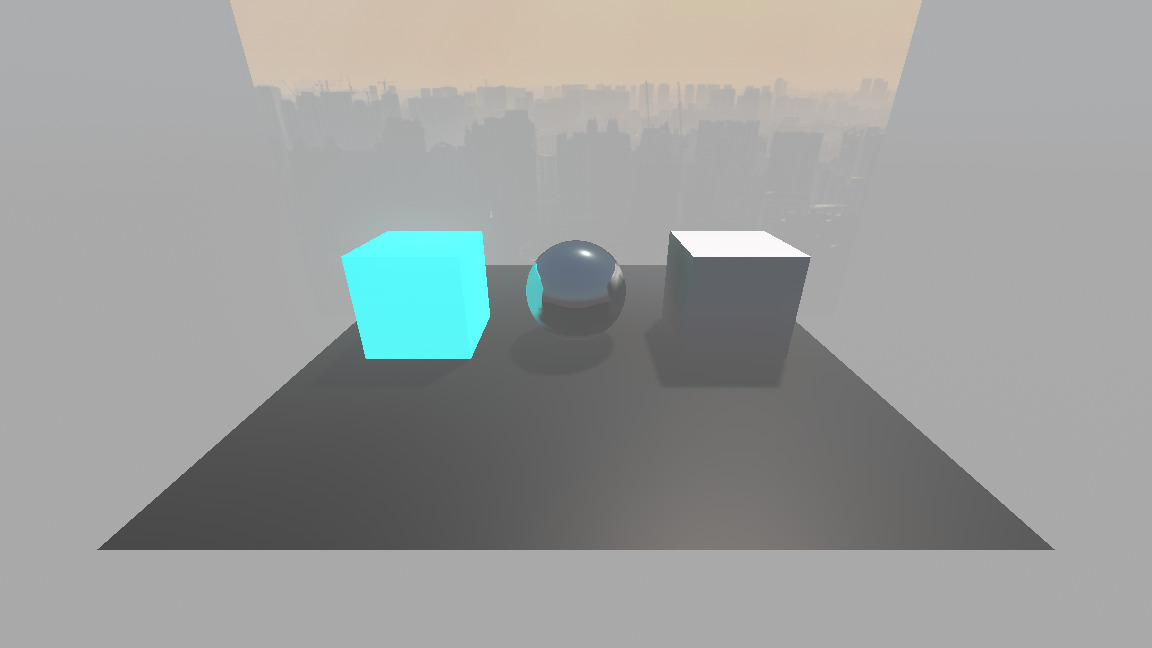
Linear Depth/Depth Fog
‘Linear Depth/DepthFog’ post-processing effect
How to apply:
1. Create a new Mesh Instance and set the mesh to a Quad2. Set the newly created Quad's size to '2x2'3. Create a new shader material in the 'Material' or 'Surface Material Override' tab4. Create a new shader under the 'Shader' tab5. Copy and paste the shader.
This shader is a part of my tutorial/learning repository.
Shader code
// Linear Depth Shader written by absentSpaghetti
//
// This shader is a part of my tutorial/learning Github repository: https://github.com/absentSpaghetti/Shader-Basics-With-Spaghetti
// Feel free to use, edit and share this shader according to your needs
//
// MIT License
//
// prerequisites:

shader_type spatial;
render_mode unshaded, cull_disabled;

uniform sampler2D depth_texture : hint_depth_texture, filter_linear_mipmap;
uniform sampler2D screen_texture : hint_screen_texture, filter_linear_mipmap;

//uniform vec4 fog_color : source_color = vec4(0.75);
//uniform float fog_intensity : hint_range(0.0, 1.0, 0.01) = 0.1;

uniform float amount : hint_range(0.01, 1.0, 0.01) = 0.1;

void vertex() {
	POSITION = vec4(VERTEX, 1.0);
}

void fragment() {

	vec3 screen_color = texture(screen_texture, SCREEN_UV).rgb;

	// The depth can be read using this line. The values returned by it are between 0.0 - 1.0 and are non-linear.
	// If we plug this directly into the ALBEDO texture, you will notice that everything is white, unless we get very close to it.
	// In order to fix this, we need to linearize the value.
	float depth = texture(depth_texture, SCREEN_UV).x;
//	ALBEDO = vec3(depth)

	// Normalized Device Coordinates ('NDC' for short), are a way of representing point's position on the 2D screen, relative to the width and height of it.
	// It ranges from (-1, 1), where the bottom-left corner has a value of (-1, -1) and the top-right corner has a value of (1, 1)
	vec3 ndc = vec3((SCREEN_UV * 2.0) - 1.0, depth);
//	ALBEDO = ndc;

	// To use the ndc, we need to convert it to the view (camera) space, we can do it by multiplying it by the inverse of the projection matrix.
	// Space view gives us values relative to the camera position, which means that the 'z' (forward/backward), will give us the distance
	vec4 view = INV_PROJECTION_MATRIX * vec4(ndc, 1.0);
	view.xyz /= view.w;
	float linear_depth = -view.z; // Resulting value has a range of (-1, 0), which means we have to multiply it by -1 to get positive values
	ALBEDO = vec3(linear_depth * amount);

//	// Using this depth, a simple depth fog shader can be written. We just need to mix the screen_color with the fog_color using the depth as a value to interpolate by
//	float fog_factor = clamp(linear_depth * fog_intensity, 0.0, 1.0);
//	vec4 fogged_color = mix(vec4(screen_color, 1.0), fog_color, fog_factor);
//
//	ALBEDO = fogged_color.rgb; // we then apply the fog color and alpha to the albedo and alpha channels
//	ALPHA = fogged_color.a;
}

// Sources: https://docs.godotengine.org/en/stable/tutorials/shaders/advanced_postprocessing.html
Live Preview

GLES2 or GLES3?
The shader was originally written for Godot 4.x, but should work in Godot 3’s GLES2 and GLES3 after some changes
// Linear Depth Shader written by absentSpaghetti // // This shader is a part of my tutorial/learning Github repository: https://github.com/absentSpaghetti/Shader-Basics-With-Spaghetti // Feel free to use, edit and share this shader according to your needs // // MIT License // // prerequisites: shader_type spatial; render_mode unshaded, cull_disabled; uniform vec4 fog_color : hint_color = vec4(0.75); uniform float fog_intensity : hint_range(0.0, 1.0, 0.01) = 0.1; uniform float amount : hint_range(0.01, 1.0, 0.01) = 0.1; void vertex() { POSITION = vec4(VERTEX, 1.0); } void fragment() { vec3 screen_color = texture(SCREEN_TEXTURE, SCREEN_UV).rgb; float depth = texture(DEPTH_TEXTURE, SCREEN_UV).x; vec3 ndc = vec3((SCREEN_UV * 2.0) - 1.0, depth); vec4 view = INV_PROJECTION_MATRIX * vec4(ndc, 1.0); view.xyz /= view.w; float linear_depth = -view.z; ALBEDO = vec3(linear_depth * amount); float fog_factor = clamp(linear_depth * fog_intensity, 0.0, 1.0); vec4 fogged_color = mix(vec4(screen_color, 1.0), fog_color, fog_factor); ALBEDO = fogged_color.rgb; ALPHA = fogged_color.a; }This is great! Would it be possible to modify this to allow for non-linear fog and also adding a fog start distance?