
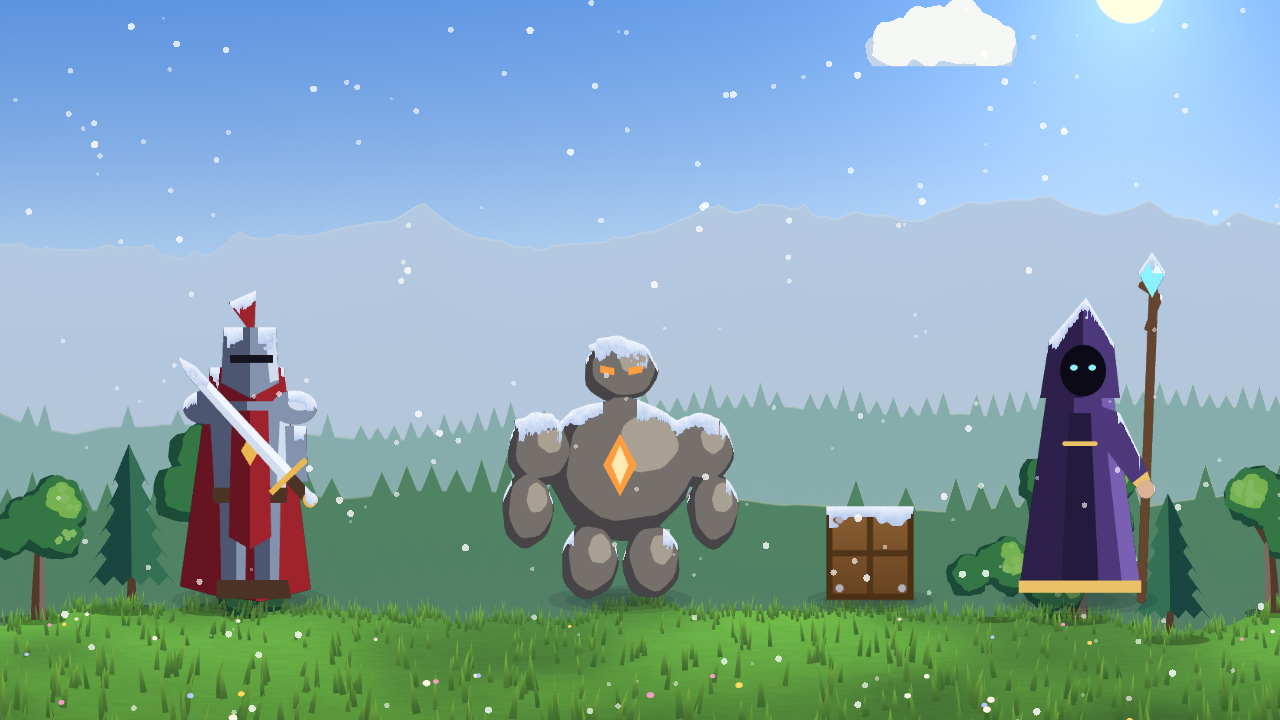
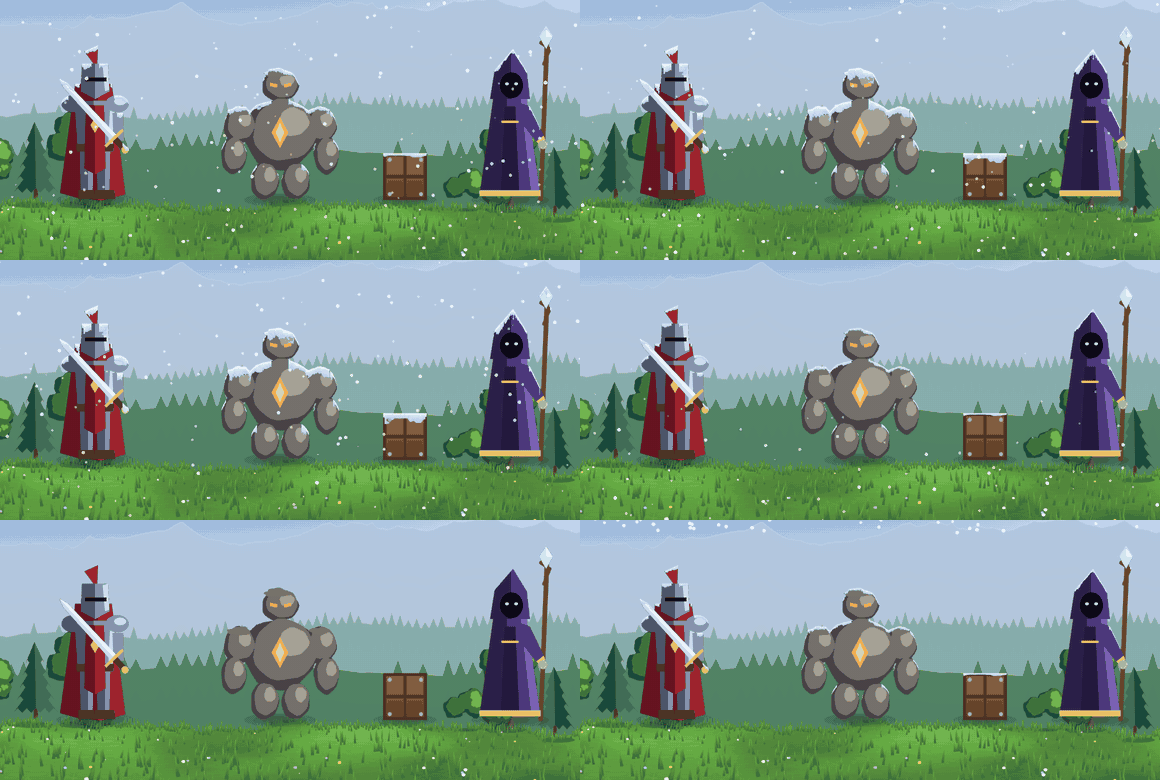
Snow that settles on any sprite

Snow found from the sprite’s own alpha: it settles on heads, shoulders and ledges that face the sky, never on the sides, with a ragged inner edge so it never copies the outline. No extra art, no mask to paint.
Put it on a Sprite2D or an AnimatedSprite2D (every frame works) and set amount from 0 to 1; tween it to let the snow settle or thaw.
Settings:
- amount: 0 none, 1 the full thickness.
- coat_color, shade_color: the snow on top and the colour deep in it.
- thickness_px: the depth at amount 1, in screen pixels, whatever the sprite’s scale.
- raggedness: how uneven the inner edge is.
- uv_flip: set x to -1 when the sprite uses flip_h (the free CoatLite2D node does it for you).
Works with the Compatibility renderer.
The free Coat 2D Lite adds a node with grow() and melt(); the full Coat 2D has 14 coats (moss, frost, rust, ice, mud…) and grass, flowers, icicles and drips that grow past the outline.
Shader code
shader_type canvas_item;
// Snow on any sprite, found from its alpha: a pixel is coated when the sprite ends within
// the snow's depth above it, and only on surfaces that face the sky. The inner limit is
// broken by noise at two scales, so the snow never copies the outline, and its edge is
// anti-aliased over one screen pixel.

uniform vec4 coat_color : source_color = vec4(0.95, 0.97, 1.0, 1.0);
uniform vec4 shade_color : source_color = vec4(0.62, 0.72, 0.9, 1.0);
uniform float amount : hint_range(0.0, 1.0) = 0.6;
uniform float thickness_px : hint_range(1.0, 32.0) = 14.0;   // depth of the coat at amount 1, in screen pixels
uniform float raggedness : hint_range(0.0, 1.0) = 0.5;       // how uneven the inner edge is
uniform vec2 uv_flip = vec2(1.0);                            // set by CoatLite2D: -1 on an axis the sprite mirrors
uniform bool overlay = false;                                // set by CoatLite2D: drawn as a layer over the sprite, so only the snow is output
const vec2 from_direction = vec2(0.0, -1.0);                 // the sky
const float grain = 0.1;
const float noise_scale = 1.0;

varying vec4 tint;
varying vec2 dir_local;   // from_direction turned into the sprite's own axes (rotated sprites)

float hash(vec2 p) {
	p = fract(p * vec2(0.3183099, 0.3678794)) * 17.0;
	return fract(p.x * p.y * (p.x + p.y));
}

float vnoise(vec2 p) {
	vec2 i = floor(p);
	vec2 f = fract(p);
	f = f * f * (3.0 - 2.0 * f);
	return mix(mix(hash(i), hash(i + vec2(1.0, 0.0)), f.x), mix(hash(i + vec2(0.0, 1.0)), hash(i + vec2(1.0, 1.0)), f.x), f.y);
}

// how many steps of `step_uv` until the sprite ends (alpha below one half or out of the
// picture), up to max_steps; 99 when it does not end that close
float open_dist(sampler2D tex, vec2 uv, vec2 step_uv, float max_steps) {
	for (int k = 1; k <= 49; k++) {   // 32 px at amount 1, plus the deepest bump
		if (float(k) > max_steps) break;
		vec2 q = uv + step_uv * float(k);
		if (q.x < 0.0 || q.y < 0.0 || q.x > 1.0 || q.y > 1.0 || texture(tex, q).a < 0.5) {
			return float(k);
		}
	}
	return 99.0;
}

void vertex() {
	tint = COLOR;
	// from_direction is given on screen (0, -1: the sky): undo the node's rotation and
	// scale so a rotated or mirrored sprite still gets its coat from the sky
	mat2 m = mat2(MODEL_MATRIX[0].xy, MODEL_MATRIX[1].xy);
	dir_local = abs(determinant(m)) > 1e-6 ? inverse(m) * from_direction : from_direction;
}

void fragment() {
	vec4 c = texture(TEXTURE, UV);
	// texels per screen pixel: the coat keeps its thickness on screen whatever the scale
	// (below 1 when the sprite is magnified: pixel art, a close camera)
	float tpp = max(fwidth(UV.y) / TEXTURE_PIXEL_SIZE.y, 0.02);
	vec2 st = TEXTURE_PIXEL_SIZE * tpp;
	// as far as the deepest bump of a ragged edge (1.5 times the thickness), or the bumps
	// past the search would be cut flat
	float reach = thickness_px * amount * (1.0 + 0.5 * raggedness) + 1.0;
	float d = 99.0;
	float facing_k = 1.0;
	if (amount > 0.0 && c.a > 0.01) {
		{
			vec2 dir = length(dir_local) > 0.001 ? normalize(dir_local) * uv_flip : vec2(0.0, -1.0);
			d = open_dist(TEXTURE, UV, dir * st, reach);
			if (d < 99.0) {
				// a coat that falls (snow, dust) only settles on a surface that faces where it
				// comes from: at the edge it reached, the alpha gradient points into the
				// sprite; a steep side faces sideways and keeps almost none
				vec2 e = UV + dir * st * (d - 1.0);
				vec2 gx = vec2(st.x * 2.0, 0.0);
				vec2 gy = vec2(0.0, st.y * 2.0);
				vec2 grad = vec2(texture(TEXTURE, e + gx).a - texture(TEXTURE, e - gx).a,
						texture(TEXTURE, e + gy).a - texture(TEXTURE, e - gy).a);
				float facing = length(grad) > 0.01 ? dot(-normalize(grad), dir) : 1.0;
				// the slope of the edge from two more rays, 3 screen pixels to each side: on a
				// steep side drawn in pixel steps the gradient above sees each step as facing
				// up; the edge height changing fast between the rays does not
				vec2 side = vec2(-dir.y, dir.x) * st * 3.0;
				float dl = open_dist(TEXTURE, UV - side, dir * st, reach + 6.0);
				float dr = open_dist(TEXTURE, UV + side, dir * st, reach + 6.0);
				float slope = (dl < 99.0 && dr < 99.0) ? (dr - dl) / 6.0 : 99.0;
				facing = min(facing, inversesqrt(1.0 + slope * slope));
				facing_k = smoothstep(0.35, 0.8, facing);
			}
		}
	}
	// the bumps are fixed on the picture (in its own pixels), so they do not crawl when the
	// sprite breathes, zooms or turns
	vec2 sp = UV / TEXTURE_PIXEL_SIZE / noise_scale;
	// bumps about 15 picture pixels wide with finer detail on them; shaped so that a ragged
	// coat swings from a thin film to well past its thickness, never an even band
	float n = vnoise(sp * 0.065) * 0.7 + vnoise(sp * 0.22) * 0.3;
	float lumps = 0.15 + 1.35 * smoothstep(0.2, 0.8, n);
	float limit = thickness_px * amount * mix(1.0, lumps, raggedness) * facing_k;
	// one screen pixel of soft edge, measured in steps. The sprite's own soft rim (alpha
	// under one half) is coated too, or its dark fringe shows as a line between the coat
	// and what is behind the sprite; it keeps its alpha, so the outline stays smooth
	float on = clamp(limit - d + 0.5, 0.0, 1.0);
	if (c.a < 0.5) {
		// only the rim that touches the body: a soft glow or a baked shadow farther out stays as drawn
		// (one and a half picture pixels, or one screen pixel on a sprite drawn smaller than its
		// picture: a fringe a screen pixel wide would otherwise stay as a dark line)
		vec2 tx = max(TEXTURE_PIXEL_SIZE * 1.5, st * 1.2);
		float body = max(max(texture(TEXTURE, UV + vec2(tx.x, 0.0)).a, texture(TEXTURE, UV - vec2(tx.x, 0.0)).a),
				max(texture(TEXTURE, UV + vec2(0.0, tx.y)).a, texture(TEXTURE, UV - vec2(0.0, tx.y)).a));
		on *= step(0.5, body);
	}
	float inner = clamp(d / max(limit, 1.0), 0.0, 1.0);
	vec3 col = mix(coat_color.rgb, shade_color.rgb, inner * 0.7);
	col *= 1.0 - grain * 0.35 * step(0.82, hash(floor(sp * 1.5)));
	if (overlay) {
		// the sprite is drawn under this layer with its own material (a petrify, a hit flash)
		COLOR = vec4(col, on * c.a) * tint;
	} else {
		COLOR = vec4(mix(c.rgb, col, on), c.a) * tint;
	}
}
Live Preview

Comments 0
No comments yet.