
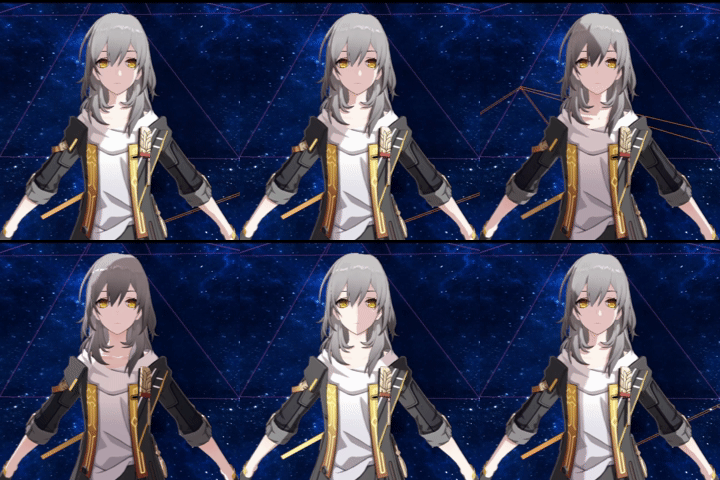
Toon Shader Contact Shadows

This project demonstrates the use of screen-space shadows in Godot to add clean shadows to a toon shader. Godot to my knowledge doesn’t offer this feature by default (maybe one day it will).
Why do this? You can’t easily modify the shadow map of the directional light. The shadows the directional light casts are not very accurate at small distances.
It is strongly recommened to check the Demo project to see how the shader works.
Copyright: The model has been provided for free by Hoyoverse for fair use. It is not permitted to edit it or to use it for commercial purposes.
Inspiration:
Spartan Engine Screen space shadows
Shader code
shader_type spatial;
render_mode depth_draw_always;//, diffuse_toon, specular_toon;

global uniform sampler2D gradientMetallic;

uniform sampler2D albedo_texture : source_color;
uniform sampler2D lightmap_texture : source_color;

uniform int g_sss_max_steps        = 32;     // Max ray steps, affects quality and performance.
uniform float g_sss_ray_max_distance = 0.03f;  // Max shadow length, longer shadows are less accurate.
uniform float g_sss_thickness        = 0.45f;  // Depth testing thickness.
uniform float g_sss_max_delta_from_original_depth = 0.005f; // The maximum allowed depth deviation from the original pixel (a big deviation decreased the probabilty that the pixel is the occluder).
uniform float g_sss_min_thickness = 0.004f;
global uniform vec4 shadow_color: source_color;

uniform sampler2D depth_texture : hint_depth_texture, repeat_disable;
uniform sampler2D screen_texture : hint_screen_texture, filter_nearest;
varying vec3 camera_pos_world;

vec2 get_uv_from_view_position(vec3 position_view_space, mat4 proj_m)
{
	vec4 position_clip_space = proj_m * vec4(position_view_space.xyz, 1.0);
	vec2 position_ndc = position_clip_space.xy / position_clip_space.w;
	return position_ndc.xy * 0.5 + 0.5;
}

vec3 get_view_position_from_uv(vec2 uv, float depth, mat4 inv_proj_m)
{
	vec4 position_ndc = vec4((uv * 2.0) - 1.0, depth, 1.0);
	vec4 view_position = inv_proj_m * position_ndc;
	return view_position.xyz /= view_position.w;
}

bool is_within_screen_boundaries(vec2 position)
{
	return position.x > 0.0 && position.x < 1.0 && position.y > 0.0 && position.y < 1.0;
}

float get_noise_interleaved_gradient(vec2 screen_pos)
{
    vec3 magic = vec3(0.06711056f, 0.00583715f, 52.9829189f);
    return fract(magic.z * fract(dot(screen_pos, magic.xy)));
}

float screen_fade(vec2 uv)
{
    vec2 fade = max(vec2(0.0f), 12.0f * abs(uv - 0.5f) - 5.0f);
    return clamp(1.0f - dot(fade, fade), 0.0, 1.0);
}


vec3 reconstruct_world_position(vec2 uv, float depth, mat4 inv_proj_matrix, mat4 inv_view_matrix) {
	vec3 ndc = vec3(uv * 2.0 - 1.0, depth);

	vec4 view = inv_proj_matrix * vec4(ndc, 1.0);
	view.xyz /= view.w;

	vec4 world = inv_view_matrix * inv_proj_matrix * vec4(ndc, 1.0);
	return world.xyz / world.w;
}


float screen_space_shadows(vec3 surface_view_position, mat4 proj_m, mat4 inv_proj_m, mat4 view, vec2 screen_uv, vec3 light)
{
	vec3 current_position_view_space = surface_view_position;
	/*
	vec3 light_dir = (inverse(view) * vec4(light, 0.0)).rbg;

	vec3 ray_dir = (view * vec4(light_dir, 0.0)).xyz;
	*/
	vec3 ray_dir = light;
	float g_sss_step_length = g_sss_ray_max_distance / float(g_sss_max_steps);
    vec3 ray_step = ray_dir * g_sss_step_length;

	vec2 current_screen_position = vec2(0.0);

	float depth_original = current_position_view_space.z;

	current_position_view_space +=  ray_step;

	vec2 old_screen_position = current_screen_position;

	float occlusion = 0.0;
	float not_valid_uv = 0.0;
    vec2 ray_uv_screen_pos   = vec2(0.0);

	vec3 resulting_color = vec3(-1.0);

	float depth = texture(depth_texture, screen_uv).x;
	float eps = 1e-6;
	float objectMask = (depth > eps && depth < 1.0 - eps) ? 1.0 : 0.0;

	float offset  = get_noise_interleaved_gradient(screen_uv);

	for(int travel= 0; travel < g_sss_max_steps; travel ++)
	{

		current_position_view_space += ray_step;

		current_screen_position = get_uv_from_view_position(current_position_view_space, proj_m);
		/*
		if(!is_within_screen_boundaries(current_screen_position)){
			return 1.0f;
		}*/

		float depth_texture_probe_raw = texture(depth_texture, current_screen_position).x;

		vec3 depth_texture_probe_view_position = get_view_position_from_uv(current_screen_position, depth_texture_probe_raw, inv_proj_m);

		float depth_diff = depth_texture_probe_view_position.z - current_position_view_space.z;

		bool can_the_camera_see_the_ray     = (depth_diff > g_sss_min_thickness) && (depth_diff < g_sss_thickness);
		bool occluded_by_the_original_pixel = abs( current_position_view_space.z - depth_original) < g_sss_max_delta_from_original_depth;

		if (can_the_camera_see_the_ray &&  occluded_by_the_original_pixel)
        {
			occlusion = 1.0;
			//occlusion *= screen_fade(current_screen_position);
            break;
        }

	}

	return 1.-occlusion;
}

/*
void vertex() {
	//POSITION = vec4(VERTEX.xy, 1.0, 1.0);
}
*/
void vertex(){
	camera_pos_world = CAMERA_POSITION_WORLD;
}

void fragment(){

	ALBEDO = texture(albedo_texture,UV).rgb;
}


void light() {
	bool is_directional = false;
	if(LIGHT_IS_DIRECTIONAL){
		is_directional = true;
	}

	float depth_center = texture(depth_texture, SCREEN_UV).x;

	vec3 surface_view_position 	= get_view_position_from_uv(SCREEN_UV, depth_center, INV_PROJECTION_MATRIX);

	vec4 worldSpacePosition = INV_VIEW_MATRIX * vec4(surface_view_position, 1.0);

	float sss = screen_space_shadows(surface_view_position,
	 PROJECTION_MATRIX,
	 INV_PROJECTION_MATRIX,
	 VIEW_MATRIX,
	 SCREEN_UV,
	 LIGHT);

	vec3 worldNormal = (INV_VIEW_MATRIX * vec4(NORMAL.xyz, 0.0)).xyz;

	vec3 light_dir = (INV_VIEW_MATRIX * vec4(LIGHT.xyz, 0.0)).rgb;

	float NdotL = dot(worldNormal, -light_dir);

	float lSmooth  = smoothstep(0, 0.05, NdotL);

	float lLerp = mix((1.0), (0.0), lSmooth);

	vec2 metallicUV = vec2(dot(worldNormal, normalize(normalize(camera_pos_world-worldSpacePosition.rgb) + light_dir)));

	/*
	vec3 toon_shadows = mix(shadow_color.rgb ,
	vec3(1.0) ,
	sss*lLerp)
	* LIGHT_COLOR/PI
	* ATTENUATION;
	*/
	/*
	vec3 metalliness = (mix( vec3(0.0) ,
	 vec3(texture(gradientMetallic,metallicUV).r) ,
	texture(lightmap_texture,UV).b));
	*/
	vec4 lm = texture(lightmap_texture, UV);
	float ao = lm.r;
	float aoSkinMask = lm.a;
	float roughness = lm.g;
	float metallic_mask = lm.b;

	float metallic_lookup = texture(gradientMetallic, metallicUV).r;
	float metallic = mix(0.0, metallic_lookup, metallic_mask);

	float aoao =mix(0.3,1.0, (ao + (aoSkinMask > 0.01?0.0:1.0)));

	vec3 toon_diffuse = mix(shadow_color.rgb * texture(albedo_texture,UV).rgb, vec3(1.0), sss * lLerp*aoao)
	                  * LIGHT_COLOR / PI * ATTENUATION;

	vec3 V =  normalize(normalize(camera_pos_world-worldSpacePosition.rgb));
	vec3 L = normalize(light_dir);

	vec3 H = normalize(V + L);
	float spec = pow(max(dot(worldNormal, H), 0.0), 1.0 / max(1.0 - roughness, 0.001));

	vec3 diffuse_part = toon_diffuse * (1.0 - metallic);
	vec3 specular_part = LIGHT_COLOR * spec * metallic;

	vec3 final_color = (diffuse_part + specular_part);

	if(is_directional){
		DIFFUSE_LIGHT = final_color;
	}
}
If shadows enabled in directionallight3d then this breaks the shader
I fixed it by changing the LIGHT_VERTEX. Now the directional light doesn’t cast shadows on the player but the player can cast shadows on objects.
man whoever made this shee… is a goat… can you tell me how can you even make and remember all those variables and predict how will it effect each pixels, i mean tell me best way to learn the shaders sensei…
Some bugs found. The shader is visible through itself, but I suppose it should not: https://postimg.cc/gallery/qq2Kxvq.
https://postimg.cc/hQfg6Vnn
https://postimg.cc/r0yqGvYK
https://postimg.cc/9RxCLJv1
https://postimg.cc/G92c4nyf
https://postimg.cc/yJyVZVjM
Also neck and head has a visible cut between. Probably because of different shaders
No MIT license? Lame