
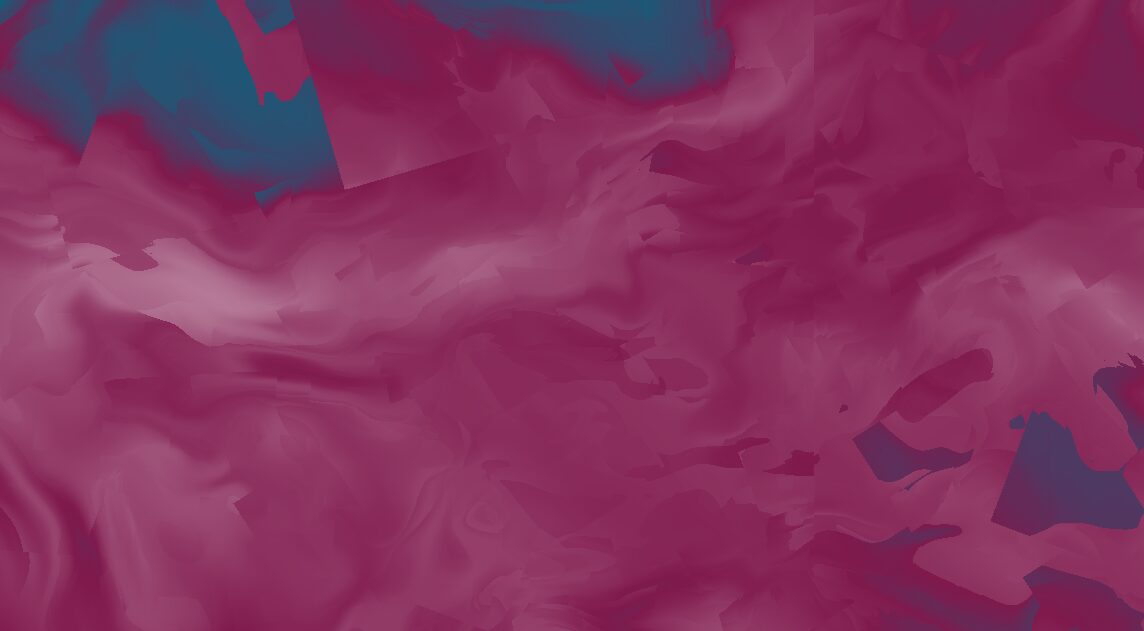
Warped Fractal Noise

This is a Procedural Shader adapted for Godot’s CanvasItem that generates a dynamic, flowing abstract pattern. The unique characteristic of this shader is its use of recursively warped FBM (Fractal Brownian Motion), where the noise field distorts itself multiple times (fbm( p + fbm( p + fbm( p ) ) )) to create an intricate, self-organizing structure.
The effect is highly scalable and customizable through exposed Uniforms:
| Parameter | Type | Description |
| u_speed | float |
Controls the animation speed of the noise flow. |
| u_color_low | vec4 |
The base color used for the lowest density/darkest areas of the noise pattern. |
| u_color_mid_red | vec4 |
The transition color used for mid-density areas (the “pivot” color in the gradient). |
| u_color_high | vec4 |
The brightest color used for the highest density/most prominent areas of the pattern. |
The underlying Simplex/Value Noise implementation is highly optimized, ensuring smooth, GPU-accelerated movement suitable for animated backgrounds or abstract visual effects.
Shader code
shader_type canvas_item;
uniform float u_speed = 1.0;

uniform vec4 u_color_low : source_color = vec4(0.01, 0.41, 0.51, 1.0);
uniform vec4 u_color_mid_red : source_color = vec4(.50, 0.10, 0.30, 1.0);
uniform vec4 u_color_high : source_color = vec4(1.0, 1.0, 1.0, 1.0);


#define iTime (TIME * u_speed)
#define iResolution 1.0/SCREEN_PIXEL_SIZE

const mat2 mtx = mat2( vec2(0.80, -0.60), vec2(0.60, 0.80) );

float rand(vec2 n) {
    return fract(sin(dot(n, vec2(12.9898, 4.1414))) * 43758.5453);
}

float noise(vec2 p){
    vec2 ip = floor(p);
    vec2 u = fract(p);
    u = u * u * (3.0 - 2.0 * u);

    float res = mix(
        mix(rand(ip), rand(ip + vec2(1.0, 0.0)), u.x),
        mix(rand(ip + vec2(0.0, 1.0)), rand(ip + vec2(1.0, 1.0)), u.x), u.y);

    return res * res;
}

float fbm( vec2 p )
{
    float f = 0.0;

    f += 0.500000 * noise( p + iTime ); p = mtx * p * 2.02;
    f += 0.031250 * noise( p ); p = mtx * p * 2.01;
    f += 0.250000 * noise( p ); p = mtx * p * 2.03;
    f += 0.125000 * noise( p ); p = mtx * p * 2.01;
    f += 0.062500 * noise( p ); p = mtx * p * 2.04;
    f += 0.015625 * noise( p + sin(iTime) );

    return f / 0.96875;
}

float pattern( in vec2 p )
{
	return fbm( p + fbm( p + fbm( p ) ) );
}

vec4 colormap(float x) {

    if (x < 0.24) {
        return mix(u_color_low, u_color_mid_red, x / 0.24);
    }
    else {
        return mix(u_color_mid_red, u_color_high, (x - 0.24) / 0.76);
    }
}

void fragment()
{
    vec2 screen_size = 1.0 / SCREEN_PIXEL_SIZE;
    vec2 uv = FRAGCOORD.xy / screen_size.x;
   	float shade = pattern(uv);

    COLOR = colormap(shade);
}
looks so good ! well done
it looks nice but it heats up my computer. needs more optimizing