
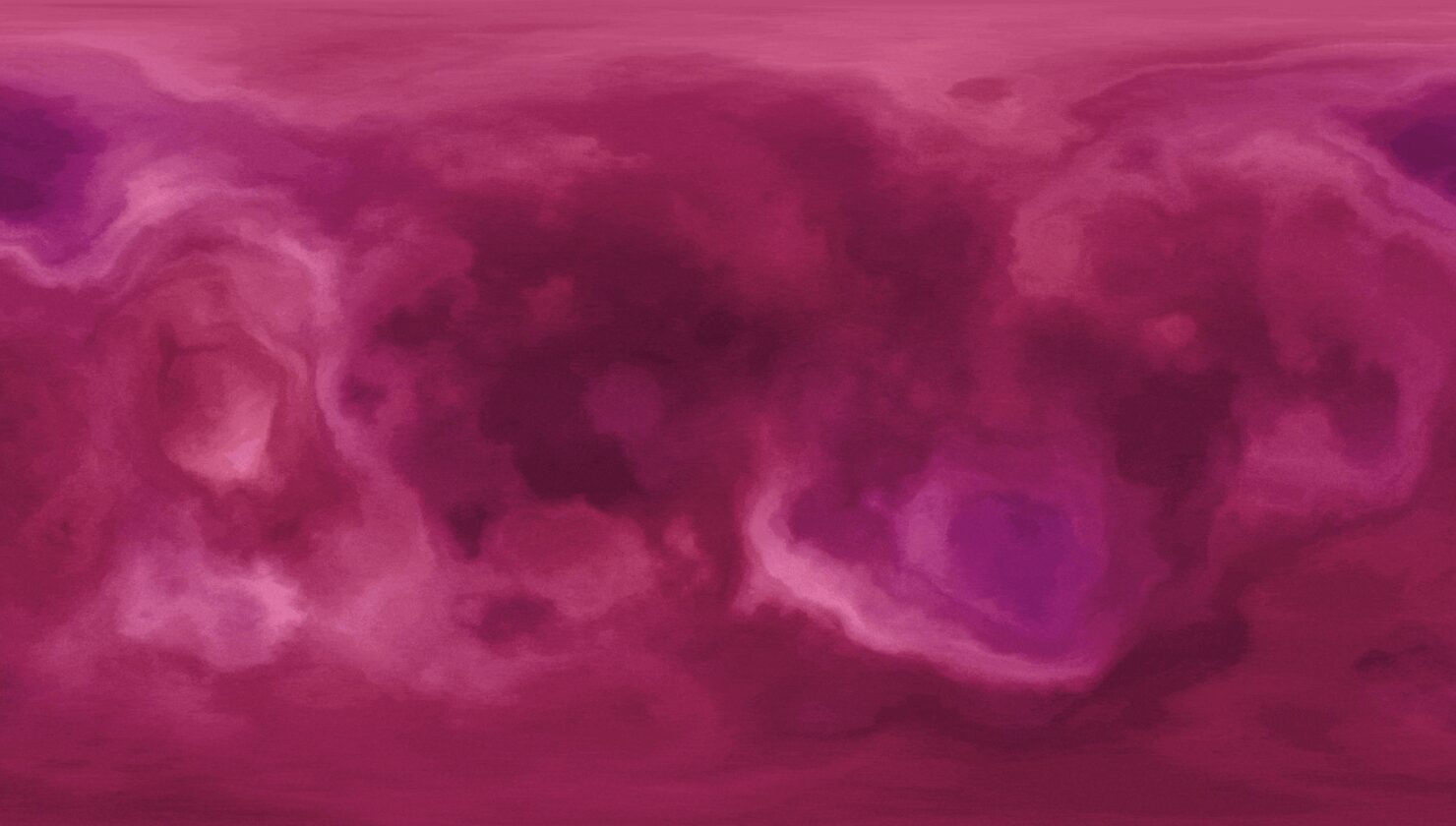
Planet Coffee

This shader generates a dynamic planetary map using a sophisticated 4D Smooth Noise algorithm. The primary advantage of this method is the creation of a perfect equirectangular texture, ensuring there are no visible seams or “pinching” at the poles when applied to a sphere or used as an environment map.
The visual effect is deeply inspired by fluid dynamics—resembling the organic movement of coffee mixing with milk—and utilizes Fractal Brownian Motion (FBM) combined with domain warping. The 4D noise allows the pattern to evolve fluidly over time without needing to physically shift coordinates, preserving the integrity of the spherical projection.
Parameters (Uniforms)
| Parameter | Type | Description |
| colorA | vec3 |
Deep base color for low-density areas. |
| colorB | vec3 |
Mid-tone color for noise transitions. |
| colorC | vec3 |
Accent color for turbulence peaks. |
| discomode | bool |
Toggles between static colors and an animated chromatic cycle. |
| speed | float |
Velocity multiplier for the noise animation. |
Shader code
shader_type canvas_item;

uniform vec3 colorA : source_color = vec3(0.2, 0.0, 0.1);
uniform vec3 colorB : source_color = vec3(0.7, 0.3, 0.4);
uniform vec3 colorC : source_color = vec3(1.0, 0.2, 0.4);
uniform bool discomode = false;
uniform float speed : hint_range(0.1, 2.0) = 1.0;

#define iTime (TIME * speed)

float rand(vec4 p) {
    return fract(sin(p.x*1234. + p.y*2345. + p.z*3456. + p.w*4567.) * 5678.);
}

float smoothnoise(vec4 p) {
    const vec2 e = vec2(0.0, 1.0);
    vec4 i = floor(p);    // integer
    vec4 f = fract(p);    // fract

    f = f*f*(3. - 2.*f);

    return mix(mix(mix(mix(rand(i + e.xxxx),
                           rand(i + e.yxxx), f.x),
                       mix(rand(i + e.xyxx),
                           rand(i + e.yyxx), f.x), f.y),
                   mix(mix(rand(i + e.xxyx),
                           rand(i + e.yxyx), f.x),
                       mix(rand(i + e.xyyx),
                           rand(i + e.yyyx), f.x), f.y), f.z),
               mix(mix(mix(rand(i + e.xxxy),
                           rand(i + e.yxxy), f.x),
                       mix(rand(i + e.xyxy),
                           rand(i + e.yyxy), f.x), f.y),
                   mix(mix(rand(i + e.xxyy),
                           rand(i + e.yxyy), f.x),
                       mix(rand(i + e.xyyy),
                           rand(i + e.yyyy), f.x), f.y), f.z), f.w);
}

float fbm(vec3 x) {
    float v = 0.0;
    float a = 0.5;
    vec3 shift = vec3(1.0);
    for (int i = 0; i < 10; ++i) {
        v += a * smoothnoise(vec4(x, cos(iTime * 0.002) * 200.0));
        x = x * 2.0 + shift;
        a *= 0.5;
    }
    return v;
}

vec3 uvTo3D(vec2 uv) {
    float theta = uv.x * 2.0 * 3.14159265359; // Longitud
    float phi = uv.y * 3.14159265359; // Latitud
    float x = sin(phi) * cos(theta);
    float y = sin(phi) * sin(theta);
    float z = cos(phi);
    return vec3(x, y, z);
}

float max3 (vec3 v) {
  return max (max (v.x, v.y), v.z);
}

void fragment() {
    vec3 col_a = colorA;
    vec3 col_b = colorB;
    vec3 col_c = colorC;

    if(discomode){
        col_a = vec3(sin(iTime), sin(iTime + 7.0), cos(iTime));
        col_b = vec3(cos(iTime), cos(iTime + 7.0), sin(iTime));
        col_c = vec3(sin(iTime), cos(iTime), sin(iTime + 0.5));
    }

    vec2 uv = UV;
    vec3 pos = uvTo3D(uv);

    pos.y += sin(iTime / 5.0);
    pos.x += cos(iTime / 5.0);
    pos.z += sin(iTime / 5.0);

    float fbmm = fbm(pos);
    vec3 q = vec3(fbmm, sin(fbmm), cos(fbmm));
    vec3 r = vec3(fbmm, sin(fbmm), cos(fbmm));
    float v = fbm(pos + 5.0 * r + iTime * 0.005);

    vec3 col_top = vec3(1.0);
    vec3 col_bot = vec3(0.0);

    vec3 res_color = mix(col_a, col_b, clamp(r, 0.0, 1.0));
    res_color = mix(res_color, col_c, clamp(q, 0.0, 1.0));

    float poss = v * 2.0 - 1.0;
    res_color = mix(res_color, col_top, clamp(poss, 0.0, 1.0));
    res_color = mix(res_color, col_bot, clamp(-poss, 0.0, 1.0));

    res_color = res_color / max(max3(res_color), 0.001);

    res_color = (clamp((0.4 * pow(v, 3.0) + pow(v, 2.0) + 0.5 * v), 0.0, 1.0) * 0.9 + 0.1) * res_color;

    COLOR = vec4(res_color, 1.0);
}
How do you even conceive making this Lmao, this is so cool
Is there a way to make a version of this where it’s darker? I’d like to use this as a shifting nebular background for a menu, but the bright parts distract from the actual menu. If it could be where all of the brightest parts are actually a dark color that I could choose, that would be ideal.